Iran and US Edge Toward Deal as oil Prices Slide on Hormuz Optimism
Crude markets shed nearly 5% as Washington and Tehran signal progress on a peace framework, but deep disputes over uranium, sanctions, and Lebanon continue to cloud the path forward.
Erbil (Kurdistan 24) - Hundreds of tankers sit motionless in the waters approaching the Strait of Hormuz, waiting. For nearly three months, the narrow waterway through which roughly a quarter of the world's seaborne oil and gas once flowed has been effectively closed, a chokepoint turned into a pressure point, squeezing fuel prices, food costs, and economic confidence across the globe. On Monday, the faintest signal that the waiting might soon end was enough to move markets sharply. Oil prices fell, Asian stocks surged, and investors for the first time in weeks began pricing in the possibility of a deal.
Whether that deal materialises and how quickly, remains deeply uncertain.
Oil prices hit two-week lows
Global crude prices dropped sharply on Monday as investors responded to growing signs of diplomatic movement between Washington and Tehran.
Fortune reported on Monday that Brent crude fell as much as 5.2% to $98.12 a barrel, while West Texas Intermediate slid to near $92, the first time Brent had dipped below the $100 threshold in intraday trading since early May.
The declines marked the lowest levels for both benchmarks in roughly two weeks, driven by mounting expectations that negotiations could eventually lead to the reopening of the Strait of Hormuz and an easing of the global energy crisis that the conflict has unleashed. Before the war began on Feb. 28, the strait carried nearly one-fifth of global oil and liquefied natural gas shipments. Its effective closure has driven up the costs of fuel, fertiliser, food, and transportation across the world.
In its Monday coverage, Al Jazeera noted that Japan's benchmark Nikkei 225 surged more than 3%, hitting an all-time high, while stock markets in Shanghai, Taipei, Manila, Bangkok, Jakarta, Singapore, Sydney, and Wellington all posted gains. Kuala Lumpur edged down 0.1%. Hong Kong and Seoul remained closed for public holidays.
Trump signals caution despite optimism
The market moves came despite deliberate efforts by both sides to cool expectations of an imminent breakthrough. On Saturday, as CNBC reported, President Trump declared the deal "largely negotiated" and suggested an announcement was close, a statement that sent oil prices tumbling and set off a fresh round of diplomatic speculation. By Sunday, the tone had shifted.
In a Truth Social post on Sunday, Trump wrote that the US naval blockade on Iranian shipping in the Strait of Hormuz would "remain in full force and effect until an agreement is reached, certified, and signed." He urged negotiators not to rush. "Both sides must take their time and get it right," he added.
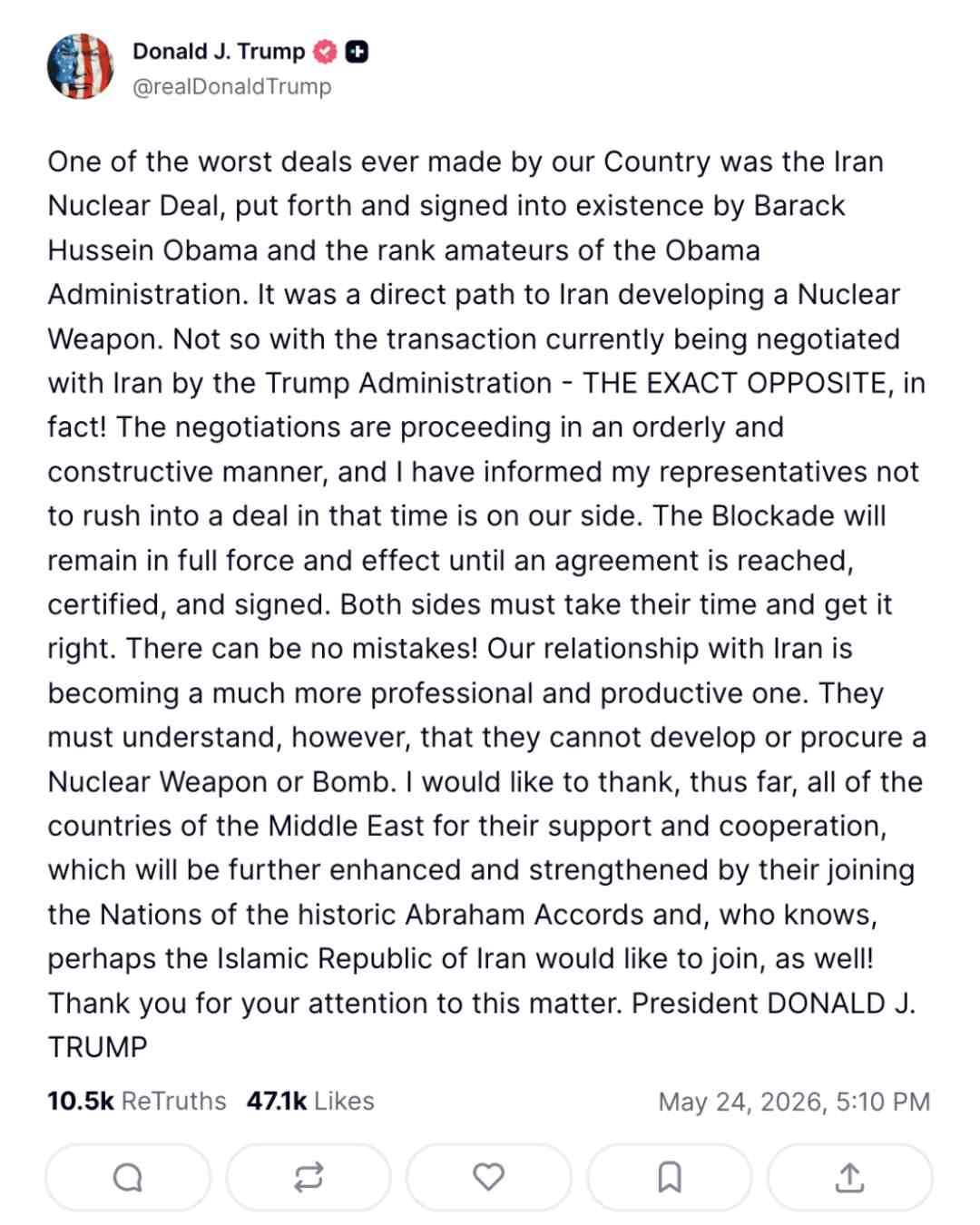 US President's Post on Truth Social on Sunday (Photo: Truth Social)
Speaking to reporters in New Delhi on Monday, Secretary of State Marco Rubio said the United States would continue giving diplomacy every chance to succeed before considering what he called "alternatives." He described a solid framework under discussion that would involve the gradual reopening of the Strait of Hormuz, followed by what he termed a "serious and time-limited" negotiation on Iran's nuclear programme. As CNN reported on Monday, both sides are working toward a memorandum of understanding setting out a roadmap for all outstanding issues, though the deal, in Washington's own words, remains a work in progress.
Tehran says agreement is not imminent
Iranian officials were equally measured. Foreign Ministry spokesperson Esmaeil Baghaei stated on Monday that Tehran's current focus is on ending the war, not on negotiating nuclear issues at this stage. A general framework exists, he acknowledged, but he was direct: no one can claim a final agreement is imminent. He also pushed back firmly on any suggestion that the Strait of Hormuz would be placed under international management, arguing the waterway belongs to the coastal states. Iranian media close to the Revolutionary Guards added that Tehran still considers several major issues unresolved, particularly the release of frozen Iranian assets and the lifting of US sanctions. CNBC, in its Saturday report, noted that the proposed structure envisions a memorandum of understanding as a first phase, with broader negotiations to follow within 30 to 60 days.
Pakistan, Oman, and Moscow
The diplomatic landscape on Monday was shaped by a weekend of intensive parallel manoeuvring. As Euronews documented on April 26, Iran's Foreign Minister Abbas Araghchi had conducted a sweeping regional offensive, holding talks in Muscat with Omani officials, returning to Islamabad for a second round of consultations with Pakistani intermediaries, and departing Sunday night for Moscow to meet Russian President Vladimir Putin. Iran's ISNA news agency reported that Tehran transmitted written messages to Washington via Pakistani mediators, addressing core red lines including nuclear issues and the Strait of Hormuz. Araghchi described his Pakistan visit as "very fruitful" but made his scepticism clear: he had yet to see whether the US was truly serious about diplomacy.
In St. Petersburg, The Hill reported on April 27, Putin reaffirmed Moscow's strategic partnership with Tehran, telling Araghchi that Russia would do everything in its power to contribute to peace in the Middle East. Putin also confirmed he had received a personal message from Iran's Supreme Leader, Mojtaba Khamenei, asking Araghchi to convey his gratitude. Russia's potential role as a recipient of Iran's highly enriched uranium stockpile under any final agreement has become one of the most closely watched dimensions of the negotiations.
PBS NewsHour, in its Sunday coverage, noted that Pakistan Prime Minister Shehbaz Sharif welcomed Trump's diplomatic efforts, saying Islamabad would support peace with utmost sincerity and expressing hope to host the next round of talks very soon.
Major sticking points remain
Behind the cautious optimism lie disputes that have resisted resolution for weeks. Three stand out.
The first and most technically complex is Iran's stockpile of highly enriched uranium. A senior Trump administration official, speaking on condition of anonymity, said Iran had agreed in principle to eventually dispose of or dilute part of its enriched uranium reserves. International Atomic Energy Agency figures show Iran currently holds more than 440 kilograms of uranium enriched to 60% purity, technically a short step from weapons-grade levels. Iranian officials have not publicly confirmed any such commitment, and the question of how, not whether, the stockpile would be addressed remains unresolved. CNN's Monday analysis confirmed that major disagreements persist over both the timing of sanctions relief and the future management of the waterway itself.
The second sticking point is sanctions relief and access to tens of billions of dollars in frozen Iranian oil revenues held in foreign banks, a demand Tehran has consistently placed at the centre of any deal. The third is the broader regional security picture: negotiators are reportedly discussing whether a final agreement must also address the war in Lebanon between Israel and Hezbollah. This Iran-backed armed group has continued exchanging fire with Israeli forces despite a fragile ceasefire.
A ticking clock
The urgency pressing down on negotiators is not abstract. Speaking at a Chatham House session on Thursday, as CNBC reported, IEA Executive Director Fatih Birol issued one of his starkest warnings yet: global oil markets could enter a "red zone" by July or August if tanker traffic through Hormuz remains heavily restricted. The full and unconditional reopening of the strait, he said, is the single most important solution to the energy shock.
The IEA's May 2026 Oil Market Report, published on May 13, laid out the scale of the crisis in unsparing terms. Cumulative supply losses since the start of the conflict have already exceeded one billion barrels. More than 14 million barrels per day of Gulf oil remains shut in, an unprecedented supply shock in the agency's history. Global oil inventories fell by 129 million barrels in March and a further 117 million barrels in April, a pace of depletion that has alarmed energy security planners worldwide.
At the strait itself, only 33 vessels passed through in one recent 24-hour period, NPR reported on Sunday, compared to roughly 140 ships daily before the conflict began. Around 240 ships were waiting for Iranian permission to transit. As Al Jazeera reported on Monday, Singapore-based oil market analyst June Goh of Sparta said there was no fundamental change to the underlying supply picture. Still, markets are anticipating a surge of roughly 100 million barrels from stranded vessels the moment a deal is finalised.
Full normalisation, however, remains far off. As CNBC noted on Friday, energy executives have warned that a complete recovery of the Middle East oil supply may not occur until 2027. Demining operations, evacuating stranded tankers, repairing damaged infrastructure, and replenishing depleted inventories are each expected to take months, and the combined weight of those tasks means relief, even after a deal, will arrive slowly.
Fragile ceasefire still holds
The diplomatic push unfolds against the backdrop of a conflict that has already killed thousands, displaced hundreds of thousands, and inflicted damage on regional energy infrastructure that will take years to fully repair. A ceasefire has largely held since early April, though tensions remain high across multiple fronts. Markets welcomed Monday's diplomatic signals, but analysts caution that the situation remains highly fragile, and that the distance between a memorandum of understanding and a durable peace is still considerable.
The tankers are still waiting.
SUMMARY: Iran and the US signalled progress on Monday toward a peace deal that would reopen the Strait of Hormuz, sending oil prices down nearly 5%. The IEA warned of a supply "red zone" by July or August, with more than 14 million barrels per day still shut in and global inventories depleting at a record pace.