U.S. Denies Missing Pilot Captured in Iran as Search Operations Continue
A U.S. State Department source told Kurdistan24 a missing F-15 pilot has not been captured in Iran, as search efforts continue after one crew member was rescued—highlighting growing risks as the conflict intensifies.
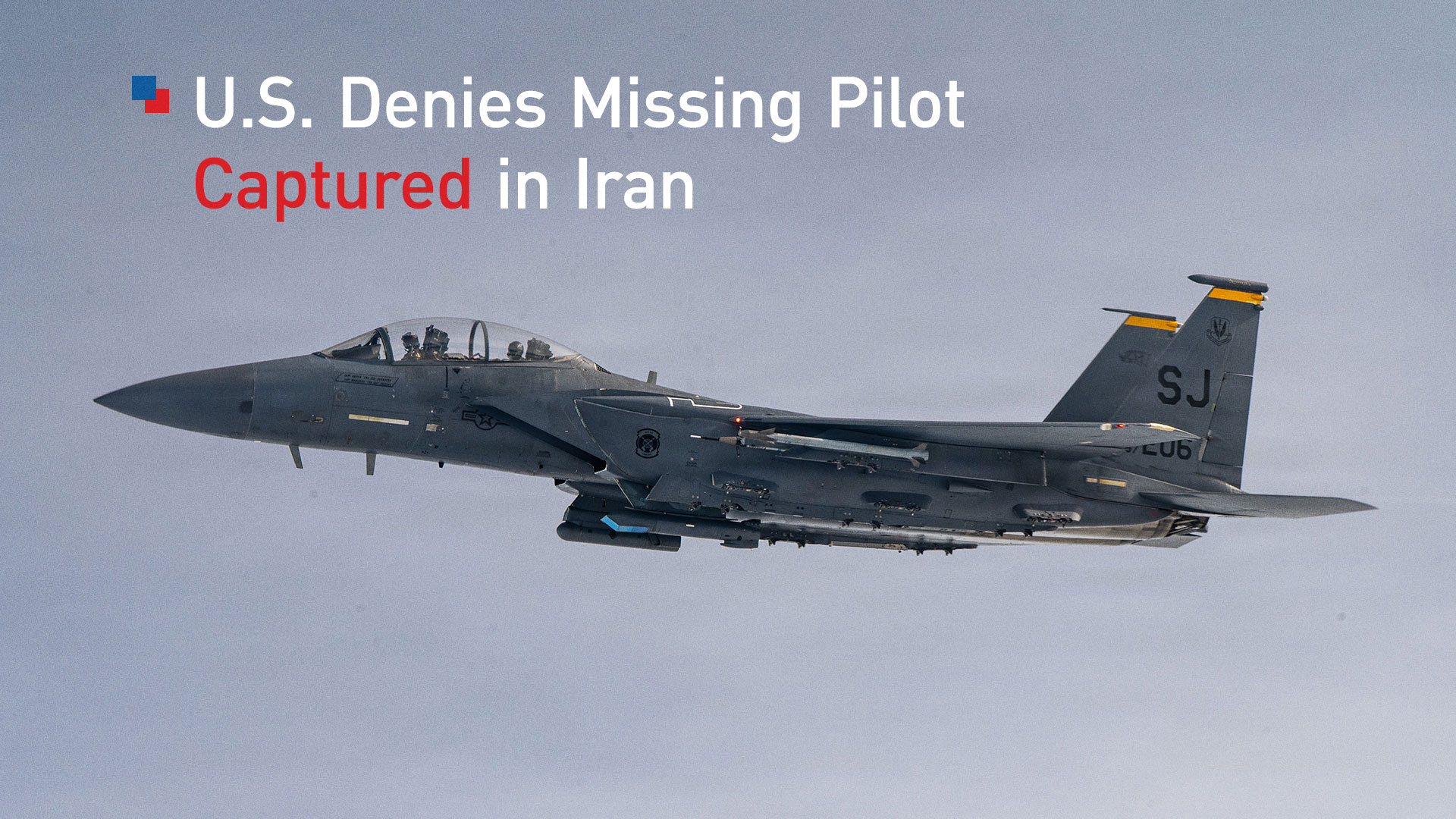
ERBIL (Kurdistan24) - A U.S. State Department official denied Saturday that a missing American pilot has been captured inside Iran, stating that search and rescue operations remain ongoing following the downing of a U.S. fighter jet, according to information provided to Kurdistan24.
The official, speaking on condition of anonymity, told Kurdistan24 that a U.S. F-15 fighter jet was struck in Iranian airspace on Friday, April 3, with two pilots on board. Both crew members ejected from the aircraft after the incident, the source said, adding that one pilot was successfully located and rescued by U.S. search and rescue teams, while the second pilot’s whereabouts remain unknown.
The U.S. official emphasized that there is no information indicating the missing pilot has been taken prisoner by Iranian forces. “We have received no information indicating that the pilot has been taken prisoner by Iran,” the source said, adding that a joint American-Israeli operation is underway to locate and recover the missing individual.
The statement follows initial reports of the aircraft’s downing, which prompted questions regarding the fate of the second pilot. U.S. President Donald Trump declined to comment on potential responses if the pilot were captured, telling reporters, “I won't go into details, because we hope that doesn't happen,” according to remarks cited after the incident.
Iranian authorities, for their part, have called on citizens to provide information regarding the missing pilot, offering a reward in exchange for relevant details, according to the account provided to Kurdistan24.
The incident forms part of a broader pattern of aerial engagements in the ongoing conflict between Iran, the United States, and Israel, which has entered its sixth week. The Associated Press reported that two U.S. aircraft have gone down in separate incidents in recent days, marking what officials described as a significant development in the course of the war.
According to AP reporting, one U.S. fighter jet was shot down in Iran, with one crew member rescued and another remaining missing, prompting an active search-and-rescue operation. In a separate incident, Iranian state media reported that a U.S. A-10 attack aircraft crashed in the Persian Gulf after being struck by Iranian defense systems. A U.S. official, speaking on condition of anonymity to discuss a sensitive matter, told AP that it remained unclear whether the aircraft had been shot down or had crashed due to other causes.
The Associated Press noted that the incidents occurred shortly after President Trump stated in a national address that the United States had “beaten and completely decimated Iran,” underscoring the contrast between official rhetoric and ongoing military developments.
The conflict has continued to expand geographically and operationally, affecting infrastructure, trade routes, and civilian areas across the region. AP reported that an airstrike near Iran’s Bushehr nuclear facility killed a security guard and damaged a support building. The International Atomic Energy Agency confirmed that no increase in radiation levels was detected following the strike, stating in a social media post that “no increase in radiation levels was reported.”
Iranian authorities said the Bushehr facility has been targeted multiple times since the start of the war. The site, which uses low-enriched uranium supplied by Russia, contributes a small but significant portion of Iran’s electricity generation capacity, according to AP.
Elsewhere, U.S. and Israeli airstrikes have targeted additional facilities in Iran, including petrochemical installations and sites associated with government ministries. Iran’s official English-language Tehran Times reported that a facility linked to the Agriculture Ministry in Mehran was struck, while other media outlets cited by AP reported explosions in the Mahshahr Special Petrochemical Zone in Khuzestan province.
The Associated Press further reported that Bahrain experienced eight drone attacks within a 24-hour period, bringing the total number of projectiles launched at the country since the start of the conflict to 188 missiles and 453 drones. Bahrain hosts the U.S. Navy’s Fifth Fleet, making it a strategic location in the regional security framework.
In Israel, emergency services reported that a man sustained injuries from glass shrapnel following a missile strike in the central city of Bnei Brak. Israel’s Magen David Adom rescue service said the individual was transported to a hospital, though it remained unclear whether the injuries were caused by a direct strike or falling debris, AP reported.
Regional infrastructure has also been affected outside direct combat zones. Authorities in Dubai reported that debris from intercepted drones damaged the facades of buildings, including one belonging to U.S. technology company Oracle, though no injuries were recorded, according to AP. Iranian officials have previously issued warnings against certain U.S. companies, accusing them of involvement in intelligence-related activities.
On the Iraq-Iran border, the Shalamcheh crossing was temporarily closed following a strike that killed one person and wounded several others, AP reported, citing Iraqi officials. The crossing serves as a key route for trade and religious travel, and authorities said alternative crossings were being used to maintain movement.
The broader economic impact of the conflict has also drawn international attention. AP reported that finance ministers from several European countries, including Spain, Germany, Italy, and Portugal, called for a European Union-wide tax on energy company profits, citing concerns that rising oil and gas prices linked to the conflict could increase inflation and strain household finances.
Diplomatic efforts are ongoing as countries seek to address the escalating situation. Italian Prime Minister Giorgia Meloni discussed defensive military assistance with Saudi Prime Minister Mohammed bin Salman, focusing on measures to counter potential Iranian retaliation and ensure stability in key trade routes, including the Strait of Hormuz, according to a statement cited by AP.
Pentagon data referenced by AP indicated that 365 U.S. service members have been wounded since the conflict began, including personnel from the Army, Navy, Marine Corps, and Air Force. The reported death toll stands at 13 service members killed in combat.
The downing of the F-15 and the ongoing search for the missing pilot highlight the risks faced by military personnel operating in contested airspace during the conflict. Historical precedents referenced by the U.S. official suggest that incidents involving captured or missing pilots have occurred in previous conflicts in the region, though no confirmation has been made regarding the current case.
As search operations continue, both U.S. and Iranian authorities have issued statements addressing the situation, with Washington denying any evidence of capture and Tehran calling for public assistance in locating the pilot. The developments reflect the broader uncertainty surrounding the incident and its potential implications within the ongoing conflict.