President Barzani Extends Easter Greetings to Christian Communities
The Kurdish leader calls for peace, coexistence, and prosperity for all religious and ethnic groups in Iraq and the region
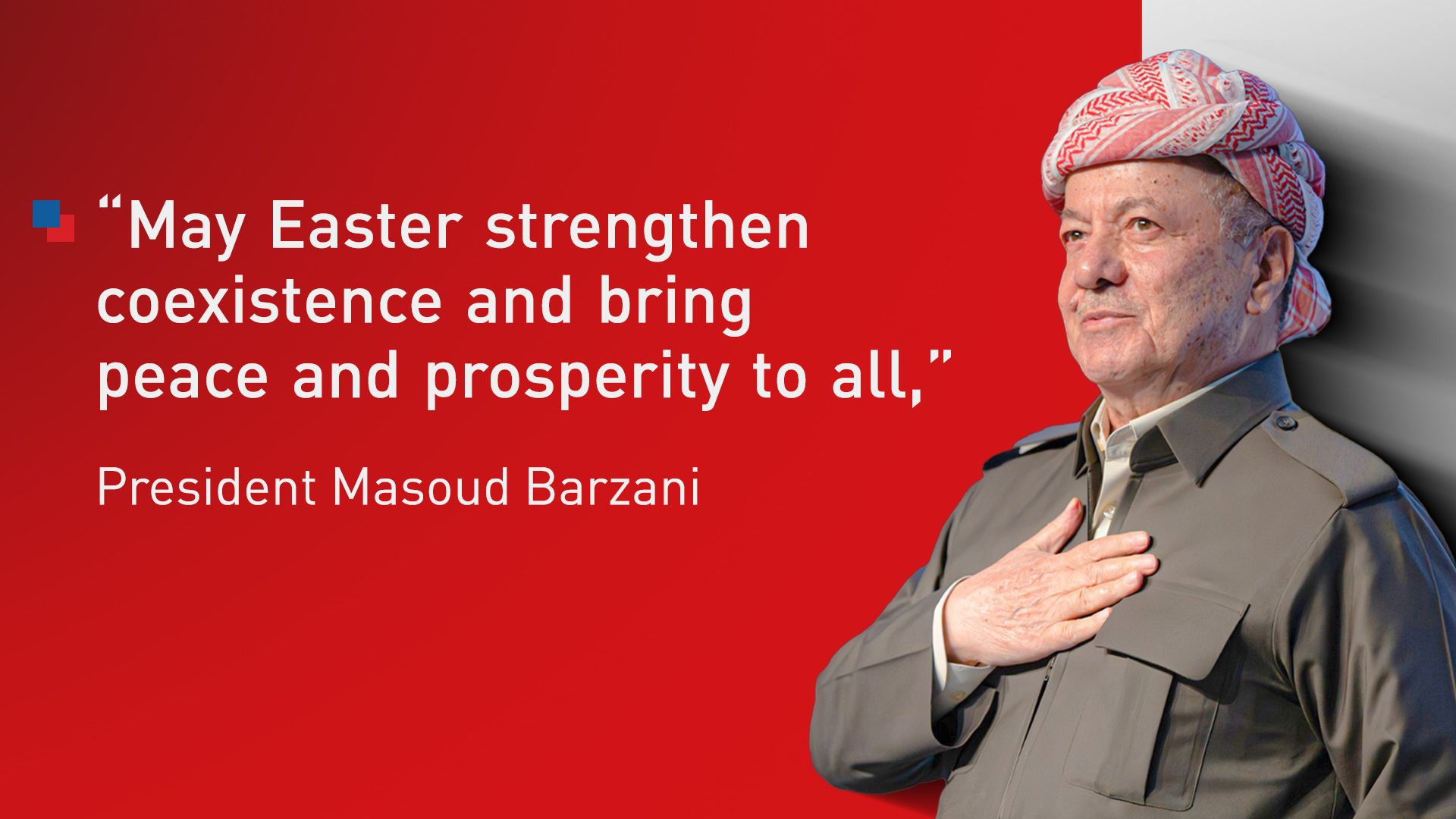
ERBIL (Kurdistan24) — On the occasion of Easter, President Masoud Barzani extended heartfelt congratulations to Christian communities across Kurdistan, Iraq, and the entire world.
In a message released on Saturday, Barzani expressed hope that the Feast of the Resurrection of Jesus Christ (peace be upon him) would strengthen the culture of coexistence and brotherhood.
He called for peace and stability for Christian communities, as well as for all religious and ethnic groups in Iraq and the wider region.
“May your feast be blessed, and may you remain in prosperity and happiness,” Barzani said, offering his warmest wishes for the holiday.
The message reflects the Kurdistan Region’s ongoing emphasis on interfaith harmony and respect for diversity, reinforcing its commitment to protecting the rights and traditions of all communities.
The Kurdistan Region has long been regarded as a relative haven of religious and ethnic pluralism, particularly during periods of instability elsewhere in the country.
Under the leadership of President Barzani, the Region’s political framework and security environment emphasized coexistence among Kurds, Arabs, Turkmen, Assyrians, Chaldeans, Armenians, Yazidis, and other communities, alongside diverse religious groups including Muslims, Christians, Yazidis, and others.
This approach was not only rhetorical but institutional, reflected in policies that safeguarded minority representation, protected places of worship, and upheld cultural rights within the Region’s governance system.
During the years of heightened sectarian violence in Iraq following 2003, the Kurdistan Region became a refuge for tens of thousands of displaced Christians and other minorities fleeing persecution.
The regional authorities facilitated their resettlement, particularly in areas such as Erbil and Duhok. This period reinforced the Region’s image as a zone of relative stability, where diversity was managed through a combination of security provision and political inclusion.
Barzani’s leadership also coincided with the Kurdistan Region’s response to the rise of ISIS in 2014, when Peshmerga forces played a decisive role in protecting vulnerable populations, including Yazidis in Sinjar and Christians in the Nineveh Plains.
The defense of these communities, alongside humanitarian assistance and reconstruction efforts, became a defining element of the Region’s narrative of coexistence. It underscored a broader policy orientation that framed pluralism as integral to regional stability rather than a source of division.
At the societal level, coexistence has been reinforced through shared public life, intercommunal dialogue, and official recognition of religious holidays and cultural practices.
Christian holidays such as Easter and Christmas are publicly acknowledged, and minority representatives hold seats in the Kurdistan Parliament, contributing to legislative processes. These measures have helped institutionalize a sense of inclusion and mutual respect.
While challenges remain—particularly in the Kurdistani territories outside the control of the Kurdistan Regional Government (KRG) and in the aftermath of conflict—the Kurdistan Region under Barzani’s leadership has consistently projected a model that prioritizes tolerance, security, and the protection of diversity.
This legacy continues to shape the Kurdistan Region's domestic governance and its external image as one of the more stable and pluralistic areas in Iraq and the broader region.