KRG Foreign Relations Chief Says EU Talks Focus on Recent Attacks on Kurdistan Region
KRG foreign relations chief Safeen Dizayee told Kurdistan24’s Barzan Hassan in Brussels that he is briefing the EU on recent attacks. Dizayee emphasized Erbil’s neutrality in regional conflicts and urged European leaders to help mediate long-standing financial and political rifts with Baghdad.
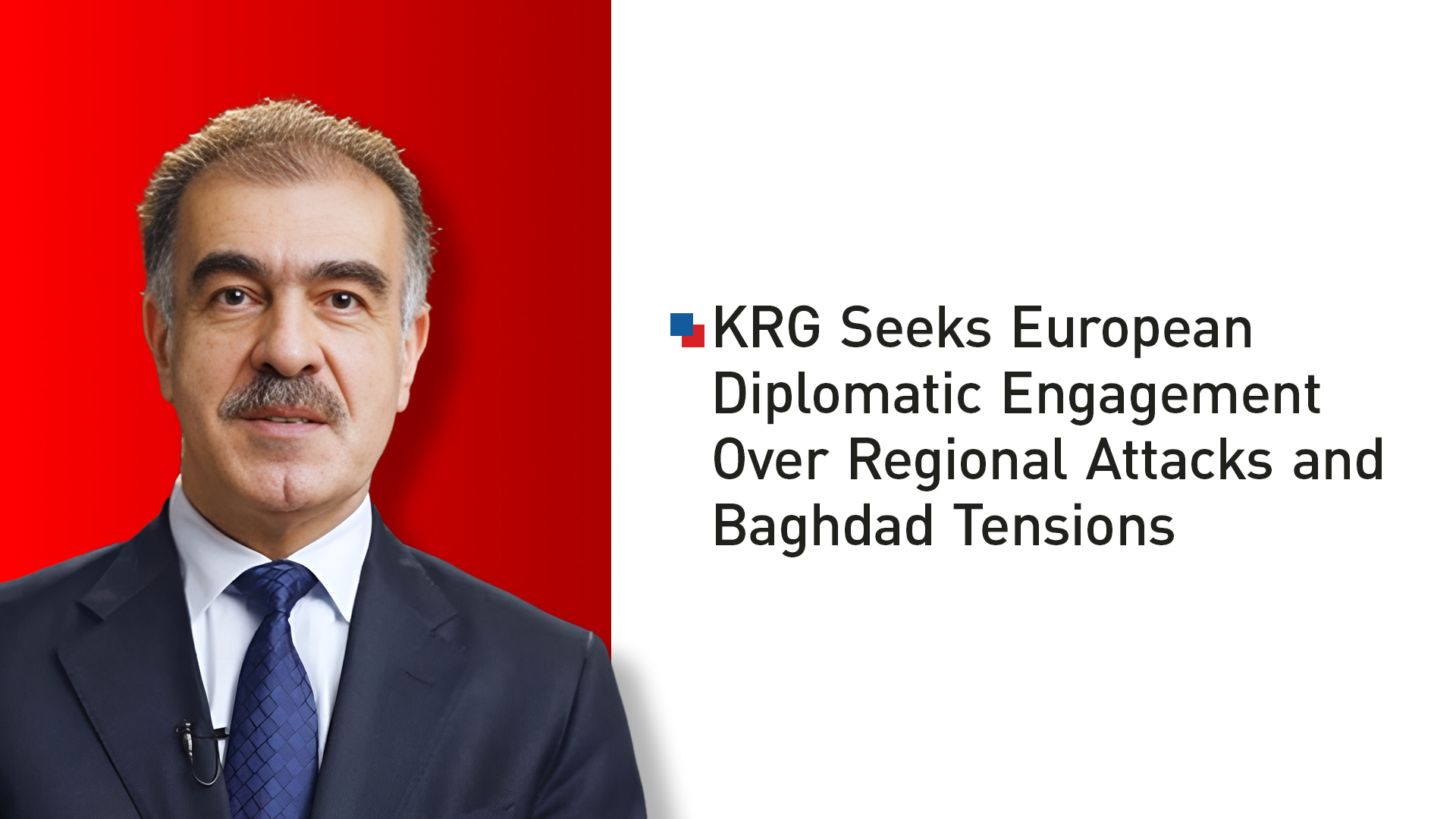
ERBIL (Kurdistan24) - The Head of the Department of Foreign Relations of the Kurdistan Regional Government, Safeen Dizayee, stated on Tuesday that regional authorities are engaged in formal discussions with the European Union Commission to clarify Erbil's non-involvement in the broader Middle East conflict and address the recent wave of attacks against the Kurdistan Region.
Speaking outside the European Parliament, Dizayee detailed that the diplomatic meetings are designed to formally communicate the Kurdistan Regional Government's position regarding the escalating regional hostilities.
The discussions also aim to leverage European diplomatic channels to mediate ongoing governance and security disputes between Erbil and the federal government in Baghdad, citing Europe’s established role in Iraq’s institutional reconstruction since 2003.
"We are meeting with the European Union Commission so that everyone is aware that the Kurdistan Region is not a part of the wars and tensions that exist in the region, and also so that they are closely informed about the events," Dizayee told Kurdistan24's Barzan Hassan
The foreign relations chief noted that the majority of European nations have already issued formal condemnations regarding the recent strikes targeting the region.
According to Dizayee, the primary request from the Kurdish administration is for European states to assume a proactive role in resolving the political and security gaps between regional and federal authorities in Iraq.
The diplomatic outreach to the European Union follows a protracted period of sustained security disruptions across the Kurdistan Region.
Over the past several weeks, amid the war between Iran, the United States, and Israel, and its wider regional spillovers, the Middle East has witnessed repeated waves of drone and ballistic missile strikes.
These attacks, attributed to the Islamic Republic of Iran and aligned armed factions in Iraq, have extended across multiple countries in the region, underscoring the scale and persistence of the ongoing escalation.
Regional leadership has consistently emphasized that local authorities maintain no involvement in the broader geopolitical confrontation. Kurdistan Region Prime Minister Masrour Barzani recently issued statements indicating that the administration has not been part of the conflict, yet continues to face unprovoked bombardments and attacks.
The continuous aerial operations have resulted in significant casualties among civilian populations and security forces, prompting the diplomatic push in Europe.
In late March, drone attacks targeted the residence of Nechirvan Barzani, president of the Kurdistan Region, as well as several other sites in Duhok Governorate. The strikes drew widespread condemnation at the national, federal, regional, and international levels. The targeting of the presidential residence marked one of the most severe instances of the unchecked drone campaign against the Kurdistan Region, striking at a central symbol of its political leadership.
Earlier this month, an explosive-laden drone launched from Iranian territory struck a civilian residence in the village of Zargazawi in Erbil province, resulting in the deaths of a Peshmerga fighter and his wife.
In a separate incident near the provincial border of Erbil, a coordinated drone and missile assault targeted the Jezhnikan displacement camp. The strike resulted in multiple fatalities, including a child and several members of the Democratic Party of Iranian Kurdistan (KDPI), alongside injuries to other non-combatants.
Furthermore, the Ministry of Peshmerga Affairs previously reported the deaths of six fighters and injuries to 30 others following ballistic missile strikes targeting military positions in the Soran border area. The ministry characterized the strikes as a hostile act and a direct violation of regional security.
The European diplomatic meetings coincide with a fragile two-week ceasefire established between the United States and Iran.
Kurdistan senior leadership, including President Masoud Barzani, Kurdistan Region President Nechirvan Barzani and Prime Minister Masrour Barzani, have publicly endorsed the truce, calling for international partners to consolidate the cessation of hostilities.
During a recent interview with European media, President Nechirvan Barzani emphasized that the regional energy infrastructure and domestic stability require immediate diplomatic intervention, noting that Kurdish areas have been subjected to over 600 strikes since the regional escalation began.
As part of broader economic stabilization efforts discussed amid the conflict, regional authorities have indicated a readiness to expand energy export capacities through neighboring Türkiye, provided the security environment is stabilized and international maritime routes remain secure.
The Kurdistan Regional Government’s appeal to the European Union for mediation with Baghdad reflects deep institutional frustrations over the federal response to the security crisis. Both the Prime Minister and the regional President have criticized the federal government for failing to implement practical defense measures or control the armed militias responsible for the bombardments.
Authorities in Erbil have formally requested that Baghdad secure the region's airspace and halt the cross-border aggression, stating that the federal administration bears the ultimate responsibility for domestic defense.
In addition to seeking political mediation, regional officials have appealed to international partners to provide the necessary defensive equipment to protect civilian areas and critical energy infrastructure.
The attacks have caused substantial disruptions to regional stability, intermittently affecting operations at the Khor Mor Gas Field and prompting temporary airspace closures. The diplomatic delegation led by Dizayee seeks to formalize international awareness of these impacts at the European Union level.
The sustained external military pressure from Tehran has also generated complex domestic administrative challenges within the Kurdistan Region. The Ministry of Health recently launched a formal investigation into the death of an Iranian Kurdish opposition fighter who succumbed to injuries sustained in a drone strike.
The casualty occurred after private medical facilities in Sulaimani province reportedly refused emergency admission, citing a lack of police authorization typically required for domestic criminal cases. The regulatory body declared the hospital refusals unacceptable, highlighting the jurisdictional voids created by the foreign aerial strikes.
Discussions between the Kurdish delegation and the EU Commission remain ongoing as officials formally communicate Erbil’s stance on the conflict and seek mediation with Baghdad.