Trump Says U.S. to Host Israel, Lebanon Leaders After Ceasefire Extension
"The Meeting went very well! The United States is going to work with Lebanon in order to help it protect itself from Hezbollah," U.S. President Donald Trump said, adding, "The Ceasefire between Israel and Lebanon will be extended by THREE WEEKS."
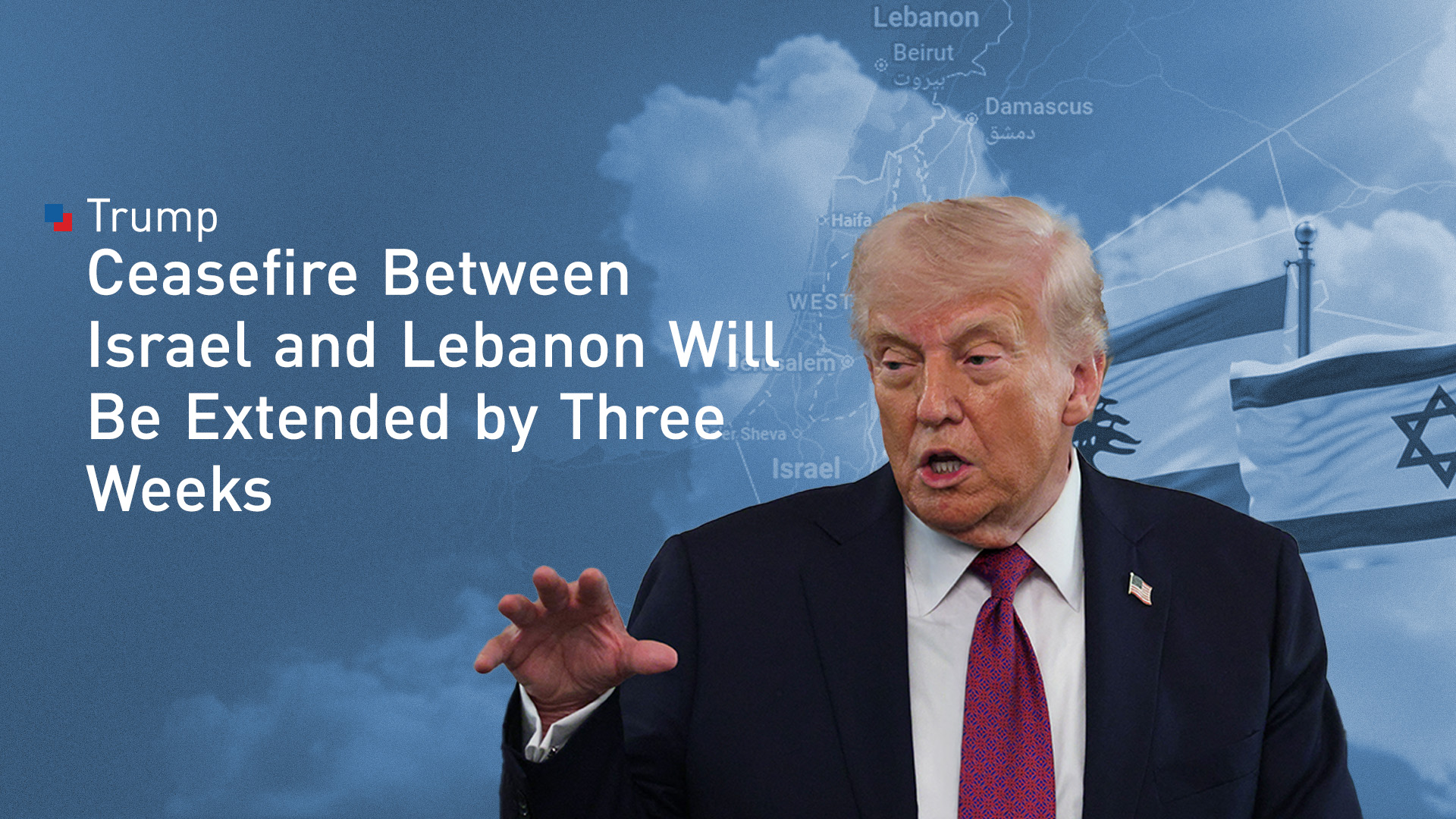
ERBIL (Kurdistan24) - U.S. President Donald Trump announced via a post on his Truth Social on Thursday that the ceasefire between Israel and Lebanon will be extended by three weeks following direct diplomatic discussions in Washington.
The announcement followed a high-level Oval Office meeting involving United States Vice President JD Vance, Secretary of State Marco Rubio, United States Ambassador to Israel Mike Huckabee, United States Ambassador to Lebanon Michel Issa, and ranking representatives from both Israel and Lebanon.
According to the presidential statement published on social media, the United States intends to work directly with Lebanon to assist the nation in protecting itself from the Iran-backed militant group Hezbollah.
"The Meeting went very well! The United States is going to work with Lebanon in order to help it protect itself from Hezbollah," Trump said, adding, "The Ceasefire between Israel and Lebanon will be extended by THREE WEEKS."
During the diplomatic engagement, President Trump stated that the bilateral meeting proceeded very well and characterized his participation as a great honor.
The president further indicated that he expects to host Israeli Prime Minister Benjamin Netanyahu and Lebanese President Joseph Aoun for formal discussions in Washington in the near future.
"I look forward in the near future to hosting the Prime Minister of Israel, Bibi Netanyahu, and the President of Lebanon, Joseph Aoun. It was a Great Honor to be a participant at this very Historic Meeting," he added.
The talks represent the first direct diplomatic negotiations between Israel and Lebanon since 1993, marking a significant structural shift for two neighboring states that have officially remained in a state of war since Israel’s inception in 1948.
The initial ten-day cessation of hostilities, which went into effect last Friday, had been scheduled to expire in the coming days.
Speaking to reporters at the White House alongside the respective ambassadors, President Trump expressed optimism regarding the diplomatic trajectory, stating that he believes there is a very good chance of achieving peace and that the process should be straightforward.
However, the president acknowledged the ongoing security complications during the Oval Office gathering, telling the press pool that the negotiating parties must factor Hezbollah into their strategic calculations.
He reiterated that Israel maintains an inherent right to defend itself if its forces are subjected to hostile fire.
The diplomatic representatives expressed mutual support for the United States mediation efforts.
As reported by The Associated Press, Israeli Ambassador Yechiel Leiter told those gathered that his government hopes to formalize a permanent peace agreement with Lebanon under Washington's leadership in the very near future.
Lebanese Ambassador Nada Hamadeh Moawad expressed gratitude for the diplomatic intervention, referencing the American president's political slogan by stating that with United States support, the international community could make Lebanon great again.
The framework for wider-reaching negotiations remains complex.
Lebanese President Joseph Aoun noted in comments released by his office a day earlier that the Lebanese delegation would formally request an end to Israeli home demolitions in villages and municipalities occupied by Israeli military forces since the latest conflict began on March 2.
According to the statements released by the Lebanese presidency, the ultimate objective of future talks includes a complete halt to Israeli military operations, the withdrawal of Israeli ground troops from Lebanese territory, the release of Lebanese prisoners held in Israeli facilities, the deployment of the official Lebanese armed forces along the southern border, and the initiation of comprehensive reconstruction programs.
Israeli Foreign Minister Gideon Saar has explicitly called upon the Lebanese state to cooperate with Israel in disarming Hezbollah.
In remarks delivered to Israel’s diplomatic corps, Saar characterized Lebanon as a failed state, while asserting that the two nations do not possess any serious bilateral disagreements. He categorized existing territorial issues as minor border disputes capable of resolution.
The foreign minister identified Hezbollah as the singular obstacle to peace and normalization, suggesting that its removal could grant Lebanon sovereignty and freedom from what he termed Iranian occupation.
Hezbollah, which operates with backing from Tehran, has vehemently opposed the diplomatic track in Washington. Wafiq Safa, a senior official within the militant group’s political council, told The Associated Press that the organization will not abide by any agreements formulated during the direct bilateral negotiations.
Since the initial ceasefire implementation, both sides have registered multiple tactical violations. According to a statement from the Lebanese health ministry obtained by Agence France-Presse, an Israeli strike in southern Lebanon on Thursday resulted in the deaths of three individuals.
In a corresponding public statement, Hezbollah confirmed it had launched a rocket salvo targeting the northern Israeli settlement of Shtula, framing the bombardment as a defensive response to Israeli targeting of the southern Lebanese town of Yater.
The current conflict, which erupted when Hezbollah launched rocket attacks into northern Israel two days after joint United States and Israeli military strikes on Iran, has exacted a severe humanitarian toll.
Israeli ground incursions established a military buffer zone extending ten kilometers into southern Lebanon, an operation the Israeli military stated was necessary to eliminate the threat of short-range munitions directed at its northern communities.
The hostilities have resulted in approximately 2,300 fatalities in Lebanon and displaced more than one million residents. The atmosphere preceding the Washington talks was further strained following an Israeli strike on Wednesday that killed well-known Lebanese journalist Amal Khalil.
Lebanese health authorities alleged that the Israeli military fired upon emergency responders attempting to reach the site, a charge the Israeli military formally denied.
Following a government cabinet session, Lebanese Deputy Prime Minister Tarek Mitri confirmed to reporters that authorities are documenting alleged war crimes and discussing potential accession to the International Criminal Court.
While the Lebanese and Israeli diplomatic tracks advance, broader regional peace negotiations aimed at resolving the confrontation with the Islamic Republic of Iran have severely stalled. Prospective peace talks slated to occur in Pakistan currently hang in the balance.
Agence France-Presse reported that despite blanket security protocols remaining active in Islamabad for a fourth consecutive day, no diplomatic delegations are presently en route to the Pakistani capital. President Trump recently told the New York Post that discussions could potentially resume within two to three days.
The United States administration maintains that it is under no immediate pressure to conclude the military standoff with Tehran.
President Trump utilized his Truth Social platform to declare that while he possesses unlimited time, the clock is ticking for the Iranian government. The president simultaneously ruled out the deployment of nuclear weapons against Iran, stating explicitly to White House reporters that such armament should never be utilized by any party.
The military and economic focus of the United States-Iran confrontation has increasingly concentrated on the Strait of Hormuz, a critical maritime corridor that typically facilitates a fifth of global oil and liquefied natural gas exports.
Following the imposition of an Iranian blockade on the waterway, President Trump posted public directives ordering the United States Navy to shoot and kill any Iranian vessels discovered placing naval mines in the strait. The United States military posture in the region has escalated significantly with the arrival of the USS George H.W. Bush.
The United States Central Command announced on the social media platform X that the aircraft carrier had deployed to the Indian Ocean, bringing the total number of American carrier strike groups operating in the Middle East to three, with another currently operating in the Red Sea.
Maritime interdictions have intensified concurrently. The United States Department of Defense stated that its forces conducted a right-of-visit boarding of the sanctioned stateless vessel M/T Majestic X in the Indian Ocean, identifying the ship as transporting Iranian oil.
Central Command reported that its forces have redirected 33 vessels since the initiation of the maritime blockade against Iran. Conversely, Iran's Revolutionary Guards issued a statement confirming they forced two ships to the Iranian shoreline from the Strait of Hormuz.
Iranian deputy parliament speaker Hamidreza Hajibabaei told the Tasnim news agency that the government in Tehran has already deposited its first revenues derived from tolls imposed on international shipping through the contested strait into the nation's Central Bank.
The economic disruptions have prompted European Union leaders to schedule intensive dialogues with counterparts from Lebanon, Egypt, Syria, and Jordan to address the maritime closure.
Inside Iran, state media agencies IRNA and Mehr reported the activation of air defense systems and audible blasts over western Tehran, marking the first such occurrences since the regional ceasefire commenced two weeks ago.
An Israeli security source, speaking to Agence France-Presse on the condition of anonymity, officially denied that Israel was conducting airstrikes within Iranian territory.
Despite the denial of immediate airstrikes in Tehran, Israeli Defense Minister Israel Katz issued stark operational warnings in a video statement, declaring that his forces are prepared to resume the war.
Katz indicated that Israel is awaiting authorization from the United States to complete the elimination of the current Iranian leadership and return the nation's infrastructure to the Stone Age.
In response to external pressures and reports published by the New York Times concerning the health of the supreme leader, Iranian officials presented a highly coordinated public front.
The president, parliament speaker, and chief justice published identical statements emphasizing national unity, while the official social media account of Mojtaba Khamenei condemned what it termed enemy media operations designed to undermine domestic security.