Erbil Airport Set for Full Flight Resumption by Early June, Official Says
All commercial airlines are scheduled to fully resume normal flight operations at Erbil International Airport by the beginning of June, facilitated by the reopening of federal Iraqi airspace.
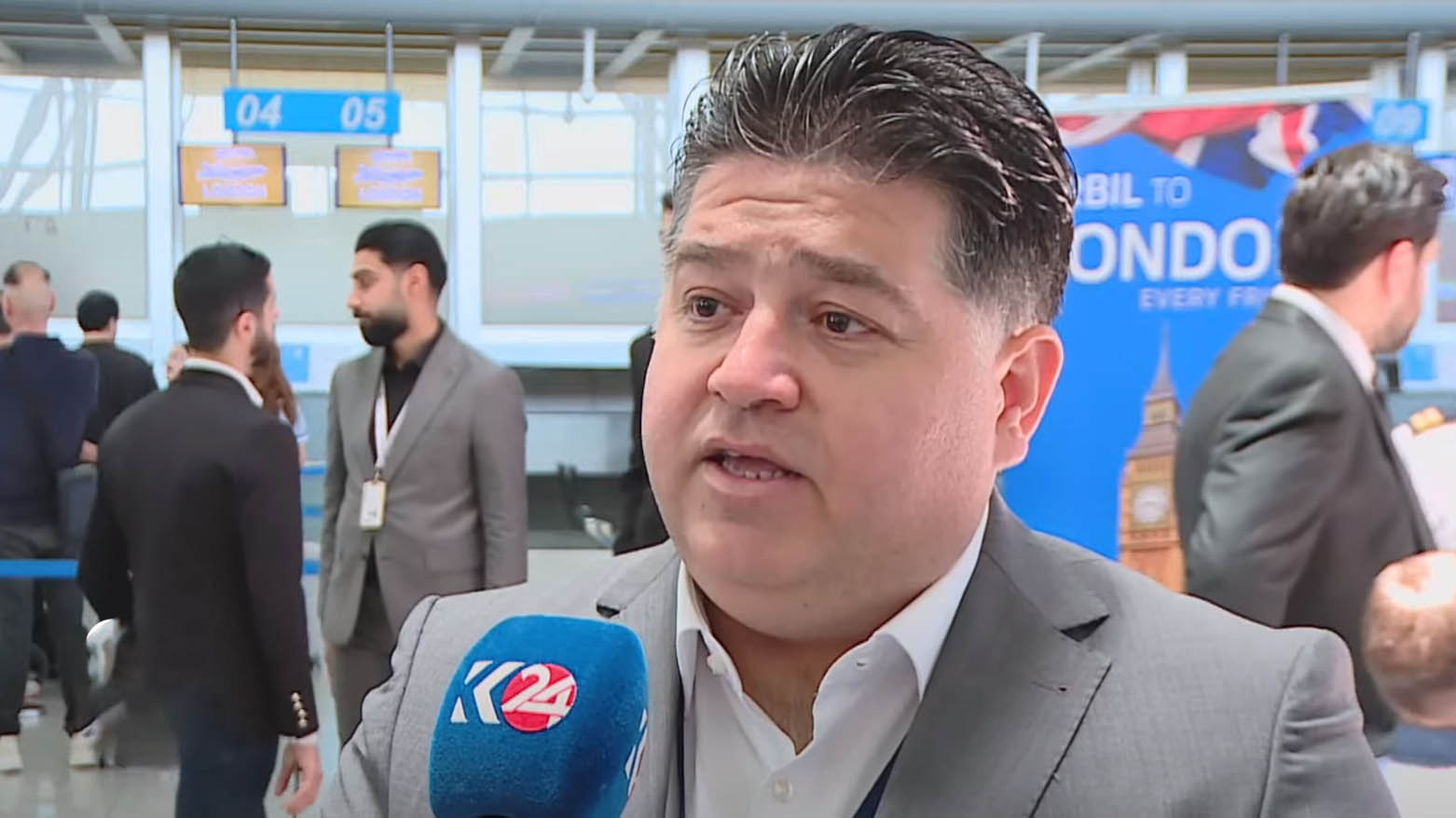
ERBIL (Kurdistan24) - All commercial airlines are projected to fully resume normal flight operations at Erbil International Airport by the beginning of June, according to statements released on Friday by Lawand Mamondy, head of the Kurdistan Region's Aviation and Tourism Companies Union.
The announcement outlines a phased normalization of international and regional air travel following recent geopolitical disruptions.
Mamondy, who concurrently serves as the Chief Executive Officer of the regional carrier Fly Erbil, confirmed that daily flight schedules are currently being executed from the regional transportation hub. These aviation operations are actively connecting the Kurdistan Region to various destinations across European nations and the Arab world.
During this transitional period, Fly Erbil has functioned as the primary regional aviation operator, stepping in to fill the operational flight gap left by the temporary withdrawal of broader international carrier services.
Speaking on Friday, Mamondy provided specific operational metrics regarding the current state of passenger transit. In remarks provided to Kurdistan24, he noted that the logistical process of restoring the aviation sector is advancing methodically.
He described the recovery as a step-by-step progression wherein flights are steadily returning to their standard operational capacity. At present, the regional airline is facilitating the travel of approximately 500 passengers on a daily basis, maintaining a crucial transportation lifeline for the region amid broader logistical constraints.
To support this passenger volume, Fly Erbil is maintaining a consistent schedule of round-trip flight operations to a concentrated list of international transit hubs. The regional carrier's active network currently encompasses several major European destinations.
According to the operational details provided by the airline's chief executive, Fly Erbil is presently conducting regular flights to Istanbul, Dusseldorf, Hanover, Stuttgart, Berlin, Copenhagen, Munich, and Amsterdam.
This network has allowed the Kurdistan Region to maintain civilian connections with the European continent during a period characterized by restricted regional airspace navigation.
The gradual normalization of commercial air traffic at Erbil International Airport is linked directly to recent shifts in the regional security environment. The resumption of flights follows the implementation of a formal ceasefire agreement between the United States and Iran.
In the wake of this bilateral cessation of hostilities, the Iraqi federal government intervened to restore civilian aviation logistics, officially reopening Iraqi national airspace to commercial flight operations.
However, despite the federal authorization and the formal reopening of the skies over Iraq, the airspace encompassing both the federal republic and the Kurdistan Region is not yet experiencing a significant volume of tourist or passenger travel movement.
Mamondy addressed this discrepancy by detailing the complex navigational realities of international flight corridors. The head of the Union explicitly stated that Iraqi airspace is currently completely open and that there is no operational danger to commercial aircraft navigating the territory.
Instead, the constraints on regional air traffic volume are attributed to logistical bottlenecks located elsewhere in the Gulf. According to Mamondy, the relevant aviation authorities in Kuwait and Bahrain have not yet reopened their respective national airspaces to standard commercial transit.
The head of the Union explained that this closure has a cascading effect on flight paths. Previously, various European nations and international carriers utilized the airspace of Kuwait and Bahrain as a designated navigational corridor.
After transiting through that specific Gulf corridor, those commercial planes would subsequently pass directly through the airspace of the Kurdistan Region.
Mamondy clarified that the primary reason the Region's airspace currently lacks heavy international flight traffic is strictly due to the ongoing closure of those two specific airspaces, which effectively severs the traditional intercontinental routing system.
Despite these external navigational hurdles, local aviation authorities and regional operators are proceeding with scheduled expansions. The head of the Union announced that beginning next month, the regional carrier will systematically broaden its European network.
Starting in early May, Fly Erbil is scheduled to officially resume dedicated passenger flights to Frankfurt and London. This planned May expansion is designed to serve as a direct precursor to the broader industry normalization, culminating in the projected return of all airlines and the resumption of their normal flights by early June.
While Fly Erbil has assumed a prominent role in bridging the recent aviation gap, the regional carrier is not the sole operator currently active at the Erbil transportation hub.
The aviation executive noted that several other commercial airlines are actively maintaining round-trip flight operations from Erbil International Airport. These supplementary carriers are currently focused on servicing specific regional and domestic routes.
According to the provided data, these other airlines are successfully operating regular flights connecting Erbil to the domestic Iraqi cities of Baghdad and Basra. Furthermore, these carriers are facilitating ongoing international travel to key Middle Eastern destinations, including Dubai, Cairo, Sharjah, and Damascus.