Kurdistan Region Launches One of the Middle East's Most Ambitious Urban Climate Programs
A new substation project worth 100 billion dinars will bring national grid power to Shamamk's agricultural plains.
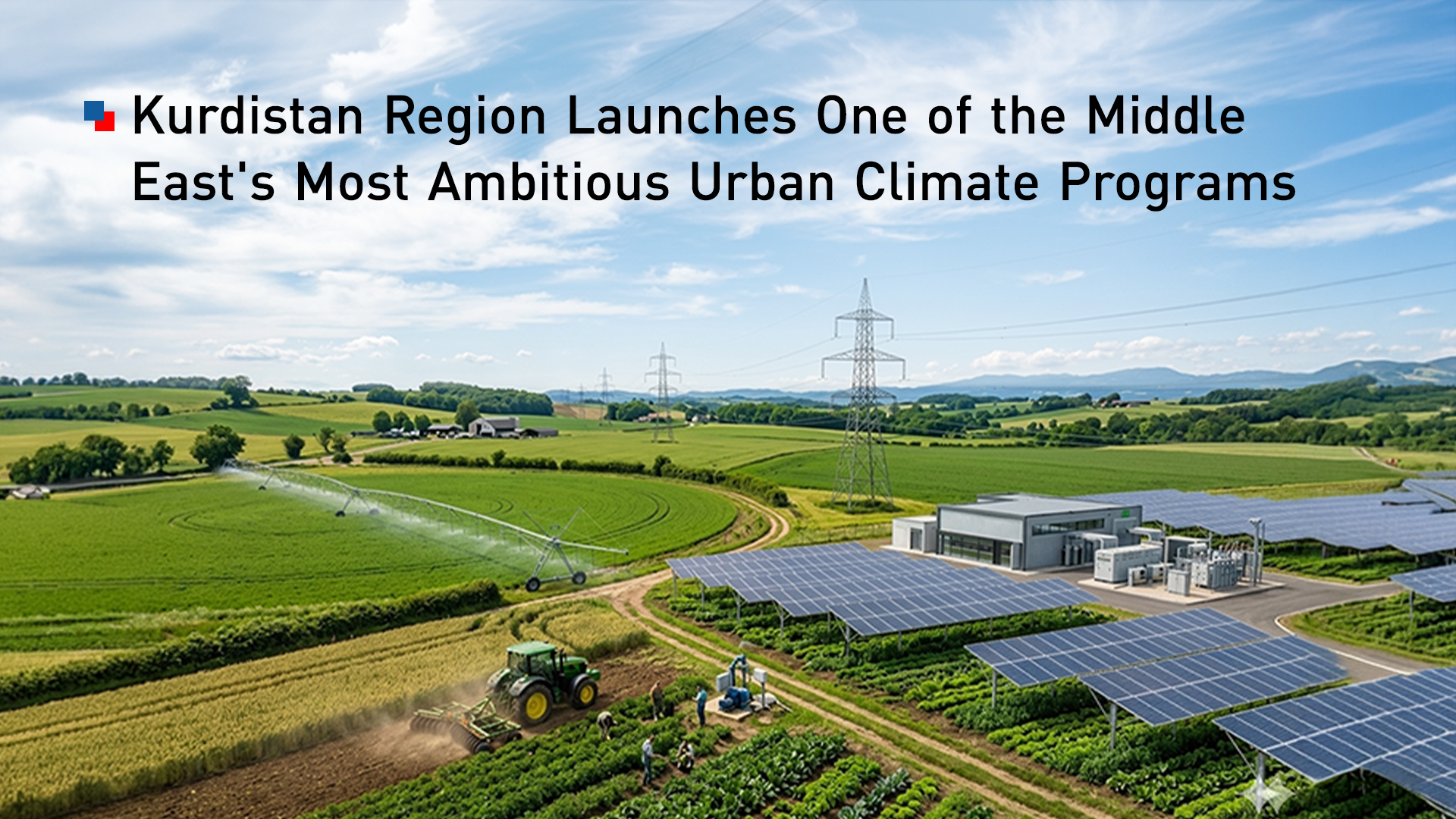
ERBIL (Kurdistan24) - For years, the farmers working the plains of Shamamk on Erbil's outskirts have run their irrigation pumps, poultry facilities, and agricultural projects against a backdrop of chronic power shortages.
The Kurdistan Regional Government (KRG) is now moving to change that — and the announcement is the latest milestone in an electricity reform that has already transformed daily life for millions across the Region.
Heman Saidmurad, Director General of Agriculture in Erbil, told Kurdistan24 on Sunday, that thousands of farmers across Erbil's boundaries will benefit from national grid power following a Ministry of Electricity decision to install three 132-kilovolt substations across eight enclosures in the Timar industrial zone and the Shamamk area.
The project carries a price tag of approximately 100 billion Iraqi dinars and represents the agricultural frontier of the Runaki Project — the KRG's sweeping electricity overhaul that has already phased out more than 2,500 private diesel generators and delivered reliable power to more than 2.7 million residents across Erbil, Sulaimani, Duhok, and Halabja.
Saidmurad described the scale of agricultural activity concentrated in the Shamamk plains boundary:
thousands of farmers are actively cultivating land and running agricultural projects in the area, alongside a number of poultry operations.
All of them, he said, stand to become primary beneficiaries of the substation network once it is operational.
He was direct about what reliable electricity means for the sector. "Farmers and agricultural project owners will no longer face the problems caused by power shortages," he said, adding that the Runaki Project had already delivered significant benefits wherever it had reached.
That assessment was reinforced by Bêstûn Bakr, Director of Fisheries Resources at the KRG Ministry of Agriculture and Water Resources, who told Kurdistan24 in an earlier statement that demand from agricultural project owners for connection to the 24-hour grid had been overwhelming.
"Every day, large numbers of project owners contact us to complete the procedures for connecting to 24-hour electricity," he said.
The Ministry of Agriculture, he added, was coordinating closely with the Ministry of Electricity to streamline the process for applicants.
Bakr also called on the KRG to extend 24-hour supply beyond urban centers to surrounding areas — a call the new Shamamk substation project appears to directly answer.
2.7 million beneficiaries — and counting
The Runaki Project, launched in 2024 with a target of eliminating 7,000 private diesel generators across the Kurdistan Region by the end of 2026, has moved at a pace that exceeded initial expectations.
As of mid-2025, more than 2,500 generators had been decommissioned, benefiting more than 2.7 million residents.
When the program reaches its full target, the transition is projected to cut 600,000 tons of carbon dioxide emissions annually — a figure that has led regional officials to describe Runaki as an "invisible forest," running alongside the KRG's more visible afforestation initiatives.
The environmental arithmetic of the program is significant. Thousands of diesel generators, each burning fuel around the clock to compensate for gaps in centralized supply, have been among the most persistent sources of urban air pollution across Kurdish cities.
Their removal has improved air quality in ways that are difficult to quantify but immediately felt by residents — particularly in dense urban neighborhoods where generators once hummed on every block.
A broader infrastructure transformation
The Runaki expansion into Shamamk's agricultural zones comes as Erbil advances on two other landmark infrastructure fronts.
The city's emergency water supply station — a $480 million project launched on Sept. 8, 2024, and completed in under 550 days — has reached 100 percent construction completion, with integration into Erbil's internal water network now at 85 percent.
Ari Ahmed, Director General of Water and Sewerage in the Kurdistan Region, told Kurdistan24 on Saturday that once the main lines are connected, all residents of Erbil will benefit directly and indirectly, with a significant impact on distribution across the city.
The system is designed to supply 480,000 cubic meters of potable water daily from the Great Zab River, serving approximately 1.5 million residents for the next 30 years.
Meanwhile, Governor Omed Xoshnaw confirmed that the first phase of Erbil's Green Belt project — a forested perimeter designed to encircle the capital across 78 kilometers — is nearing completion, with 700,000 saplings planted across 4,200 dunams of land.
The full master plan projects the planting of seven million trees by 2050, with species chosen for both climate resilience and economic productivity: olive, pistachio, and orange.
Environmental assessments project the completed belt will eliminate up to 210,000 tons of greenhouse gas emissions annually.
Taken together, the three projects represent an unusually coherent and locally driven infrastructure program — one that addresses power, water, and environment simultaneously, at a regional government level, within a federal state that has often struggled to execute comparable initiatives nationally.
For the farmers of Shamamk, the immediate reality is simpler: when the substations come online, the grid arrives, and the pumps can finally run through the night.