PKK Commander Warns Peace Process 'Suspended' as Erdogan Insists Process on track
Contradictory signals from both sides cast fresh uncertainty over the Turkish-Kurdish peace process
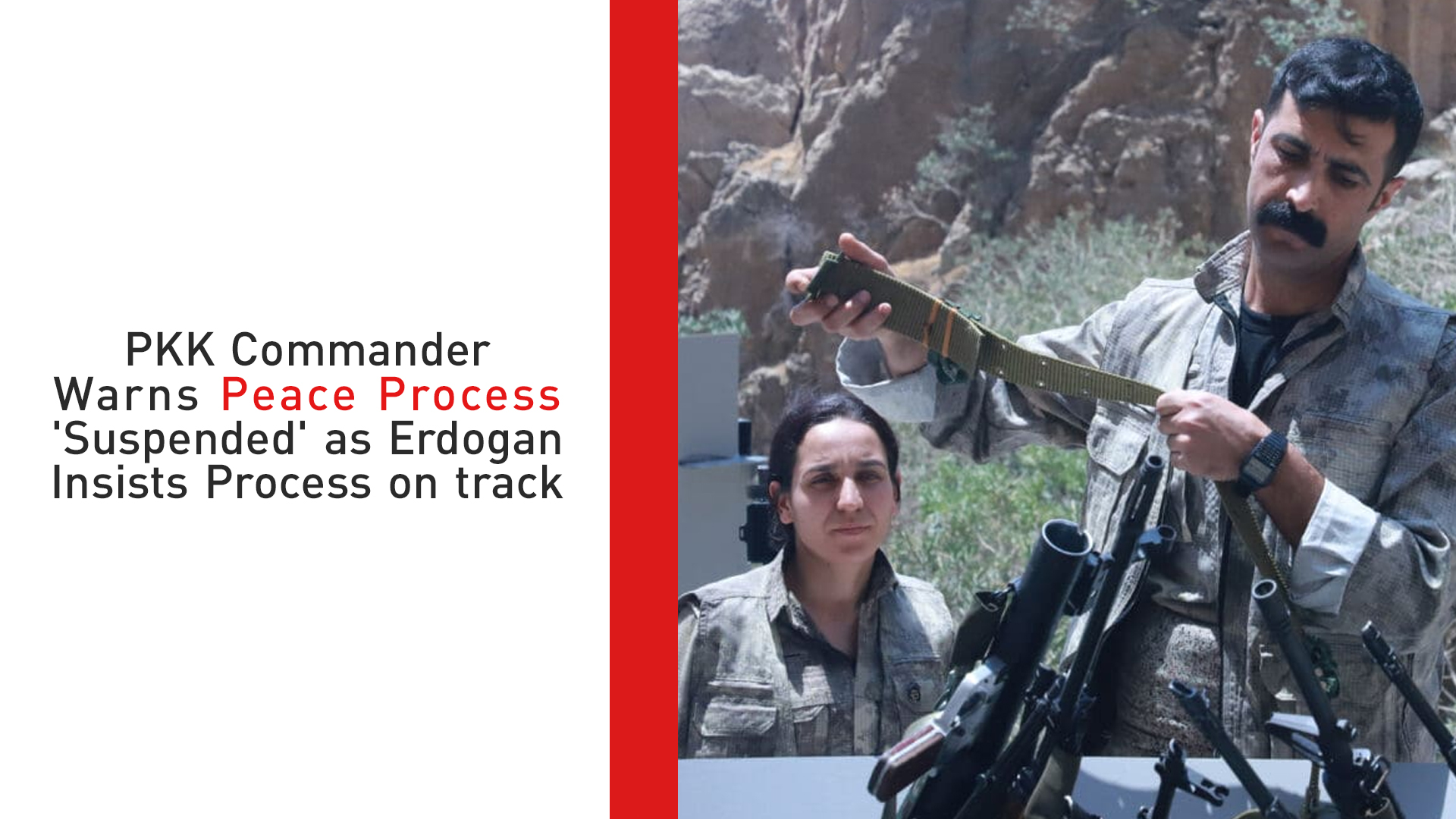
ERBIL (Kurdistan24) - On the day of International Workers' Day, one of the PKK's most senior commanders issued a stark warning: the Turkish-Kurdish peace process, celebrated only months ago as a historic opening, may have already ground to a halt.
Murat Karayilan, a member of the PKK's People's Defense Centre executive command, made the remarks Thursday in an interview with a PKK-affiliated media outlet, using the occasion of May 1 to deliver some of the sharpest public criticism yet of how the process has been managed.
His words came a day after Turkish President Recep Tayyip Erdogan had taken the floor in parliament to offer a starkly different assessment.
At the heart of Karayilan's grievances is what he described as the unbroken legal isolation of Abdullah Ocalan, the imprisoned PKK leader whose call for disarmament in early 2025 set the peace process in motion.
Karayilan said that isolation remains in place and that visits to Ocalan on Imrali Island cannot be permitted or cancelled based on the word of a single official.
"This kind of handling builds trust in no one," Karayilan said, adding that it implies the absence of any governing legal framework.
He argued that organizations must operate according to their own institutional decisions, yet these decisions have not been made transparent to the public.
The only formally documented step, he said, has been the work and report of the parliamentary commission.
Karayilan pointedly criticised the manner in which delegations have been granted or denied access to Imrali, saying such a consequential matter cannot rest on the judgment of one person who unilaterally decides that further visits serve no purpose.
He said that no visit to Ocalan has been permitted in the past month, describing the absence of meetings as "a dangerous signal for the future of the peace process."
He linked the slowdown to regional developments and what he described as certain internal processes, suggesting that decision-makers had concluded it was appropriate to pause or delay steps forward.
The parliamentary commission's formal report, he said, after months of work, leaves no other interpretation for why the process has not advanced.
Karayilan also addressed the PKK's own conduct throughout the process.
He said the organization had fulfilled its obligations and taken every step it was expected to take — steps, he emphasized, carried out in full public view.
Ending 42 years of armed struggle, he said, is not an ordinary decision, and no one can claim the PKK has failed to act.
He acknowledged that on March 27, a Turkish government delegation and a DEM Party delegation met with Ocalan — a meeting that had generated considerable expectations.
However, Karayilan said that as far as could be determined, those discussions did not yield the anticipated outcomes.
The absence of any subsequent meeting since that date, he said, is what has brought the process to its current, precarious state.
Erdogan: 'The atmosphere is positive'
Speaking before the Turkish parliament on Wednesday, Turkish President Erdogan offered a sharply contrasting view.
He acknowledged that recent steps had brought the process to "a more sensitive stage," but insisted the overall atmosphere remained positive and that the process was unfolding as expected.
Erdogan's remarks came after Tülay Hatemoğlu, co-chair of the DEM Party, accused the Turkish government of "wavering and wasting time" despite what she called a historic opportunity for peace.
Erdogan dismissed those criticisms, saying those who spread pessimistic assessments about the process "are operating on the basis of imagination and illusion, not reality."
He said the approval of the parliamentary commission's report had brought the process to a juncture requiring more careful management, and affirmed that the ruling People's Alliance aims to navigate this phase with the cooperation and support of other political parties.
The current peace process was launched in October 2024 at the initiative of Devlet Bahçeli, leader of the MHP, when he called on Ocalan to appeal for the PKK's dissolution.
In early 2025, the PKK formally declared a ceasefire and subsequently announced a decision to lay down arms.
A special body — the National Unity, Brotherhood and Democracy Commission — was established within the Turkish parliament to oversee the process.
Despite the PKK's disarmament announcement, the DEM Party and Kurdish political factions have continued to criticize the government's pace in implementing legal reforms.
Their central demands include ending the practice of appointing trustees over elected Kurdish municipalities, releasing political prisoners, and establishing a legal framework for PKK members to reintegrate into civilian life.
Whether Karayilan's stark assessment and Erdogan's measured reassurances represent a temporary impasse or a deeper erosion of trust between the parties remains to be seen. What is clear is that the distance between the two positions has rarely been wider.