Kurdistan Region Attracted More Than $80 Billion in Investment Over Two Decades
Investment Board statistics highlight expanding foreign and domestic economic activity across the Kurdistan Region
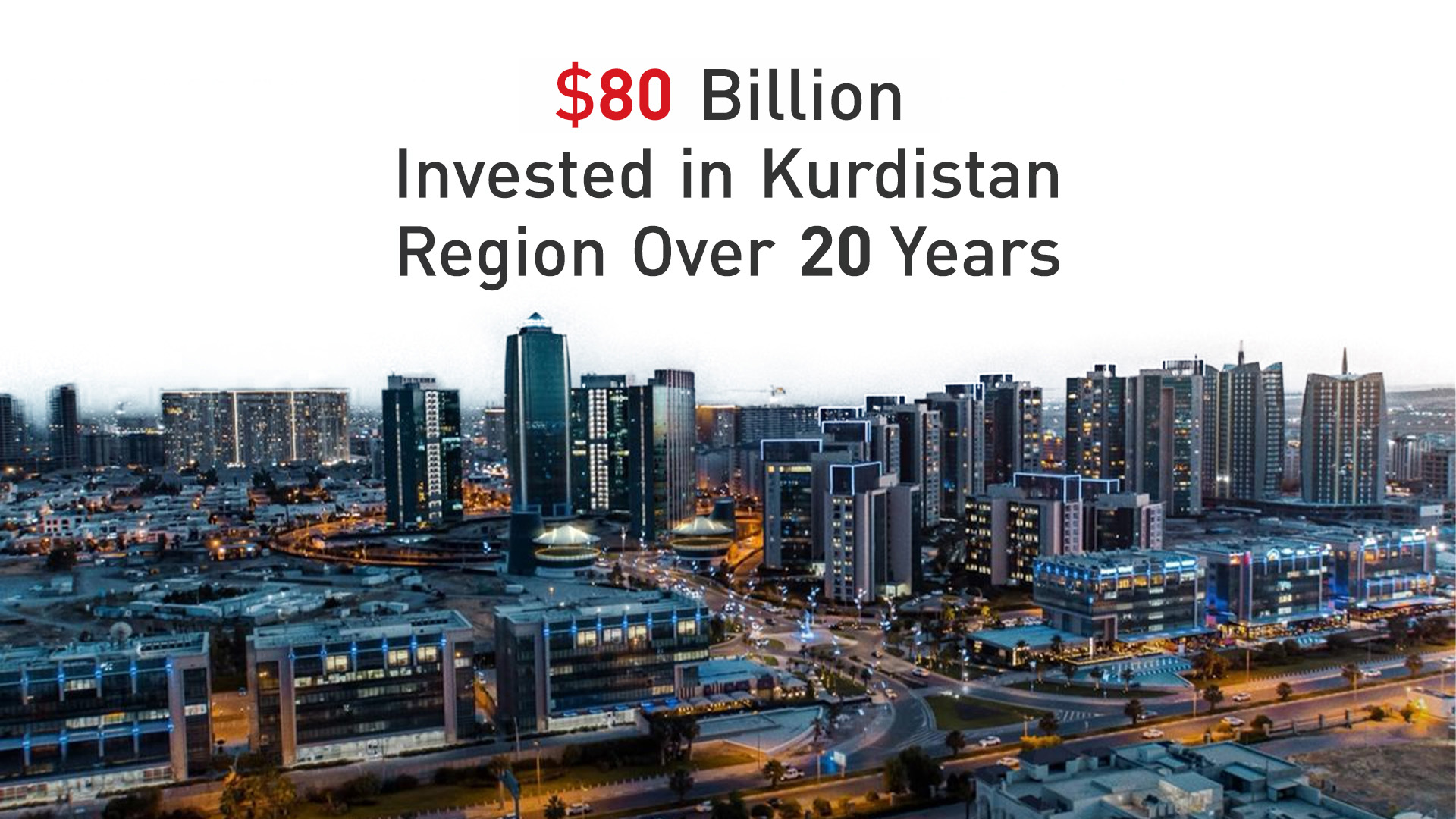
ERBIL (Kurdistan 24) - Official statistics from the Kurdistan Region Board of Investment published in May 2026 show that more than $80 billion has been invested across various sectors of the Kurdistan Region over the past 20 years, highlighting the region’s growing role as a major economic and investment hub in Iraq and the wider Middle East.
Bargasht Akrayi, Spokesperson of the Board of Investment, told Kurdistan 24 that the investment amount in Kurdistan rose to $80 Billions this year.
According to the figures released by the Kurdistan Region Board of Investment, approximately 23 percent of the total investment volume consists of foreign or joint international investments, while more than 77 percent comes from domestic investment projects.
The investments are distributed across multiple sectors, including housing, tourism, energy, industry, transportation, telecommunications, agriculture, healthcare, logistics, and trade infrastructure.
In the early years after 2006, a large share of investments focused on housing and urban development projects to address rapid population growth and reconstruction needs. In recent years, the Kurdistan Regional Government has increasingly shifted toward diversification into agriculture, manufacturing, tourism, renewable energy, industrial zones, and logistics projects.
The data reflects the participation of investors from neighboring countries, Gulf states, Europe, and North America in sectors including energy, housing, tourism, trade, infrastructure, industry, transportation, and telecommunications.
Among foreign investors, China ranks first with approximately $4.609 billion invested in the Kurdistan Region, representing around 10.55 percent of total foreign investment. Chinese investments are concentrated mainly in energy, infrastructure, telecommunications, and industrial development projects. The United Arab Emirates follows with approximately $2.534 billion or 5.45 percent, with major activity in real estate, trade, tourism, and logistics, while Lebanon ranks third with around $1.020 billion, largely linked to banking, real estate, and commercial sectors.
Statistics from the Board of Investment also show that Germany has invested nearly $887 million in the Kurdistan Region since 2006, representing approximately 1.91 percent of total foreign investment, including projects in industry, energy, engineering, and development sectors. Türkiye’s investments have reached around $651 million, accounting for approximately 1.40 percent, with Turkish companies heavily involved in construction, transportation, trade, infrastructure, energy, and housing development.
Based on Kurdistan24's report on agricultural investment, published Dec. 21, 2025, recent government reports also indicate growing investment in agriculture and food production. Kurdistan Region Agriculture Minister Begard Talabani announced in December 2025 that agricultural investment increased from less than 2 percent to nearly 10 percent under the KRG’s Ninth Cabinet policies, driven by projects related to smart farming, water management, livestock, food processing, and agricultural modernization.
Other countries with active investment participation in the Kurdistan Region include South Korea, Canada, the United States, Russia, Iran, Syria, Switzerland, France, Spain, Sweden, New Zealand, and the United Kingdom.
The release of the investment figures coincides with Prime Minister Masrour Barzani’s meetings in Istanbul on Saturday with Turkish President Recep Tayyip Erdoğan, Turkish Foreign Minister Hakan Fidan, Turkish Defense Minister Yaşar Güler, and Minister of Energy Arpaslan Bayraktar in Istanbul, Türkiye.
During those meetings, both sides emphasized strengthening economic cooperation, trade connectivity, infrastructure development, and implementation of the strategic “Development Road” project linking the Gulf, Iraq, the Kurdistan Region, Türkiye, and Europe through railways and transportation corridors.
Analysts say the ongoing diplomatic and economic coordination between Erbil and Ankara reflects broader efforts to position the Kurdistan Region as a strategic transit and investment center connecting Gulf markets with Europe.
The Development Road project is expected to play a major role in expanding trade routes, logistics networks, industrial investment, manufacturing activity, and energy cooperation across the region over the coming decades. According to previous Iraqi and Turkish planning documents reported by Kurdistan24, the project includes approximately 1,200 kilometers of railways and highways extending from the Grand Al-Faw Port toward Türkiye and Europe, with an estimated cost of around $17 billion.
Officials in the Kurdistan Region have increasingly linked economic stability and investment growth to broader infrastructure modernization efforts pursued under the 9th Cabinet led by Prime Minister Masrour Barzani, including reforms in electricity, transportation, water infrastructure, digital governance, and industrial development.
Despite ongoing regional tensions and geopolitical instability across the Middle East, the Kurdistan Region continues to present itself as a relatively stable destination for foreign investment and regional economic cooperation.