CENTCOM Says U.S. Forces Redirected 72 Ships in Iran Blockade
U.S. Central Command said American naval forces have redirected 72 commercial vessels and disabled four ships during maritime blockade operations targeting Iranian ports, as tensions around the Strait of Hormuz continue to disrupt global shipping and energy markets.
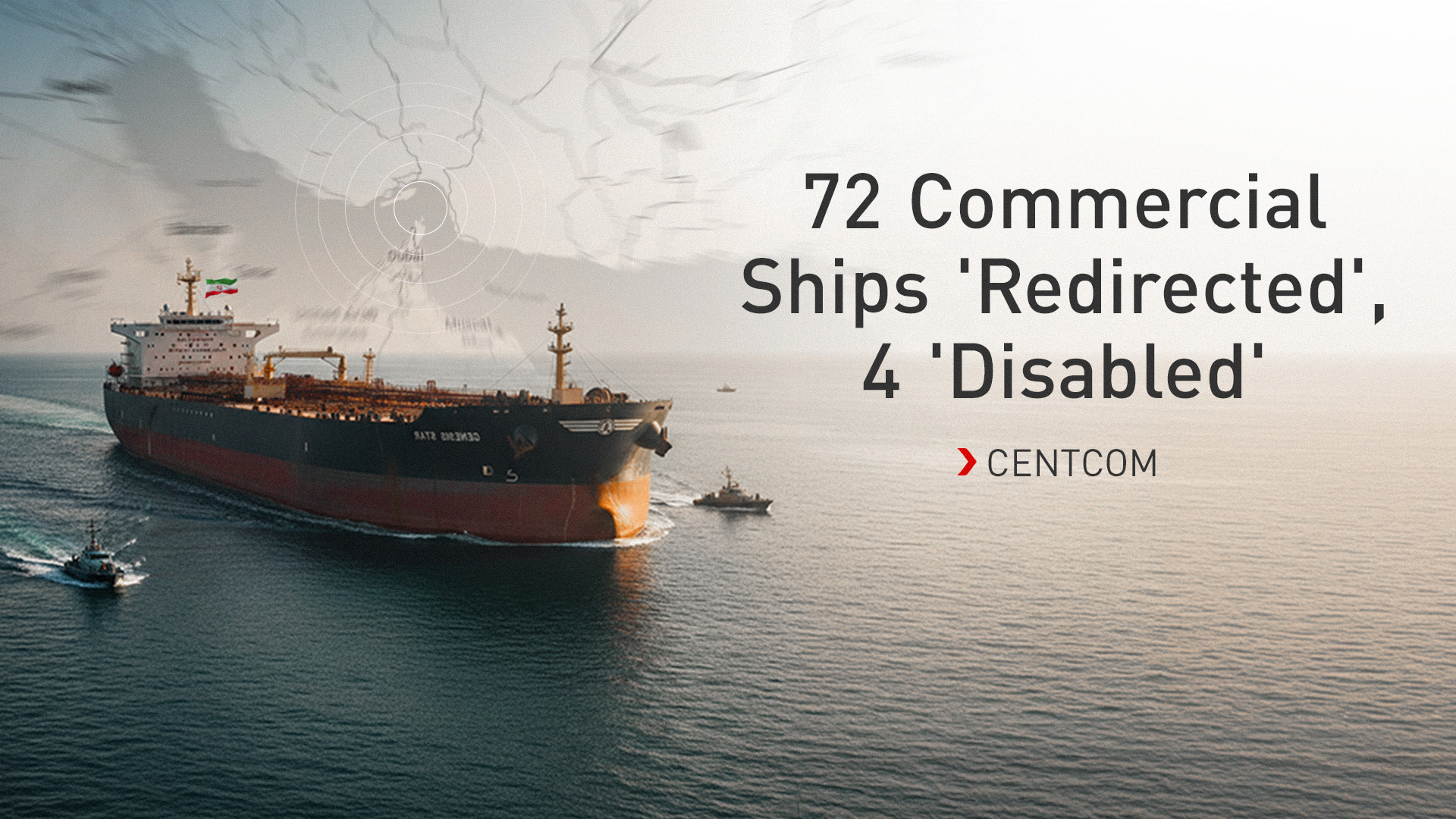
ERBIL (Kurdistan24) - The United States Central Command (CENTCOM) has released an official update on Thursday regarding its ongoing maritime security operations in the Middle East, confirming that its forces have actively redirected dozens of commercial vessels as part of the naval blockade targeting Iranian ports.
The military update underscores the sustained operational posture of U.S. forces in the region and highlights the strategic importance of the Strait of Hormuz, a critical international waterway currently at the center of heightened geopolitical tensions.
According to a public statement issued by U.S. Central Command on the social media platform X, the U.S. military is maintaining a significant naval presence to enforce the blockade.
CENTCOM reported that since the initiation of the maritime operation, its forces have successfully redirected 72 commercial ships away from restricted zones and have disabled four vessels attempting to breach the naval cordon.
The statement also detailed ongoing training exercises, noting that U.S. Marines from the 31st Marine Expeditionary Unit recently conducted rappelling drills from an MH-60S Sea Hawk helicopter aboard the USS Tripoli.
According to CENTCOM, the Tripoli is one of more than 20 American warships actively supporting the blockade operations against Iran.
The military update arrives during a period of acute maritime instability in the Persian Gulf and surrounding waters.
At the heart of this developing security situation, as detailed by The Associated Press (AP), centers on a recent series of severe maritime incidents, including the seizure of a vessel off the coast of the United Arab Emirates and the sinking of an Indian-flagged cargo ship near Oman following an attack.
These confrontations have heightened international concerns regarding the safety of commercial shipping and the stability of global energy transit.
The AP reported that the turmoil in the Strait of Hormuz, which previously facilitated the passage of approximately one-fifth of the world's oil, has severely disrupted the global economy and triggered significant increases in fuel prices, underscoring the broad geopolitical ramifications of the ongoing maritime standoff.
Tensions Persist Near Hormuz
The recent spate of maritime incidents has intensified the focus on security protocols in the region.
According to the Associated Press, the United Kingdom Maritime Trade Operations (UKMTO) center received reports on Thursday indicating that a ship anchored approximately 38 nautical miles northeast of the UAE port of Fujairah was boarded and seized by unauthorized personnel.
The AP noted that Fujairah serves as a vital oil export terminal and has been a recurring target during the broader conflict involving the United States, Israel, and Iran.
While the UKMTO did not immediately identify the seized vessel, British military authorities confirmed that the ship was subsequently directed toward Iranian territorial waters.
The AP report indicated that it remained unclear exactly who executed the seizure, though the incident occurred concurrently with assertive public statements from Iranian officials claiming sovereignty over the strategic waterway.
In a separate but equally alarming development, Indian authorities confirmed the sinking of the Indian-flagged cargo ship Haji Ali off the coast of Oman.
Mukesh Mangal, a senior official in India's shipping ministry, told the AP that the vessel was attacked on Wednesday while transiting from Somalia to the UAE port of Sharjah. The attack resulted in a fire that ultimately sank the ship.
According to the AP, Mangal confirmed that all 14 Indian crew members were safely rescued by the Omani coast guard.
The Indian foreign ministry condemned the attack on civilian mariners as "unacceptable," though officials did not attribute responsibility for the strike.
Strategic Waterway Under Pressure
The security of the Strait of Hormuz remains a central point of contention in diplomatic negotiations aimed at resolving the conflict.
According to the Associated Press, the status of the waterway has been a primary sticking point in ceasefire discussions between Washington and Tehran.
The AP reported that Iranian officials have continued to defend their actions in the region. Asghar Jahangir, the spokesperson for Iran's judiciary, told the state-owned Iran Daily newspaper that Tehran possesses the legal right to seize oil tankers connected to the United States, accusing Washington of committing piracy and violating international maritime laws.
Furthermore, Iranian Senior Vice President Mohammadreza Aref was quoted by state television asserting that the strait belongs to Iran and that the country would not surrender control "at any price."
In response to these developments, the U.S. military has maintained its aggressive enforcement of the blockade.
As noted in the CENTCOM update, the diversion of 72 ships and the disabling of four others reflect a zero-tolerance approach to vessels attempting to bypass the naval cordon.
The AP reported that just last week, U.S. forces fired upon and disabled Iranian oil tankers that were allegedly attempting to breach the blockade.
International and Regional Reactions
The escalating maritime risks have drawn significant attention from global powers.
The Associated Press reported that the ongoing instability in the Gulf coincided with a meeting between U.S. President Donald Trump and Chinese President Xi Jinping in Beijing.
According to the White House, both leaders agreed that the Strait of Hormuz must remain open to international shipping.
Interestingly, Iranian semiofficial news agencies reported that Chinese vessels began transiting the strait on Wednesday night under new Iranian protocols.
According to these reports cited by the AP, Tehran agreed to facilitate the safe passage of specific Chinese ships following direct diplomatic requests from China's foreign minister and its ambassador to Iran.
The regional dynamics are further complicated by political maneuvering among Middle Eastern states.
The AP noted that the vessel seizure off the UAE coast occurred shortly after Israeli Prime Minister Benjamin Netanyahu publicly claimed to have quietly visited the UAE during the conflict, an assertion that Emirati officials swiftly denied.
Yoel Guzansky, a senior researcher at the Institute of National Security Studies in Tel Aviv, suggested to the AP that the UAE is attempting to carefully balance its security cooperation with Israel against domestic and regional opposition to the Israeli government's policies.
Shipping Security Concerns Grow
The impact of the ongoing conflict on the commercial shipping industry has been profound.
Admiral Brad Cooper, a top U.S. military commander in the Middle East, testified before Congress regarding the situation.
According to the Associated Press, Cooper stated his belief that while Iran's military capabilities have been "dramatically degraded" during the conflict, the rhetoric from Tehran's leadership alone is sufficient to impact maritime traffic.
"Their voice is very loud, and the threats are clearly heard by the merchant industry and the insurance industry," Cooper told lawmakers, as reported by the AP.
The admiral emphasized that the U.S. possesses the military capacity to permanently reopen the strait and provide armed escorts for commercial vessels. However, he indicated that military leaders are deferring to civilian policymakers to determine the optimal strategy during what he described as a "time of sensitive negotiations."
The economic fallout from the disrupted transit routes continues to shape the strategic calculations of all involved parties.
The AP report highlighted that Iran has established strict preconditions for further negotiations with the United States, including demands for war reparations and formal recognition of Iranian sovereignty over the Strait of Hormuz.
The White House is considered highly unlikely to accept terms that would legitimize Iranian control over an internationally recognized shipping corridor.