KRG Expands Human Rights Push Through New UPR Partnership Forum
The KRG launched a new international partnership forum aimed at accelerating the implementation of human rights recommendations, as officials revealed that more than 62% of recommendations have already been carried out.
ERBIL (Kurdistan24) - Senior Kurdish officials, diplomats, UN representatives, and civil society organizations gathered in Erbil on Saturday as the Kurdistan Regional Government launched a new forum focused on strengthening cooperation in implementing international human rights recommendations between 2025 and 2029.
The initiative, organized by the Office of the Coordinator for International Recommendations in cooperation with the Lutheran World Federation (LWF), marks a new phase in the Kurdistan Region’s efforts to move from planning to the practical implementation of recommendations issued under the Universal Periodic Review (UPR) mechanism.
Speaking at the forum, Coordinator for International Recommendations Dindar Zebari said the Kurdistan Regional Government places human rights principles at the center of its strategic vision.
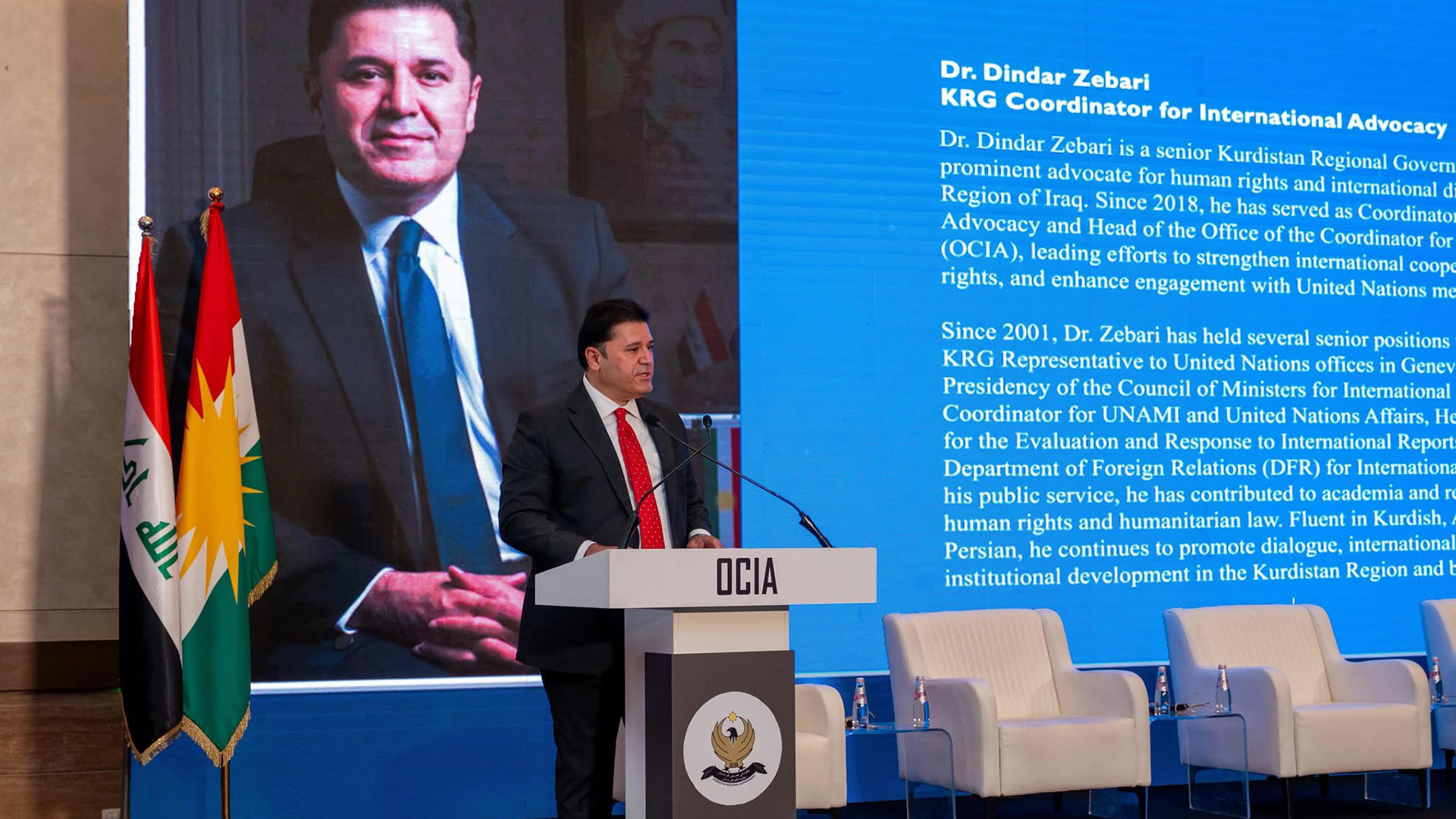
Zebari pointed to directives issued by Kurdistan Region Prime Minister Masrour Barzani, which he said place “citizens at the center of government policies” and require institutions to adapt governance systems in line with international standards.
He added that the Kurdistan Region has made significant progress by reviewing existing legislation and introducing new laws and directives aimed at integrating human rights principles into both the administrative and judicial systems.
According to figures presented during the forum, implementation indicators for international recommendations between 2022 and 2025 showed notable progress.
Officials said 62.3% of recommendations have already been implemented, while 21.6% remain under implementation. Recommendations classified as unimplemented dropped to 16.1%.
Zebari also revealed that the Office of the Coordinator for International Recommendations had issued 10 practical measures that were circulated through the Council of Ministers to accelerate work on the file.
During his remarks, Zebari stressed that protecting human rights and public freedoms cannot succeed without security, economic stability, and effective public services.
“We connect security and economic efforts to the service reality on the ground, because genuine reforms require an economic structure capable of supporting citizens’ aspirations and securing their rights,” he said.
The forum also focused on strengthening coordination between government institutions, diplomatic missions, UN agencies, and civil society organizations in order to improve implementation mechanisms and institutional capacity.
In the closing part of his speech, Zebari called on the international community and UN organizations to expand technical and institutional support for the Kurdistan Region.
He stressed the need for further capacity-building and institutional expertise to help address ongoing challenges and ensure that resources are allocated efficiently to meet citizens’ real needs in line with international obligations.
The Universal Periodic Review mechanism was established by the United Nations in 2006 to assess the human rights records of member states every four years. The Kurdistan Region has participated as part of the Iraqi delegation during review sessions held in 2010, 2014, 2019, and most recently in 2025.
The launch of the new forum comes as the Kurdistan Regional Government continues to expand cooperation with international partners while seeking to institutionalize reforms tied to governance, legal modernization, and public rights protections across the region.