Chinese Supertankers Carrying Iraqi Crude Exit Strait of Hormuz After Months of Delay
South Korean tanker also passes through strategic waterway as concerns persist over shipping security in Gulf region
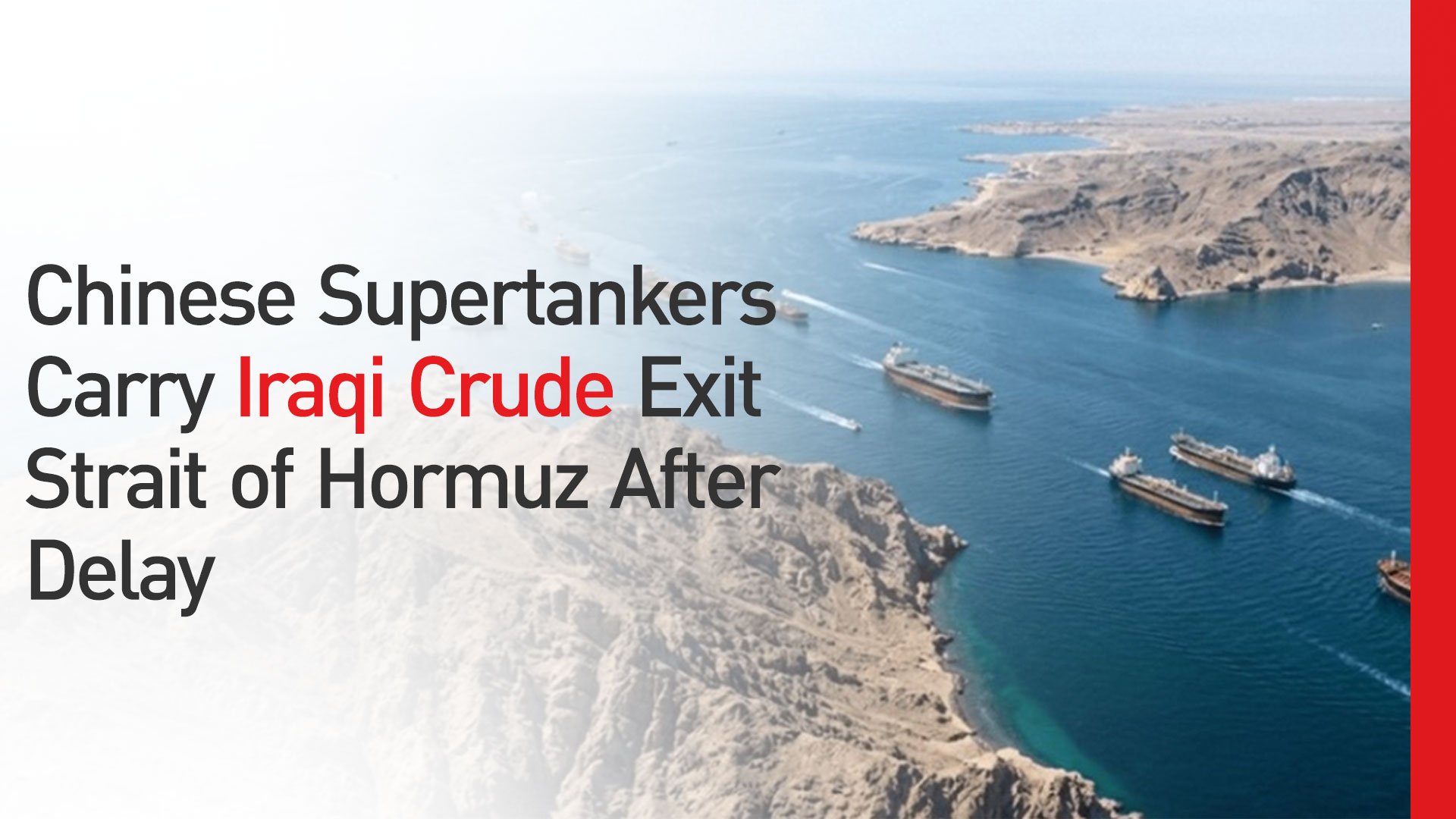
ERBIL (Kurdistan24) — Two Chinese supertankers carrying a combined four million barrels of Iraqi crude oil successfully exited the Strait of Hormuz on Wednesday after being stranded in the Gulf region for more than two months, according to shipping data cited by Reuters.
The development comes as commercial shipping traffic cautiously resumes movement through the strategic waterway amid continuing tensions linked to the confrontation involving the United States, Israel, and Iran.
The vessels are among several Very Large Crude Carriers (VLCCs) transporting Iraqi crude oil that began departing the Gulf this month through shipping routes reportedly directed by Iran.
One of the tankers, the Chinese-flagged Yuan Gui Yang, loaded approximately two million barrels of Basrah crude oil from Iraq on Feb. 27, one day before the outbreak of the US-Israel conflict with Iran, according to shipping data from London Stock Exchange Group (LSEG) and Kpler.
The vessel was chartered by China Petroleum & Chemical Corporation's (Sinopec) trading arm United Petrochemical Company (Unipec). Sinopec is regarded as Asia’s largest oil refiner.
Shipping data indicated that Yuan Gui Yang is expected to arrive at Shuidong Port near Maoming, Guangdong province, on June 4 to unload its cargo.
A second tanker, the Hong Kong-flagged Ocean Lily, loaded one million barrels each of al-Shaheen crude from Qatar and Basrah crude from Iraq between late February and early March.
The vessel is owned by China National Chemical Corporation (Sinochem) and is expected to arrive at Quanzhou Port in Fujian province on June 5.
So far, neither Sinopec, Sinochem, nor COSCO Shipping, the operator of Yuan Gui Yang, has publicly commented on the voyages.
Last week, another tanker, Yuan Hua Hu, was also reported to have passed through the Strait of Hormuz carrying two million barrels of Iraqi crude oil destined for Zhoushan Port in eastern China, signaling a gradual normalization of oil shipments through the area.
The Strait of Hormuz remains one of the world’s most strategically significant maritime chokepoints, with roughly one-fifth of global oil consumption passing through the narrow waterway connecting the Persian Gulf to the Gulf of Oman and the Arabian Sea.
Concerns over maritime security in the region were further highlighted on Wednesday when South Korean Foreign Minister Cho Hyun confirmed that a South Korean oil tanker was also transiting the Strait of Hormuz.
“At this very moment, our oil tanker is passing through the Strait of Hormuz,” Cho told lawmakers at the National Assembly in Seoul.
Ship-tracking platform MarineTraffic showed the South Korea-flagged tanker Universal Win traveling on the eastern side of the strait near the entrance to the Gulf of Oman. The vessel was reportedly heading toward the southeastern South Korean city of Ulsan after departing Kuwait’s Mina Al Ahmadi port.
The passage comes only weeks after a South Korean-operated vessel was struck by airborne objects near the Strait of Hormuz, raising fresh concerns in Seoul over the safety of South Korean commercial shipping operating in the Gulf region.
Regional tensions have repeatedly threatened maritime traffic in and around the Strait of Hormuz over recent years, particularly during periods of confrontation between Iran and Western powers. Shipping companies and energy markets closely monitor developments in the waterway due to its critical importance to global energy supplies and Asian oil imports.