Prime Minister Barzani, al-Siyada Leader Say New Opportunity Exists for Inclusive Iraqi Government
Kurdistan Region Prime Minister Masrour Barzani and Siyada Alliance leader Khamis al-Khanjar stress constitutional settlement, oil export restart, and cabinet completion amid renewed push for Erbil–Baghdad coordination.
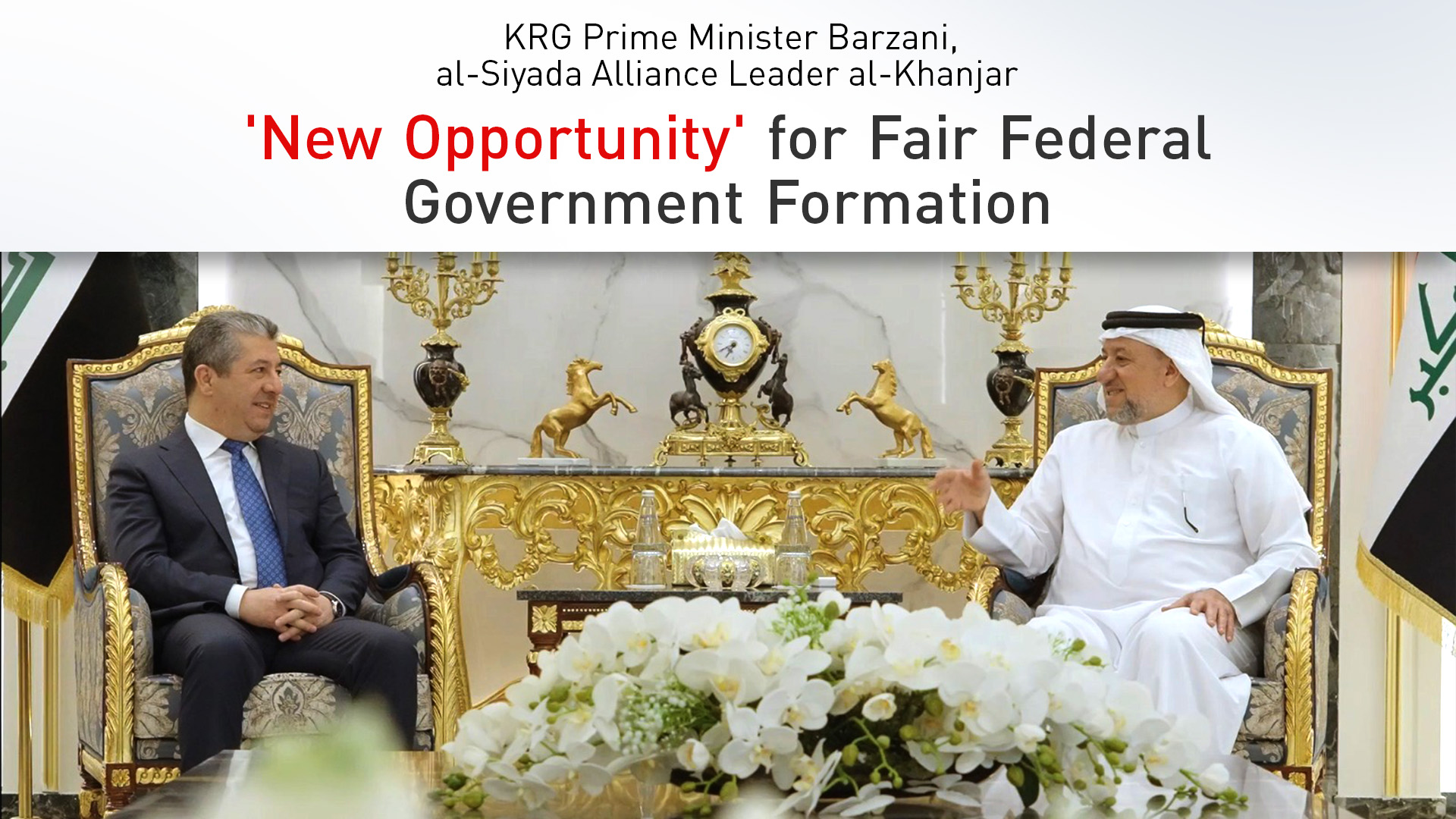
ERBIL (Kurdistan24) - Kurdistan Region Prime Minister Masrour Barzani met with prominent Iraqi political leader Khamis al-Khanjar in Baghdad on Sunday, marking the second day of a high-stakes diplomatic mission aimed at securing a constitutional resolution to the country's most pressing administrative and security challenges.
The meeting between the Prime Minister and the head of the Siyada Alliance focused on establishing a sustainable political framework to support the incoming federal government of Prime Minister Ali Zaidi.
Both leaders reached a consensus on the necessity of a fair and inclusive federal administration capable of serving all Iraqi components equally, while shielding the country from the destabilizing effects of regional conflicts.
The engagement is being viewed as a decisive turning point in the effort to move beyond a period of political stalemate.
Following the discussions, al-Khanjar characterized the current political climate as a "golden opportunity" for Iraq's political forces to settle long-standing disputes fundamentally and prevent the recurrence of future crises.
He emphasized that the timing of the visit is particularly sensitive as the nation prepares for the formal inauguration of a new government, noting that Prime Minister Barzani's presence in the capital has already begun to facilitate solutions for several complex obstacles.
A critical component of the meeting involved the security environment and the impact of the ongoing conflict between Iran and the United States on Iraqi territory.
Al-Khanjar issued a sharp critique of militia attacks targeting both the Kurdistan Region and neighboring Arab states, asserting that these violations threaten Iraq's social fabric and regional stability.
He noted that there is an urgent requirement for all political parties to coordinate their efforts to end these security breaches, which disrupt the country's progress toward normalization.
On the economic front, the discussions yielded significant momentum regarding the resumption of Kurdistan Region oil exports.
Al-Khanjar revealed that a political agreement is in place to resolve the future of outstanding technical and legal issues, with a specific focus on restarting the flow of crude oil through Türkiye's Ceyhan port.
This development is seen as a vital step in stabilizing the national economy and ensuring the equitable distribution of revenues under the constitutional framework.
The leaders also addressed the completion of the federal ministerial cabinet.
Al-Khanjar announced that an agreement has been reached among political parties to appoint ministers to those portfolios currently being managed in an acting capacity. This finalized formation is expected to take place following the Eid al-Adha holiday, with a series of follow-up meetings scheduled to draft the government's final agenda and policy priorities.
The Sunday morning meeting at al-Khanjar's residence, which followed a breakfast hosted for the Kurdish delegation, serves as a follow-up to the Prime Minister's extensive Saturday schedule.
During the first day of his visit, Prime Minister Barzani held high-level consultations with the leadership of Iraq's executive, legislative, and judicial branches.
The primary objective of this outreach was to announce the Kurdistan Region's official support for the success of the new cabinet while advocating for a national consensus based on respect for the Region's federal entity and the enactment of national laws.
The conclusion of these high-level discussions underscores a growing belief among Iraq's political elite that the continuation of direct, constitutional dialogue is the only viable path toward government stability.
As the Prime Minister prepares to conclude his mission, the emphasis on institutional cooperation and the return to constitutional mechanisms is increasingly viewed as essential to preventing renewed political volatility in Iraq.