Washington Signals Resolve Amid Fragile Peace Hopes
Secretary of State Marco Rubio warns of 'alternatives' to diplomacy as President Trump cautions negotiators against rushing toward a finalized agreement with Tehran.
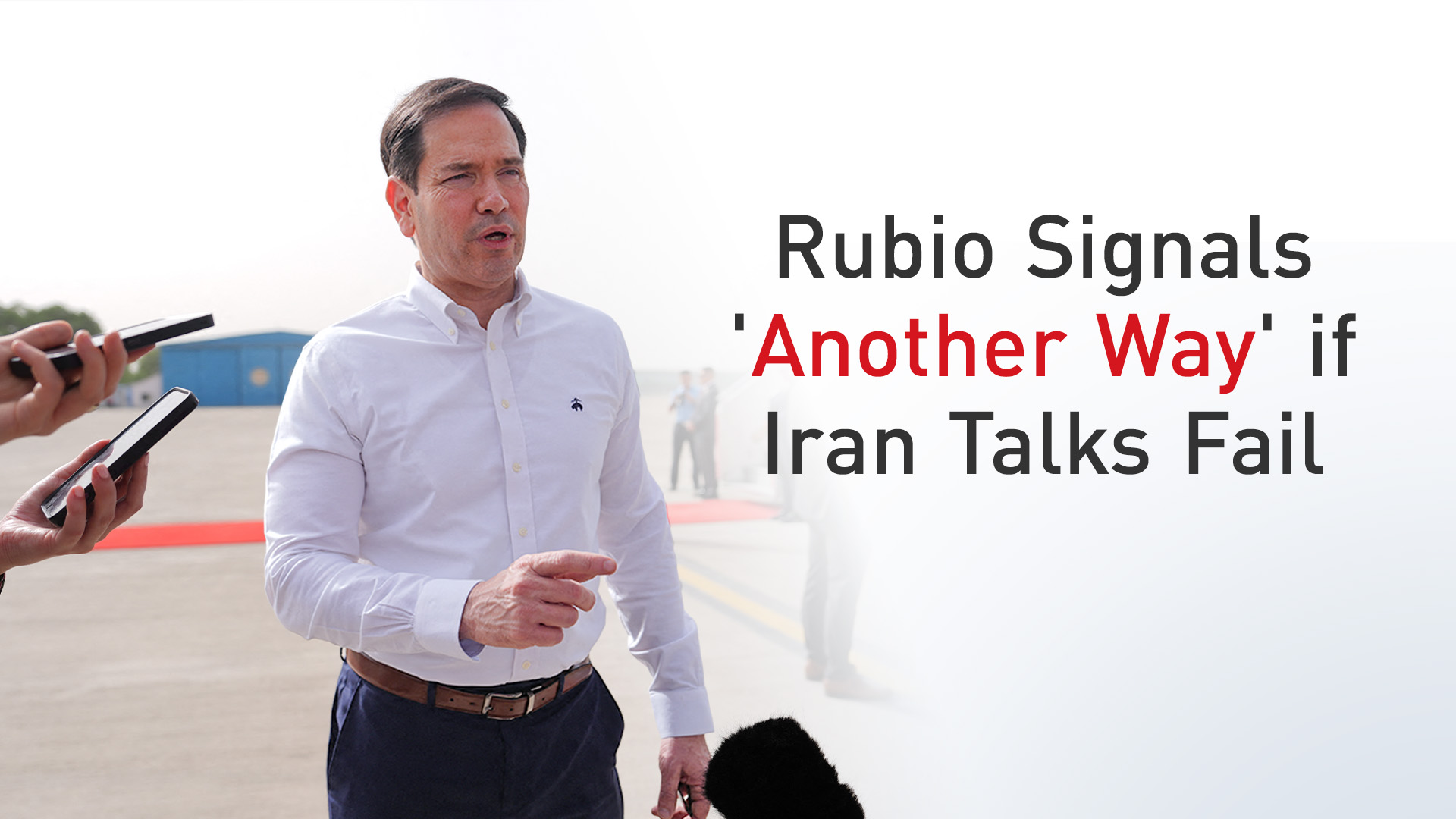
ERBIL (Kurdistan24) - The United States signaled a dual-track strategy of cautious engagement and hard-edged deterrence on Monday, as Secretary of State Marco Rubio warned that Washington would pursue "another way" to resolve the regional crisis should ongoing negotiations with Iran collapse.
Speaking to reporters in New Delhi, Rubio emphasized that while the administration remains committed to a diplomatic settlement, the window for a non-military resolution is not open-ended.
The Secretary's comments coincide with a deliberate effort by U.S. President Donald Trump to temper global expectations of an immediate breakthrough.
In a series of social media posts, Trump instructed U.S. representatives "not to rush" into a deal, asserting that time remains on Washington's side as a comprehensive naval blockade continues to squeeze the Iranian economy.
The apparent shift in tone from the White House follows a weekend of intense diplomatic activity that saw Trump claim a memorandum of understanding had been "largely negotiated."
Despite the progress, the administration is now emphasizing the complexities of "certifying and signing" a deal that would reopen the strategic Strait of Hormuz and address Iran's advancing nuclear program.
Diplomacy Under Pressure
The current diplomatic stalemate remains precarious, underscored by a fragile ceasefire that has held since early April.
According to Reuters reporting, Rubio clarified that Washington intends to exhaust all diplomatic avenues before exploring "alternatives."
The Secretary noted that a "pretty solid thing" currently sits on the negotiating table, focusing on the immediate reopening of the Strait of Hormuz followed by time-limited, substantive talks regarding Tehran's nuclear ambitions.
The rhetoric from Tehran has remained equally defiant. Ebrahim Rezaei, spokesperson for the Iranian parliament's national security committee, responded to U.S. pressure by invoking a policy of "action for action."
Writing on the social media platform X, Rezaei suggested that if Washington seeks an agreement, it must move toward genuine reciprocity, warning that a continuation of "bluffing" would result in $6-per-gallon gasoline for the American public.
This "action for action" doctrine mirrors the "eye for an eye" military strategy Tehran utilized during the height of the kinetic conflict that began on Feb. 28.
Despite the bellicose language, Iranian state-linked media, such as the Tasnim news agency, acknowledged that while clauses remain unresolved, particularly the release of tens of billions of dollars in frozen oil revenues, the trajectory toward a Memorandum of Understanding (MOU) is active.
Hormuz at the Center of Economic Equilibrium
The strategic focal point of the negotiations remains the Strait of Hormuz, a waterway that, in peacetime, facilitates the transit of twenty percent of the world's oil and liquefied natural gas.
As reported by AFP teams across the region, the mere hint of a diplomatic opening caused global oil prices to plunge nearly six percent on Monday.
North Sea Brent crude and West Texas Intermediate both slipped significantly, reflecting the market's desperation for a reprieve from the energy crisis triggered by the U.S.-Israeli bombardment and the subsequent Iranian blockade.
President Trump has maintained that the U.S. naval blockade of Iranian ports "will remain in full force and effect" until an agreement is officially certified.
However, senior administration officials told Reuters that an agreement "in principle" exists for the gradual reopening of the strait.
Under the proposed framework, the waterway would be demined, though U.S. officials noted no active mines have been found, while the U.S. would simultaneously issue sanctions waivers to allow Iran to resume oil sales.
As Samy Magdy and Darlene Superville reported for the Associated Press, the logistical recovery of the shipping lanes could take weeks or months even after a deal is signed.
This delay underscores the urgency felt by the White House, where Trump's domestic approval ratings have been tethered to soaring energy costs and inflationary pressures on food and fertilizer.
Uranium Stockpiles and the Sixty-Day Threshold
While the reopening of shipping lanes is the primary "first stage" described by Secretary Rubio, the nuclear file remains the most formidable obstacle.
U.S. officials told the Associated Press that the emerging deal hinges on Iran relinquishing its stockpile of highly enriched uranium.
Current International Atomic Energy Agency (IAEA) data suggests Tehran possesses 440.9 kilograms of uranium enriched to 60 percent, a technical threshold dangerously close to weapons-grade purity.
According to a senior U.S. official, the draft agreement establishes a 60-day window following the initial signing for the two sides to reach a final consensus on nuclear measures.
"If Iran doesn't give up its stockpile, there will be no sanctions relief," the official warned.
Proposed "feasible formulas" for this disposal include diluting the material under IAEA supervision or transferring the stockpile to a third country, with Russia reportedly offering to act as the recipient.
President Masoud Pezeshkian has utilized state television to assure the international community that Tehran is not seeking a nuclear weapon.
However, Rubio and other U.S. negotiators are seeking concessions far beyond the 2015 Obama-era agreement, including permanent restrictions on Iran's enrichment capabilities, a demand Tehran has historically viewed as a violation of its sovereign rights to nuclear technology.
Strategic Anxiety: Israel and the Lebanese Front
The regional dimension of the crisis is further complicated by the situation in Lebanon, where an April 17 ceasefire remains exceptionally fragile.
Despite the pause in large-scale combat, the Associated Press reports that Israeli forces continue to strike Hezbollah targets in southern Lebanon, while the militant group maintains daily rocket and drone attacks on northern Israel.
Israeli Prime Minister Benjamin Netanyahu, following a call with Trump, reiterated that any final settlement must "eliminate the nuclear threat entirely."
Melanie Lidman and other analysts have noted that Israeli security circles remain deeply skeptical of Lebanon's ability to disarm Hezbollah, fearing that a U.S.-Iran deal might leave Israel's northern border vulnerable to the Iran-backed militia.
U.S. officials have attempted to reassure Jerusalem that the deal would guarantee Israel's right to act in self-defense against imminent threats.
However, Secretary Rubio recently accused Hezbollah of attempting to plunge Lebanon "back into chaos" by calling for the overthrow of the democratically elected government in Beirut, further inflaming tensions on the war's second front.
The Mediation Web: Regional Allies Watch Closely
The acceleration of diplomacy has been facilitated by a complex web of regional mediators.
On Saturday, Trump held a collective call with leaders from Saudi Arabia, the UAE, Qatar, Egypt, Jordan, and Bahrain, as well as representatives from Turkey and Pakistan.
This regional bloc has largely endorsed the current "step-by-step" approach, realizing that a return to full-scale war would be catastrophic for the Gulf's economic infrastructure.
Pakistan has played a particularly pivotal role, hosting face-to-face negotiations in April. Prime Minister Shehbaz Sharif recently confirmed that Army Chief Asim Munir joined the high-level calls following a visit to Tehran, moving "ongoing peace efforts forward."
As Haitham El-Tabei reported for AFP, the involvement of seven or eight regional partners has given the U.S. the diplomatic cover necessary to move forward, even as Israeli officials express concern over being sidelined.
Ultimately, the "good and proper" deal sought by Trump remains elusive.
While the framework of a 60-day negotiation period provides a roadmap, the fundamental mistrust between Washington and Tehran, fueled by months of bloodshed and economic strangulation, ensures that the path to a certified agreement remains fraught with the risk of collapse.
As Rubio noted from New Delhi, the world may soon receive "good news," but for the populations of Iran, Israel, and Lebanon, the reality remains one of "action for action" until the final signatures are secured.