Kurdistan's Infrastructure Overhaul Redraws the Region's Economic Map
KRG reports 810 road and bridge projects (3,055 km) built under the Ninth Cabinet's 'road revolution,' backed by 1.057 trillion IQD using investment, maintenance budgets, and weigh-station revenues, with 227 more strategic projects underway despite fiscal constraints.
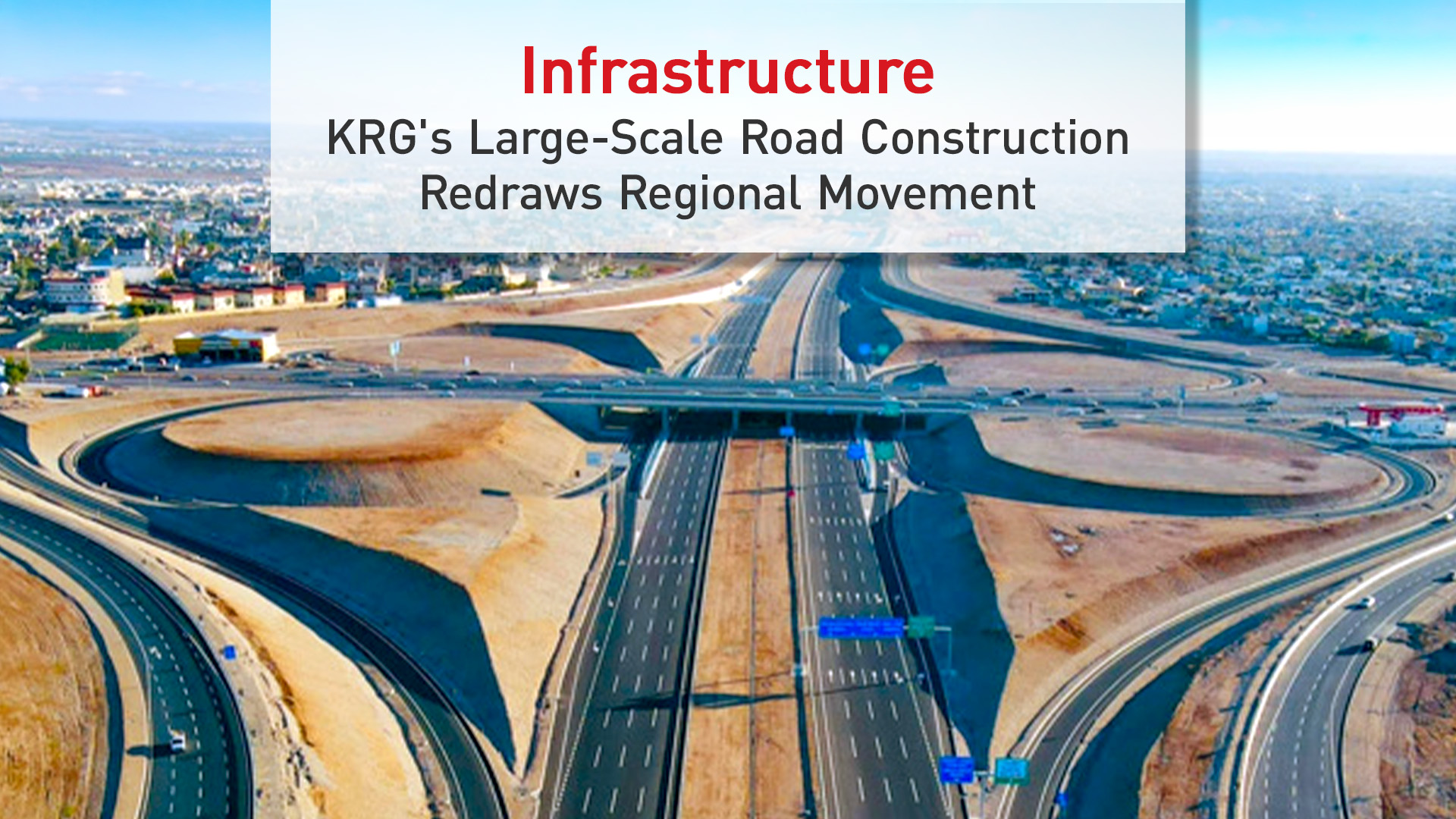
ERBIL (Kurdistan24) - In an in-depth developmental report issued on Sunday, the Kurdistan Regional Government's (KRG) Department of Media and Information unveiled a comprehensive overview documenting a sweeping transformation of the region's transit grid.
Over the course of the Ninth Cabinet's tenure from Jul. 2019 to May 2026, the government has pursued an ambitious infrastructure program that has often been described as a 'road revolution.'
According to official data, this policy has yielded 810 completed road and bridge projects, injecting 1.057 trillion Iraqi Dinars (IQD), approximately $800 million, into the transit economy.
The modernization drive has constructed or rehabilitated 3,055 kilometers of roads, establishing an integrated network designed to bolster commerce, link isolated communities, and elevate public safety across the Kurdistan Region.
The Road Revolution Framework
Rather than relying on volatile single-source funding, the KRG Ministry of Construction and Housing deployed a resilient, three-pronged financing model to insulate transport projects from macroeconomic shocks.
This framework leverages central investment budgets, standard operational allocations within the ministry's regular budget, and an innovative self-sustaining model that reinvests 30% of revenues collected from commercial truck weigh stations.
By directing logistics fees straight back into transport corridors, the government created a sustainable loop where freight shipping directly finances the maintenance of roads it degrades.
The primary tier of this model addresses macro-level connectivity through major inter-city expressways, bridges, and mountain tunnels. Under the investment budget, 104 strategic projects were finalized, dramatically enhancing travel efficiency between major urban centers.
Table 1: Strategic Road Projects Executed Through Investment Budget Across Kurdistan Region (2019-2026)
| No. | Governorate/District | Number of Projects | Total Budget (Billion IQD) | Road Length (km) | Tunnel Length (km) | Bridge Length (linear metres) |
| 1 | Region-wide | 1 | 3.7 | 0.8 | ||
| 2 | Erbil | 27 | 470.7 | 622 | 2.45 | 928 |
| 3 | Sulaimani | 21 | 115.8 | 329 | ||
| 4 | Duhok | 19 | 322.8 | 282 | ||
| 5 | Halabja | 13 | 3 | 122 | ||
| 6 | Soran | 10 | 12.4 | 204 | ||
| 7 | Raparin | 5 | 39.6 | 11 | ||
| 8 | Germian | 8 | 17.7 | 30 | ||
| Total | 104 | 986 | 1,599 | 2.45 | 928 |
Maintenance and Local Connectivity
While major corridors dominate capital expenditure, localized connectivity forms the second layer of the cabinet's master plan.
According to the Ministry of Construction and Housing, substantial resources were directed toward localized road rehabilitation, paving, and routine maintenance via the ministry's regular budget.
A total of 451 separate local projects were completed under this mechanism, ensuring that smaller districts and agrarian communities maintain safe connections to larger municipal markets.
Table 2: Road Renovation and Maintenance Projects Funded Through Ministry Regular Budget
| No. | Governorate/District | No. of Projects | Total Amount (Billion IQD) | Road Length (km) | Bridge Length (linear meters) |
| 1 | Erbil | 70 | 8.7 | 150.8 | |
| 2 | Sulaimani | 173 | 29.2 | 129.85 | |
| 3 | Duhok | 18 | 2.88 | 8.28 | 149 |
| 4 | Halabja | 9 | 0.75 | 0 | |
| 5 | Soran | 43 | 5.3 | 119.35 | 45 |
| 6 | Raparin | 66 | 3.1 | 100 | |
| 7 | Garmian | 68 | 3.3 | 82.0 | |
| 8 | Zaxo | 4 | 0.64 | 3.85 | |
| Total | 451 | 54 | 594 | 194 |
Reinvesting Weigh Station Revenues
The final component of the KRG's model relies on an innovative funding mechanism linked to heavy logistics.
Across the region, 40 designated truck weigh stations collect freight processing fees.
By official directive, 30% of this revenue is isolated and immediately reallocated into local road maintenance.
This framework funded 255 discrete projects, focusing heavily on areas enduring rapid pavement deterioration from heavy commercial cargo transit.
Table 3: Infrastructure Projects Funded Through 30% Allocation of Truck Weigh Station Revenues
| No. | Governorate/District | No. of Projects | Total Amount (Billion IQD) | Road Length (km) | Bridge Length (linear meters) |
| 1 | Erbil | 99 | 5.5 | 514 | 285 |
| 2 | Sulaimani | 57 | 4.3 | 20 | |
| 3 | Duhok | 38 | 4.3 | 265 | |
| 4 | Halabja | 8 | 0.69 | 0 | |
| 5 | Soran | 30 | 1.1 | 62 | 215 |
| 6 | Raparin | 12 | 0.56 | 0 | |
| 7 | Garmian | 6 | 0.30 | 0.3 | |
| 8 | Zaxo | 5 | 0.57 | 3.18 | |
| Total | 255 | 17.5 | 863 | 500 |
By compounding these three distinct funding methods, the Ninth Cabinet established a highly effective development pipeline.
The macro-level achievements demonstrate a balanced geographic expansion across all governorates and administrations.
Table 4: Consolidated Overview of Road Infrastructure Achievements in the Kurdistan Region (2019-2026)
| No. | Category | No. of Projects | Total Cost (Billion IQD) | Road Length (km) | Tunnel Length (km) | Bridge Length (linear meters) |
| 1 | Investment Projects | 104 | 986.13 | 1,598 | 2.45 | 928 |
| 2 | Regular Budget Projects | 451 | 54.14 | 594 | 194 | |
| 3 | Weigh Station Revenue Projects | 255 | 17.51 | 863 | 500 | |
| Grand Total | 810 | IQD 1.057 trillion | 3,055 | 2.45 | 1,622 |
Active Strategic Pipeline and Fiscal Hurdles
Beyond completed infrastructure, the Department of Media and Information detailed an extensive pipeline designed to sustain long-term economic growth.
Work is active on 227 strategic infrastructure projects.
This portfolio represents an additional 2,239 kilometers of future roads, tunnels, and structural interchanges, supported by a projected allocation of 4.179 trillion IQD.
Several mega-scale connectivity corridors form the core of this ongoing development:
- Korre-Shaqlawa-Qandil Highway: Costing 97.375 billion IQD, with roughly 50% of construction finalized.
- Koya-Erbil Highway: A 48-kilometer transit asset budgeted at 683 billion IQD, with crews completing approximately 40% of works.
- Basti Shargha Road and Bridge Project: Located in Koya, valued at 10.897 billion IQD and standing at 10% completion.
- Dukan-Chwarqurna Highway: This 35-kilometer link is budgeted at 260.699 billion IQD, currently registering 16% progress.
- Kalar-Darbandikhan Road Corridor: Spanning 40 kilometers from Warmawa to the Darbandikhan Tunnel entrance, this corridor includes 22 auxiliary projects. Financed at 591.860 billion IQD, it is 30% complete.
The department highlighted that these strategic initiatives encountered delays due to severe fiscal constraints and the federal government's suspension of the Kurdistan Region's share of the national budget.
Despite budget withholding from Baghdad, the KRG sustains construction by periodically drawing from domestic revenues to ensure steady progress.
Enhancing Connectivity and Traffic Safety
The Ninth Cabinet's master plan treats infrastructure as a catalyst for economic stimulation and rural-urban integration.
By establishing standardized transit networks, the government seeks to lower commercial transport overheads, encourage internal investment, and seamlessly link remote rural agricultural zones with urban industrial bases.
Parallel to expanding the pavement grid, the KRG has prioritized safety as a vital pillar of modernization. Since 2022, all engineering initiatives have conformed to modern international transit standards.
Safety upgrades include 2,723 kilometers of road and street marking, 19,342 traffic signs, and 62 kilometers of steel guardrails.
Urban safety features also saw the addition of 59 pedestrian overpasses, 296 pedestrian crossings, 1,500 speed-reduction units, and 2,177 plastic speed humps and rumble strips implemented by localized technical teams.
The comprehensive infrastructure data underscores a profound period of transit modernization under the Ninth Cabinet.
By introducing a multi-tiered, self-reinforcing financing framework, the KRG managed to drive continuous development despite structural financial headwinds.
As the region pivots toward completing its 227 active strategic projects, this unified infrastructure network forms a robust foundation for enduring economic stability and regional integration.