Iraq Faces New Security Test as Key Militia Signals Intent to Disarm and Integrate
One of Iraq's most powerful militias says it is ready to surrender its weapons to the state. But the real story lies in the sharp divide this move has exposed across Iraq's armed factions.
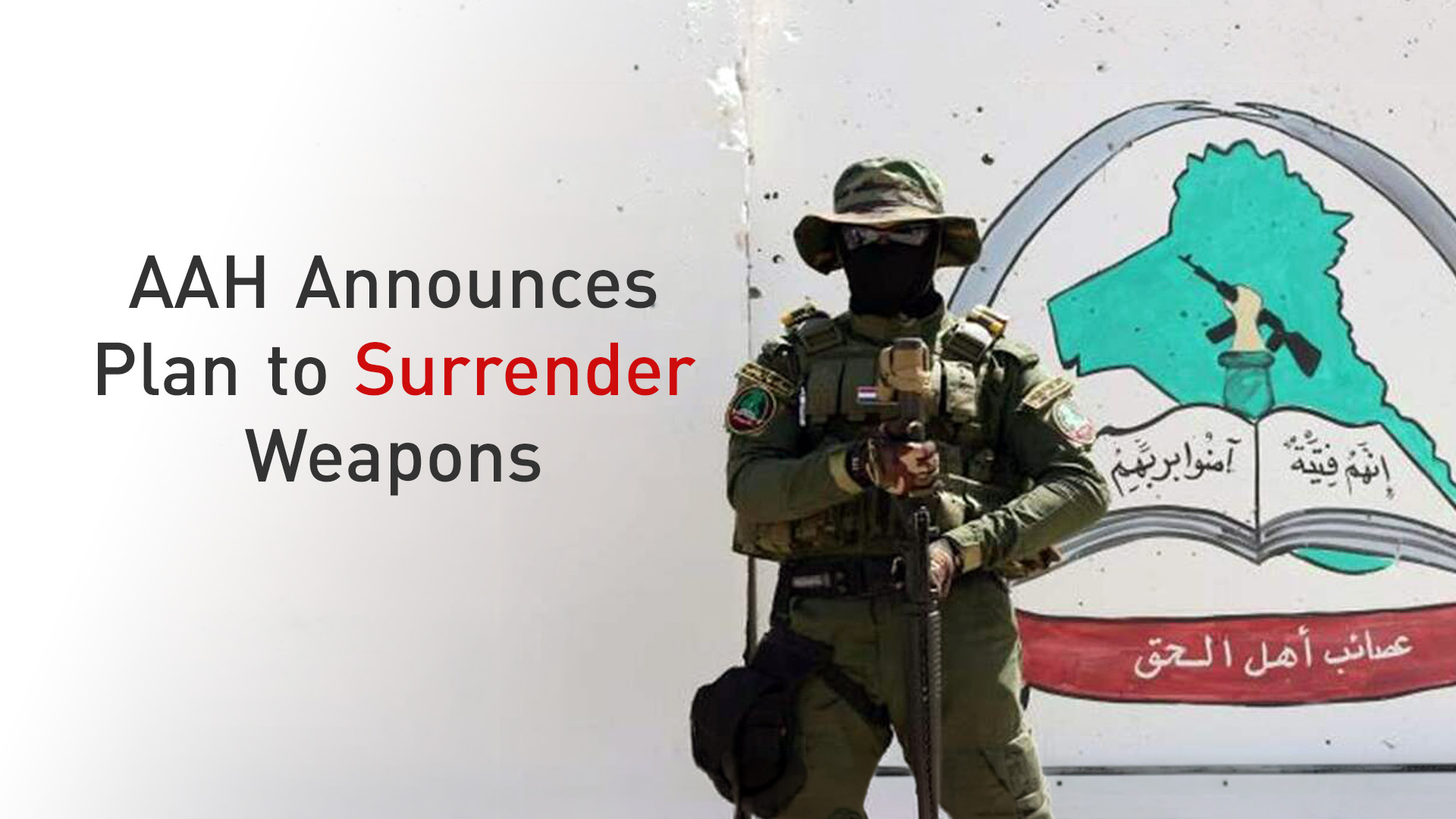
ERBIL (Kurdistan24) - In a development that could fundamentally alter Iraq's fractured security landscape, one of the country's most powerful armed factions has announced its intention to surrender its weaponry to the government and formally subordinate itself to the national military command.
Asa'ib Ahl al-Haq (AAH), the heavily armed group led by Qais al-Khazali, released a formal statement indicating a strategic shift away from independent paramilitary operations.
According to the announcement, the group intends to sever all non-state ties with the Popular Mobilization Forces (PMF), a vast umbrella organization of predominantly Shiite militias, and integrate its personnel directly under the authority of the Iraqi General Command of the Armed Forces.
To execute this transition, AAH has formed a central committee led by senior commander Haji Jawad al-Talibawi.
The committee's mandate includes conducting a full census of personnel, compiling a comprehensive inventory of all weaponry and logistical assets, and formalizing the group's integration in accordance with state security protocols.
AAH justified the move by citing directives from Iraq's supreme Shiite religious authority, the Marja'iya, the collective political stance of the ruling Coordination Framework, and previous public pledges by Khazali to ensure that "arms remain exclusively under the authority of the state."
A Coordinated Push for State Authority
The AAH announcement does not occur in a vacuum; it follows a sudden and intense political convergence in Baghdad aimed at reeling in independent armed actors.
Just days prior, Muqtada al-Sadr, the influential Shiite cleric and leader of the National Shiite Movement, ordered the complete dissolution of his own armed wing, Saraya al-Salam.
Read More: Muqtada al-Sadr Orders Saraya al-Salam's Integration Into Iraqi State
Sadr directed his fighters to integrate into formal military structures and urged all factions within the PMF to detach from partisan influence and surrender their weapons. He warned that the country faced "looming dangers" that necessitated a unified national defense.
The Iraqi government swiftly embraced Sadr's move. Prime Minister Ali Faleh al-Zaidi issued a statement praising the cleric's "responsible national stance" and explicitly called upon all armed factions to follow suit.
Read More: Iraqi PM Welcomes Sadr Move to Integrate Saraya al-Salam Into State Forces
Baghdad emphasized that the state must remain "the sole entity authorized to have a monopoly on weapons and the enforcement of the law."
This government strategy is heavily backed by the Coordination Framework, the powerful coalition of Shiite political parties that currently dominates the Iraqi parliament.
In a recent meeting attended by Prime Minister Zaidi at the office of former Prime Minister Haider al-Abadi, the Framework delivered a stark warning to independent militias.
The alliance declared that the authority to declare "war and peace" rests exclusively with the elected government and parliament, labeling any unilateral military action as a "deviation from the law and the Constitution." The Framework also formalized a decision requiring the PMF to sever all ties with political entities to maintain institutional neutrality.
The Fractured Militia Landscape
Despite this formidable political momentum, the path to disarming Iraq's militias remains treacherous. The announcements by Sadr and Khazali have exposed a deep and volatile rift among the country’s armed factions.
In sharp contrast to AAH's integration plan, the shadowy militant group Ashab al-Kahf issued a defiant statement rejecting any calls for disarmament.
Read More: Iraqi Resistance Group Rejects Calls for Disarmament, Threatens Action Against Israel
The group, which emerged in 2019 and is widely viewed by Western intelligence as an Iranian-backed proxy, dismissed claims that the Marja'iya supports surrendering weapons as "void and deceptive rhetoric."
Instead, Ashab al-Kahf doubled down on its independent militant posture. Referencing the rhetoric of the late Hezbollah leader Hassan Nasrallah, the group threatened to launch unilateral strikes against the Israeli city of Eilat and its port if Beirut or Southern Lebanon faced further Israeli aggression.
"The Eilat region and its port will become an operational zone for Ashab al-Kahf if our people in Beirut and the South are targeted," the statement declared, vowing to coordinate escalation with the broader "Axis of Resistance."
Institutional Reform or Political Maneuvering?
This defiance highlights the central challenge facing Prime Minister Zaidi's government.
While the integration of AAH and Saraya al-Salam represents a massive potential victory for state-building, the refusal of groups like Ashab al-Kahf to comply demonstrates that Baghdad still cannot fully control the factions operating within its borders.
The pressure to resolve this issue is mounting from multiple directions.
Domestically, there is widespread exhaustion with the presence of heavily armed political factions that operate above the law. Internationally, Washington and its allies are placing immense pressure on Baghdad to curb the influence of Iran-aligned militias, particularly those that have repeatedly targeted American interests and engaged in transnational strikes.
The creation of the AAH transition committee under Haji Jawad al-Talibawi will serve as a crucial test of this new security paradigm.
If the group genuinely hands over its heavy weaponry and subordinates its command structure to the Iraqi military, it could provide a blueprint for dismantling the PMF's partisan affiliations.
However, skeptics argue that integration often means militias simply don formal uniforms while retaining their internal loyalties and operational independence.
For Iraq, the stakes are existential.
As the government attempts to navigate a fragile security environment and finalize the withdrawal of the International Coalition, the ability to enforce a true monopoly on violence will determine whether the country can achieve long-term sovereignty or remain a battleground for competing armed factions.
|
Summary While Asa'ib Ahl al-Haq's announcement marks a potential breakthrough for state authority, fierce resistance from other armed factions reveals deep divisions over Iraq's military future. Asa'ib Ahl al-Haq announced its intention to disarm and integrate into official Iraqi state forces, joining a broader political push to end militia independence. However, the move has triggered a stark split among armed groups, with factions like Ashab al-Kahf outright rejecting state control. |
This article was updated on Tuesday, June 2, 2026, at 01:01pm.