Post-Eid Slump Hits Kurdistan's Gold Markets as Global Uncertainty Reshapes Local Demand
Why are gold shops selling less gold while demand for certain products remains strong? The answer lies in a surprising shift in consumer behavior driven by global uncertainty and changing purchasing power.
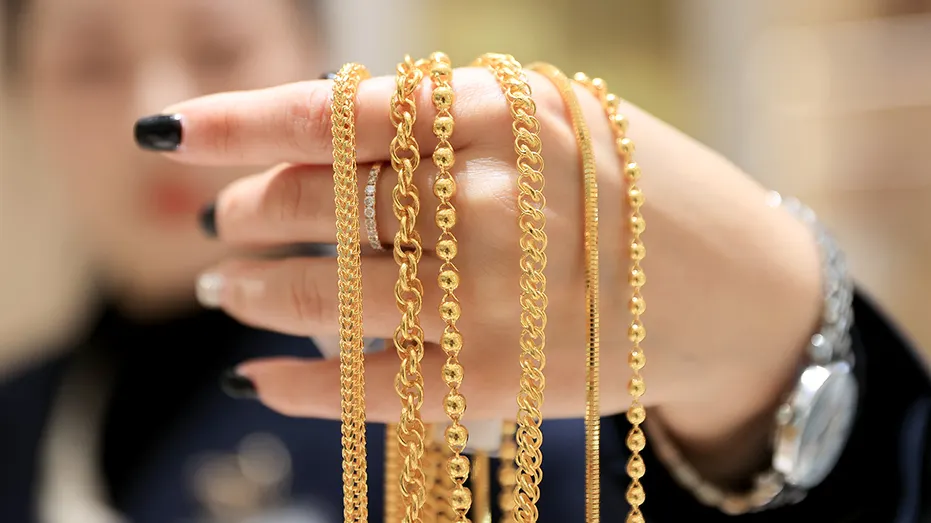
ERBIL (Kurdistan24) - The bustling gold bazaars of the Kurdistan Region have quieted noticeably in the weeks following the Eid al-Adha holiday. As overall trading volumes slip into stagnation, local jewelers are adapting to a new economic reality defined by changing consumer purchasing power and increasingly volatile international markets.
While total sales have declined, the composition of consumer demand is shifting remarkably.
Hendren Warti, spokesperson for the Kurdistan Jewelers Union, told Kurdistan24's Esra Anwer that buyers are increasingly shunning heavier, traditional ornaments in favor of lightweight pieces and gold Lira coins.
"Designs that were previously crafted using 15 to 20 mithqals are now being produced at four to five mithqals using the same aesthetic patterns to align with the current purchasing power of citizens," Warti told Kurdistan24.
Despite the broader market deceleration, Warti maintained that Erbil's gold production remains the highest quality in Iraq.
He urged consumers to view the metal as an essential financial safeguard, noting that investing in even half a Lira coin offers far greater long-term security than discretionary spending on luxury consumables.
The Global Drivers of Local Markets
The shifting patterns inside Kurdistan's bazaars cannot be fully understood without examining the broader macroeconomic forces inflating global gold prices.
Najat Jamal Mohammed, a currency and banking expert at Salahaddin University, outlined a confluence of international factors currently dictating the market.
At the institutional level, a massive surge in central bank purchasing has severely restricted global supply.
Emerging economies, particularly China, Poland, and several Middle Eastern nations, have aggressively accumulated gold. Mohammed explained that this trend accelerated after the United States froze the dollar reserves of heavily sanctioned countries like Russia and Iran.
Seeking to insulate their economies from Western financial leverage, central banks are increasingly diversifying into gold, a non-fiat "hard asset" that cannot be printed, sanctioned, or controlled by a single sovereign authority.
This institutional hoarding is compounded by profound geopolitical instability.
Escalating tensions across the Middle East, specifically the conflict between Israel and Hezbollah, alongside the broader military standoff between the United States and Iran, have driven international investors toward safe-haven assets.
When political outcomes are unpredictable, capital historically flees toward the intrinsic security of gold to hedge against sudden currency devaluations.
Furthermore, traditional financial systems are showing signs of strain. Mohammed highlighted that record-breaking global debt levels are slowly eroding trust in fiat currencies, re-establishing gold as the ultimate, reliable store of value.
Finally, the monetary policy of the United States remains a critical lever. Gold prices maintain an inverse relationship with U.S. interest rates. As the Federal Reserve signals potential rate cuts to stimulate economic growth, the yields on U.S. Treasury bonds decrease.
This lower yield drops the "opportunity cost" of holding non-interest-bearing assets like gold, making the metal highly attractive to institutional investors seeking long-term profitability.
Iraq's Strategic Accumulation
The institutional drive toward gold is clearly visible within Iraq itself. The Central Bank of Iraq (CBI) has aggressively expanded its sovereign holdings, elevating the country to approximately the 30th largest holder of gold reserves globally.
Over the past decade, Iraq's reserves have surged from roughly 30 tons to over 150 tons.
This strategic accumulation is intended to insulate the Iraqi economy from fluctuations in the U.S. dollar and provide a robust, tangible backstop for the Iraqi Dinar.
By securing a larger share of the global gold supply, Baghdad is participating in the very same macroeconomic diversification strategy currently restricting supply and driving up prices worldwide.
For the merchants in Erbil's gold markets, the coming months remain clouded in uncertainty.
As local purchasing power slowly adjusts to new price floors, jewelers must continue refining their products to meet the evolving demands of an economically cautious public.
Whether the current stagnation represents a brief post-holiday pause or a longer structural adjustment, it is clear that the value of Kurdistan's most trusted savings asset is now inextricably tied to the volatility of the global economy.
|
Summary Consumers are shifting toward lightweight jewelry and gold coins as a safeguard against inflation, reflecting a broader global trend of central banks and investors hoarding the precious metal. Following Eid al-Adha, the Kurdistan Region's gold market has stagnated, forcing jewelers to adapt by producing lighter, more affordable pieces. Experts say local demand for gold coins remains strong as consumers seek safe-haven investments amid rising global economic and geopolitical uncertainty. |
Kurdistan24's news writer Esra Anwer contributed to this report.