Trump Confirms Tense Clash With Netanyahu as Lebanon Conflict Threatens Regional Diplomacy
A rare public clash between U.S. President Donald Trump and Israeli Prime Minister Benjamin Netanyahu highlights growing tensions over Israel's Lebanon campaign, as Washington fears wider regional escalation and mounting risks to its diplomatic efforts with Iran.
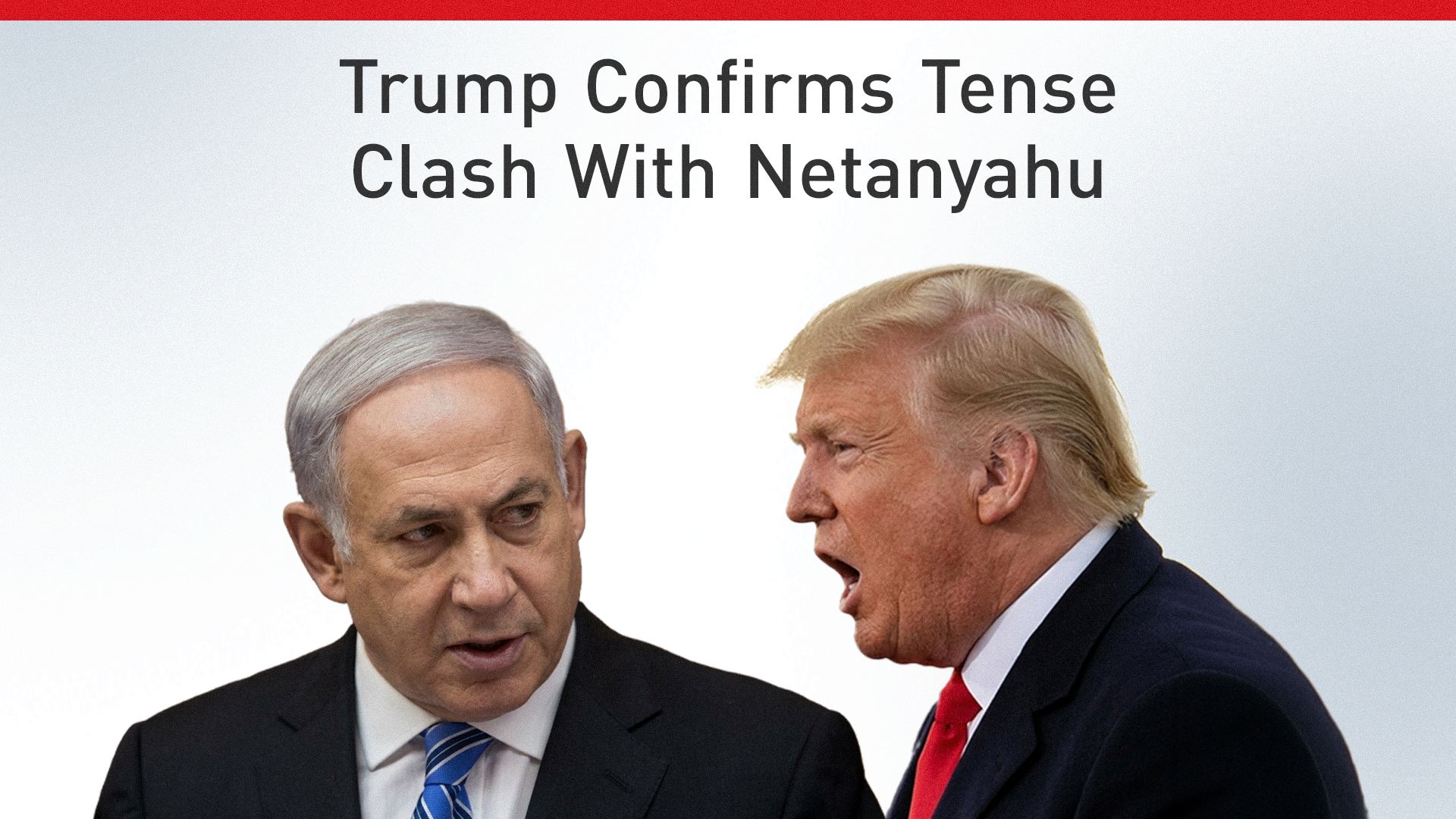
ERBIL (Kurdistan24) - The deepening crisis in Lebanon has abruptly exposed a sharp diplomatic rift between Washington and Jerusalem, as U.S. President Donald Trump confirmed a tense confrontation with Israeli Prime Minister Benjamin Netanyahu over Israel's expanding military operations against Hezbollah.
The public acknowledgment of friction between the close allies highlights the immense strain currently testing U.S. diplomacy.
As the conflict in Lebanon intensifies, Washington is increasingly concerned that Israel's military escalation could not only ignite a wider regional war but also derail complex, parallel negotiations between the United States and Iran.
During an interview with New York Post columnist Miranda Devine, relayed by Fox News, President Trump confirmed that he had a highly confrontational phone call with the Israeli leader.
Addressing reports of the heated exchange, Trump acknowledged that he took significant issue with Israel's military posture.
"I was a little bit perturbed at his constantly fighting with Lebanon," Trump stated in the interview. "At some point I said 'Bibi, we gotta stop this. We gotta stop it.'"
The Depth of the Dispute
The blunt confirmation from the U.S. President validates earlier, detailed reporting by Axios journalists Barak Ravid and Marc Caputo, who revealed that the call was fraught with anger and profanity.
According to their reporting, which cited U.S. officials and a source briefed on the exchange, Trump sharply criticized Netanyahu over what he perceived as a disproportionate escalation that threatened to further isolate Israel internationally.
The Axios report paints a picture of a profound strategic clash.
According to sources cited by the publication, Trump was reportedly furious that Israeli military actions, specifically threats to bomb Beirut, were undermining sensitive U.S.-Iran negotiations.
During the expletive-laden call, Trump allegedly told Netanyahu that he was saving the Israeli leader's political survival, shouting, "You're f****** crazy. You'd be in prison if it weren't for me. I'm saving your a***. Everybody hates you now. Everybody hates Israel because of this," in an apparent reference to his support during Netanyahu's ongoing corruption trial.
Furthermore, U.S. officials told Axios that Trump objected to the high civilian casualty toll resulting from Israeli strikes, particularly the tactic of leveling entire buildings to eliminate a single Hezbollah commander.
According to one official cited in the report, the conversation ranked among the worst exchanges between the two leaders since Trump returned to office. Following the call, Israel reportedly shelved its immediate plans to strike targets within the Lebanese capital.
Lebanon: The Immediate Flashpoint
The friction between Washington and Jerusalem is driven by the rapidly deteriorating situation on the ground in Lebanon, which has become the epicenter of regional volatility.
Despite U.S. efforts to broker a ceasefire, fighting has surged, with Israel expanding its ground operations and seizing deeply symbolic territory.
Earlier this week, Israeli forces captured the medieval Beaufort Castle in southern Lebanon, a strategic fortress that Israel previously occupied until 2000.
According to a Kurdistan24 report, the seizure provoked immediate international alarm and a condemnation from Lebanese President Joseph Aoun, who denounced the move as a "vicious and reprehensible Israeli aggression."
Read More: Lebanon Condemns Israeli “Aggression” After Beaufort Castle Seizure Sparks UN Meeting
The escalation prompted France to request an emergency meeting of the United Nations Security Council, with President Emmanuel Macron warning that the escalating violence was unjustifiable.
Prime Minister Netanyahu, however, publicly embraced the advance, declaring the capture a "dramatic shift" and vowing to deepen operations in areas previously controlled by Hezbollah.
This aggressive posture has met fierce resistance from Hezbollah, creating a deadly impasse.
In an exclusive interview with Kurdistan24, Mahmoud Qammati, deputy head of Hezbollah's Senior Political Council, categorically rejected piecemeal diplomatic proposals that would spare Beirut while allowing Israel to continue operating in the south.
Read More: Hezbollah To Kurdistan24: We Will Not Stop Bombing Israel Until a Real Ceasefire Is Reached
Qammati insisted that Hezbollah will not halt its bombardment of Israel until a comprehensive and genuine ceasefire is reached.
"As long as the enemy continues its attacks, we will continue our bombardment," he warned, explicitly stating that any Israeli strike on Hezbollah's stronghold in the Dahiyeh suburb of Beirut would trigger retaliatory strikes on deeper residential centers in northern Israel.
Iran's Shadow and the Broader Geopolitical Stakes
The crisis in Lebanon is inextricably linked to the broader, high-stakes standoff involving Iran. For Washington, the primary strategic objective is preventing the Lebanon conflict from triggering a multi-front regional war or sabotaging fragile ceasefire talks with Tehran.
As the Axios reporting indicates, Trump's anger was heavily fueled by the realization that Netanyahu's escalation in Lebanon was threatening to implode U.S. negotiations with Iran. This concern is well-founded.
According to a Kurdistan24 report tracking regional threats, Iran's Islamic Revolutionary Guard Corps (IRGC) has explicitly warned that any crossing of its "red lines" in Lebanon and Gaza would be viewed as tantamount to a direct war.
Read More: Iran Threatens ‘New Fronts,’ Warns Against Escalation in Lebanon
The IRGC's intelligence organization stated that Tehran is prepared to open "new fronts" if the escalation continues.
Crucially, these threats involve the weaponization of global maritime chokepoints. Iranian military advisers and state media have indicated that regional allies could disrupt traffic through the Bab al-Mandab Strait in the Red Sea and maintain pressure on the Strait of Hormuz, a strategic waterway that once accommodated a fifth of all globally traded oil and natural gas.
This maritime vulnerability has profound implications for global energy markets and international trade.
With shipping already severely restricted due to the threat of attack, any further disruption could spark energy shortages and destabilize the global economy, significantly raising the stakes for the Trump administration's diplomatic efforts.
Strategic Implications and the Path Forward
The public confirmation of the dispute between President Trump and Prime Minister Netanyahu reveals the intense, often conflicting pressures shaping U.S. foreign policy in the Middle East.
While the United States continues to support Israel's right to defend itself against Hezbollah's rocket fire, the Trump administration appears increasingly unwilling to tolerate military tactics that jeopardize its broader regional strategy.
The standoff over Lebanon illustrates a fundamental challenge for Washington: how to preserve leverage over a close ally while simultaneously managing a complex deterrence and negotiation strategy with Iran.
For Netanyahu, the military campaign in Lebanon is framed as an existential necessity to secure Israel's northern border.
For Trump, the conflict is increasingly viewed as a dangerous variable that threatens to drag the United States back into a broader Middle Eastern war, complicating his diplomatic ambitions.
As military developments on the ground in southern Lebanon continue to dictate the pace of diplomacy in Washington and Tehran, the fragility of the current geopolitical environment is stark.
The blunt phone call between the U.S. and Israeli leaders underscores a sobering reality: preventing a wider regional conflagration may ultimately depend as much on political restraint among allies as it does on military deterrence against adversaries.
|
Summary A heated phone call between the U.S. President and the Israeli Prime Minister underscores Washington's growing frustration as escalating violence in Lebanon risks unraveling broader diplomatic initiatives across the Middle East. |