Woman Accused of Enslaving Ezidi Girl Has Not Renounced ISIS, Australian Prosecutors Say
A Melbourne bail hearing for a Syria returnee highlights the profound legal and geopolitical challenges of prosecuting crimes against humanity a decade after the fall of the caliphate.
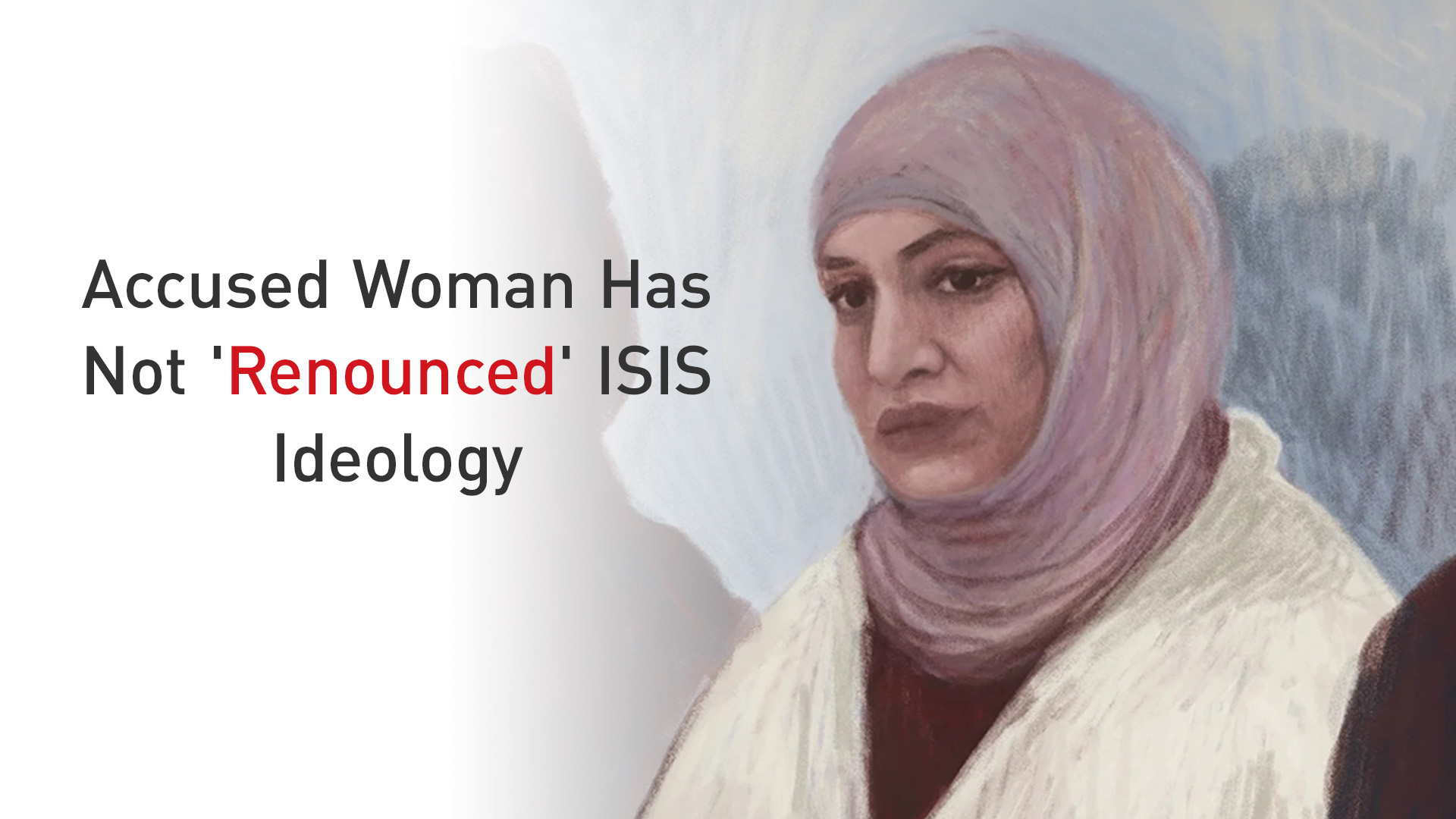
ERBIL (Kurdistan24) - An Australian woman charged with enslavement crimes linked to the Islamic State in Syria has not renounced her allegiance to the extremist group, federal prosecutors argued in a Melbourne courtroom on Friday, aggressively pushing back against her application to be released on bail.
The proceedings involving 31-year-old Zeinab Ahmad are offering a rare, detailed look into the legal and security challenges Western governments face when prosecuting citizens who traveled to the heart of the Islamic State's self-declared caliphate.
Ahmad, who returned to Australia last month from a Syrian detention camp, is facing charges of crimes against humanity, specifically, enslavement and the use of a slave.
The charges stem from allegations that her family held a Kurdish Ezidi (also refered to as Yazidi) teenager captive in Raqqa, Syria, during the height of the Islamic State's brutal reign.
During a fraught bail hearing in the Melbourne Magistrates' Court, prosecutors painted a picture of a defendant deeply entrenched in the ideology of the Islamic State.
Detective Senior Constable Marc Clendenning, a lead investigator on the case, testified that Ahmad remains an unacceptable risk to the community, emphasizing that she had not renounced her support for the terror network, according to reporting by James Oaten of ABC News.
“No conditions of that nature would ameliorate the risk because there's a lot of unknowns with the accused's ideology,” Clendenning told the court, referring to proposed bail restrictions.
The Allegations from Raqqa
The case against Ahmad and her 53-year-old mother, Kawsar Ahmad, hinges on the testimony of a Ezidi survivor.
The Kurdish Ezidi community was systematically targeted by the Islamic State. Thousands of Ezidi men were massacred, while an estimated 6,800 women and children were captured and sold into sexual slavery and forced domestic labor.
According to the prosecution's narrative, detailed in court and reported by Rod McGuirk of The Associated Press, the Ahmad family purchased a Ezidi teenager for $14,000 in 2017. The girl was allegedly forced into sexual servitude and domestic labor at the family's home in Raqqa.
The court heard that Zeinab Ahmad's father, Mohammad Ahmad, who is currently incarcerated in Iraq, was the primary purchaser and abuser, allegedly subjecting the teenager to multiple physical and sexual assaults.
However, investigators allege that Zeinab Ahmad, who was in her early twenties at the time, treated the captive "badly" and was complicit in the conditions of her enslavement before the girl was sold to another buyer more than a year later.
A Family's Journey to the Caliphate
The prosecution also detailed the Ahmad family's path from suburban Melbourne to the Syrian war zone.
According to a federal police statement read in court, three generations of the family traveled to Syria via Turkey between 2013 and 2014.
Investigators suspect the family utilized a fraudulent charity page on social media called Global Humanitarian Aid to fund their journey. Once inside Islamic State territory, Zeinab Ahmad allegedly integrated into the caliphate's structure.
The court heard that she carried an Islamic State identification card, received an income from the group, and published social media posts supporting the organization, according to ABC News.
In 2015, Ahmad allegedly posted that she was following her husband's decision to "Hijrah to the land of Khilafah", a term used by extremists to describe migrating to the Islamic State.
Following the reported death of her first husband in 2016, she married two other Australian men in Syria.
Prosecutors noted that she remains married to an Islamic State member, a fact they argued demonstrates her ongoing "proximity to, and association with Islamic State linked networks."
The Legal Battle for Bail
Defense attorney Grace Morgan mounted a vigorous effort to secure Ahmad's release pending trial, offering a suite of stringent monitoring conditions.
Morgan argued that her client would consent to a control order, which would mandate an electronic ankle monitor and surveillance of her communications.
Furthermore, Morgan proposed that Ahmad would participate in a countering violent extremism (CVE) program administered by Victoria Police and the Board of Imams Victoria.
To support the application, Ahmad's uncle, Abraham Abbas, testified that he would house her and provide a $75,000 surety. Distancing his family from the charges, Abbas vehemently condemned the Islamic State in court.
“They're evil and they don't represent anything we've got to do with Islam at all,” Abbas testified, apologizing for using profanity to describe the group.
However, law enforcement officials dismantled the proposed bail conditions.
Both Detective Senior Constable Clendenning and Victoria Police Detective Sergeant Matthew Archer testified that control orders, typically used for convicted terrorists finishing prison sentences, cannot legally be applied as a condition of bail for someone awaiting trial, according to the AP.
Furthermore, Clendenning argued that the CVE deradicalization program is designed for individuals on a "path of radicalization," not someone with Ahmad's decade-long exposure to the core of the Islamic State.
Broader Implications
The prosecution of Zeinab Ahmad represents a critical test case for the Australian judicial system. Because these specific slavery charges have never been tried in the state of Victoria, the defense argued the proceedings will be highly complex and protracted.
Gathering evidence from a fractured conflict zone presents immense logistical hurdles.
Australian officials located the Ezidi survivor in the Kurdistan Region in 2019, but due to operational constraints, they were unable to electronically record her interview.
Instead, prosecutors are relying on a typed statement, raising questions from the defense about the ability to secure all relevant documents through the Kurdistan Regional Government.
The court's decision on bail, and the eventual trial, will be closely watched by international legal experts and human rights advocates.
The outcome will not only set a precedent for how Western democracies handle citizens who aided the Islamic State, but it will also determine whether the traumatized Ezidi community can find a measure of justice within the courtrooms of the countries that exported their abusers.
The Institutional Quest for Justice
The judicial proceedings in Australia mirror the broader political demands for accountability championed by the leadership of the Kurdistan Region.
In official declarations regarding the legacy of the genocide, Kurdistan Region President Nechirvan Barzani described the actions of the Islamic State as one of the most brutal crimes in modern history, noting that over 5,000 Ezidis were executed and buried in mass graves.
The KRG leadership maintains that mitigating the economic, social, and psychological trauma of the survivors is a shared global responsibility that requires the international community to punish perpetrators and compensate victims.
Similarly, Kurdistan Region Prime Minister Masrour Barzani has repeatedly characterized the Sinjar tragedy as an unhealed wound in human history, highlighting the KRG's ongoing financial commitments, which include monthly stipends to more than 3,150 rescued women.
The KRG leadership, alongside President Masoud Barzani, continues to advocate for the formal international recognition of the Ezidi genocide and the rigorous implementation of the UN-backed Sinjar Agreement.
They argue that stabilizing the region, removing non-state militias, and establishing specialized legal frameworks to prosecute former Islamic State members are vital prerequisites to ensuring the safe, dignified return of hundreds of thousands of displaced persons still languishing in camps across Duhok.
The Melbourne bail hearing is scheduled to resume on June 15 to hear additional police testimony.
While the legal arguments continue to unfold in Australia, the allegations against Zeinab Ahmad remain unproven before the court, and she retains the presumption of innocence.
Nevertheless, the case stands as a landmark test of whether domestic legal frameworks can successfully deliver justice for atrocities committed thousands of miles away, providing a shred of accountability for a community that is still searching for its missing children.
|
Summary Australian prosecutors are fighting to deny bail to Zeinab Ahmad, an Islamic State returnee accused of enslaving a Ezidi teenager in Syria, arguing she has not renounced the group's extremist ideology. The case highlights the complex legal and security challenges of prosecuting repatriated citizens. |