'Music Is Our Life': How One Kurdish Artist Is Saving his Culture in Damascus
In a studio in Syria's capital, Mahmoud Khalil has spent a decade teaching Kurdish children an instrument, and in doing so, has waged a quiet, determined war against cultural erasure
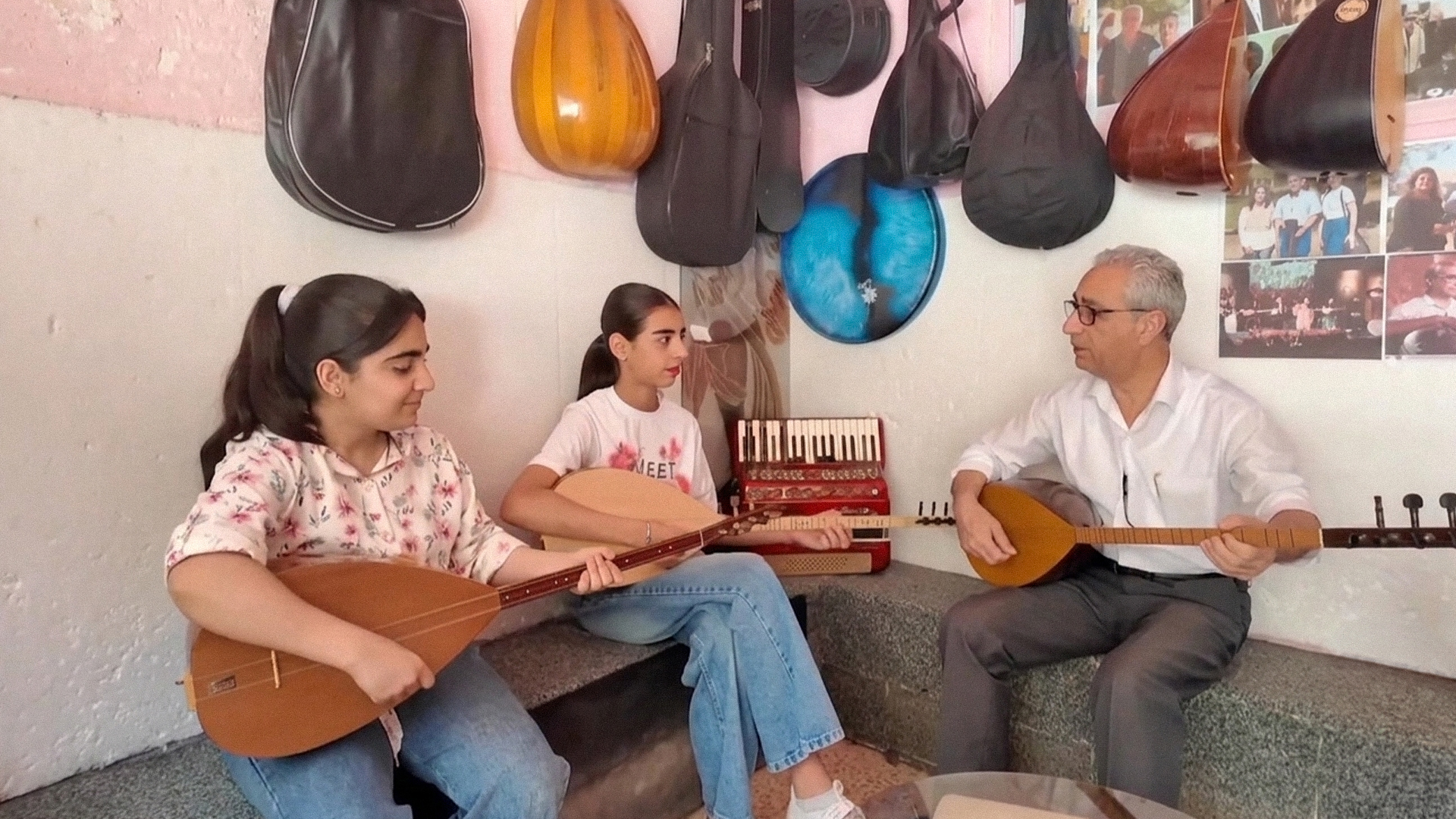
ERBIL (Kurdistan24) - In the Wadi Mashari' district of Damascus — a neighborhood that has weathered more than a decade of Syrian conflict — a small music room hums with the plucked strings of the tambour.
The students inside are Kurdish children and young people, many of them born far from the mountains and valleys of their ancestors, growing up in a city where Arabic is the language of the street and Kurdish risks becoming the language of memory alone.
At the front of the room stands Mahmoud Khalil, a Kurdish musician from the town of Tirbespi in Western Kurdistan (Northern Syria), who has lived in Damascus for 35 years and who, for the last 10 of them, has run this modest center with one animating purpose: to ensure that Kurdish children in Syria's capital do not forget who they are.
"Music is our culture, our language, our life," Khalil told Kurdistan24. "It is not an instrument for entertainment — no, not at all. It is life itself. It is our language, our culture. Wherever we go, it is our culture and our language. We will never abandon it."
The words carry the weight of experience. Khalil has watched Kurdish families in Damascus navigate the slow erosion that comes not from any single act of suppression, but from the grinding, daily pressure of living as a minority in a capital city — a city that, whatever its turbulent recent history, has never been a Kurdish one.
The Tambour as a Lifeline
The tambour — a long-necked stringed instrument with deep roots in Kurdish musical tradition — is not, in Khalil's telling, merely a cultural artifact to be preserved behind glass.
It is a living vehicle of identity: a means by which a child who cannot speak Kurdish fluently can nonetheless feel the pull of something ancestral, something that belongs to them.
"Music runs in our veins as Kurds," he said, "especially the tambour and Kurdish music."
The challenge Khalil confronts is a familiar one for any communities outside their ancestral land everywhere, but sharpened in Damascus by the particular pressures of displacement, economic hardship, and war.
Many Kurdish children in the city, he explained, are losing fluency in their mother tongue. Some students travel from the Rukn al-Din district to his center in Wadi Mashari' not only to learn music but to be immersed in an environment where Kurdish is spoken — where they have no choice but to engage with the language.
"I told the students: no one should speak to him in Arabic, so that he can learn Kurdish," Khalil recounted, describing one such student. "Now he no longer speaks Arabic with us — he speaks Kurdish all the time."
It is a small but telling detail: a music school functioning, in practice, as a language school, a cultural anchor, and a community institution — all at once, and all within the walls of a single modest room.
A Message to the World
Khalil is not a man given to grand political declarations. His ambitions are more intimate and more durable than politics: to hand something real to the next generation, so that they have something to pass on in turn.
"No matter what circumstances we have been through, no matter what difficulties we have faced, we will not abandon our heritage or our customs and traditions — whatever the cost," he said.
"We went through very difficult years, and despite all those hardships, we were able to teach, able to educate these young people, and it did not stop us."
He spoke with a hope that reaches beyond Damascus, beyond Syria, beyond the immediate moment: peace for all the world, security for Kurdistan, and — in a personal gesture that speaks to where his loyalties and affections ultimately lie — a direct salute to President Masoud Barzani.
Open Doors, Symbolic Fees
Khalil's center has never been a commercial enterprise. Tuition fees, where they exist at all, are described by their teacher as entirely symbolic. Students who cannot pay continue to attend regardless.
"My fundamental goal is for these young men and women to learn heritage, to learn Kurdish songs, to learn the instruments," he said.
"If a student can pay for one, two, or three months, and then cannot pay the next month, it is impossible for me to tell them to leave because they cannot afford it."
He frames the center less as a school and more as a charitable institution — a voluntary effort sustained by commitment rather than revenue.
He also teaches, free of charge, at the Othman Sabri Association in the Rukn al-Din neighborhood, a venue that opened within the past year and has since become another node in his quiet network of cultural preservation.
The doors, he emphasizes, are open to everyone. The center's student body includes not only Kurds but Arab students as well — among them a young woman from Deir al-Zor studying pharmacy, who came to learn the oud and, after hearing the Kurdish girls playing and singing, set aside that instrument and took up the tambour instead.
Another student, from the direction of the airport road, comes to learn Kurdish songs alongside Arabic ones.
"The center is open to all the world," Khalil said, "whoever loves music, loves our heritage."
Refuge in the Years of War
The Syrian conflict cast its shadow across everything, and Khalil's center was no exception. But he describes those years in terms that reveal a deliberate strategy: keeping children occupied, keeping them connected, giving them something to hold onto when the world outside offered very little.
"During the crisis of the war, we struck two birds with one stone," he said. "Because the children had seen nothing but war. Through music, we gave them some psychological relief."
On school holidays, he would hire a minibus to take his students to al-Thawra Park — instruments in hand — where they would play, sing, and dance in the open air, near Umayyad Square in the center of the city.
It is an image at once ordinary and quietly extraordinary: Kurdish children, in the middle of Damascus, making music together.
"In that way, they forgot themselves a little," he said.