'We Aim to Collect Maximum Wheat from Kurdistan Farmers,' Says Iraqi Trade Minister
As Iraq's trade minister promises to procure as much wheat as possible to support farmers, agricultural officials in the Kurdistan Region are negotiating to raise restrictive federal quotas that currently threaten to leave a massive surplus stranded.
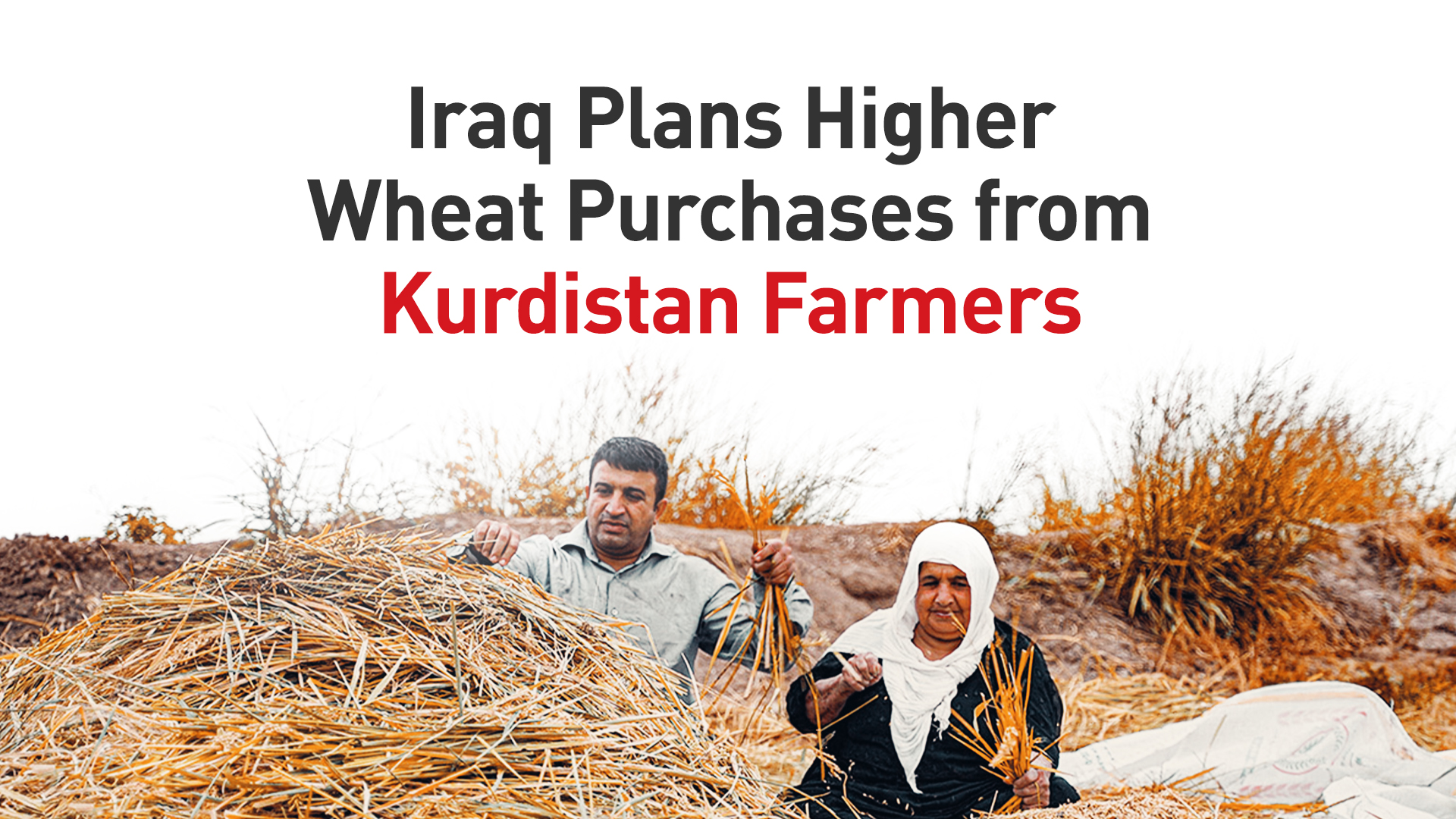
ERBIL (Kurdistan24) - The Iraqi federal government is attempting to recalibrate its national agricultural strategy amid a bumper harvest, with senior officials pledging to maximize the state's procurement of domestic wheat. The policy shift comes as unseasonably high agricultural output in the Kurdistan Region exposes a widening gap between Baghdad's initial procurement quotas and the actual yield produced by Kurdish farmers.
Speaking during a high-profile inspection of wheat deliveries at the Erbil Silo on Friday, Iraqi Trade Minister Mustafa Nizar al-Ani announced a concerted effort to support agricultural producers across the country.
According to a report from the Iraqi Ministry of Trade, Nizar indicated that the total acreage of land under wheat cultivation in the Kurdistan Region has far exceeded federal projections, necessitating an immediate adjustment to the state's purchasing plan.
"We are making every effort to ensure that the hard work of our farmers does not go to waste," Nizar told reporters in Erbil. Emphasizing the government's commitment to rural livelihoods, he confirmed that the Prime Minister has authorized the dispatch of financial dues to farmers across all Iraqi provinces, noting that the ministry has actively sought to distribute these funds fairly.
The sudden abundance of wheat is fundamentally challenging Baghdad's supply-chain calculations.
Recognizing that the anticipated yield in the Kurdistan Region significantly surpasses the quantities originally allocated by the Council of Ministers, Nizar acknowledged that the federal government will be forced to procure a much larger volume of grain than initially planned.
While the exact parameters of the revised marketing plan have yet to be finalized, the minister's rhetoric indicates a strategic shift. Nizar promised "good news" for the Region during his ongoing provincial tour, asserting that the ultimate goal is to accept all available wheat.
Crucially, the minister suggested that any grain procured beyond the nation's domestic consumption needs could be designated for international export, a significant pivot for a country that has historically prioritized domestic food security and import substitution.
Nizar's remarks in Erbil reinforced themes he outlined a day earlier in neighboring Duhok.
There, the minister underscored the pivotal role that farmers play in maintaining national food security. He explained that after securing the country's necessary strategic reserves and emergency stockpiles, the government would formulate a comprehensive plan to manage surplus production in the coming days.
However, the minister's optimistic projection of maximizing procurement stands in stark contrast to the immediate bureaucratic reality facing agricultural workers in the Kurdistan Region.
While Baghdad may aspire to absorb the excess yield, the current federal quota system severely limits the amount of wheat the state is legally obligated to purchase.
According to Sarwar Hawari, Deputy Minister of Trade and Industry for the Kurdistan Regional Government (KRG), the federal procurement quota for the Region is currently capped at just 400,000 tons.
Providing a detailed breakdown of the allocation during an interview on Kurdistan24's Basi Rozh program, Hawari explained that the quota distributes 150,000 tons to Sulaimani, 122,000 to Erbil, 116,000 to Duhok, and 11,000 to Halabja.
Hawari emphasized that this allocation is profoundly insufficient for the Region's actual output. He noted that while Iraq aims to procure a total of 4.5 million tons nationwide, the Kurdistan Region's share remains disproportionately limited.
The restrictive quota system has sparked acute frustration among the farming community, as some local producers fear that only 30 percent of their harvest will ultimately be accepted by the state. The KRG's regional silos, Hawari confirmed, boast a combined storage capacity of one million tons, far exceeding the 400,000-ton federal limit.
The tension over volume is further exacerbated by pricing and payment disputes. Hawari revealed that the federal purchase price has been reduced this year to 700,000 Iraqi dinars (IQD) per ton, down from 800,000 IQD previously. Furthermore, financial disbursements remain incomplete.
According to the deputy minister, while 159 billion IQD (approximately 53.5 percent) of the funds owed to farmers have been distributed, roughly 142 billion IQD (46.5 percent) remains held by Baghdad.
Acknowledging these systemic constraints, KRG officials are actively lobbying the federal government to revise the quotas. Hawari noted that the Iraqi Trade Minister has recognized the insufficiency of the current cap, and regional authorities plan to intensify negotiations over the next month of the procurement cycle.
Simultaneously, the KRG is developing contingency plans to prevent financial ruin for local growers.
Hawari assured farmers that the regional government is working closely with contracted private companies to purchase the remaining wheat outside the federal plan. The KRG is also facilitating efforts to bypass domestic bottlenecks entirely by marketing the agricultural surplus to international buyers.
The unfolding dynamic underscores a persistent structural mismatch between localized agricultural production and centralized federal procurement policy. As Baghdad attempts to coordinate its economic strategy with Erbil, the handling of the wheat surplus will serve as a critical test case.
The government's ability to smoothly transition from stockpiling for domestic food security toward successfully exporting surplus grain will largely dictate whether this year's abundant harvest results in economic growth or deepens rural financial instability.
|
Summary Iraq's Trade Minister pledged to maximize wheat procurement as Kurdish farmers face a severe surplus crisis. Baghdad's restrictive 400,000-ton quota has sparked negotiations between federal and KRG officials, exposing deep policy tensions surrounding agricultural production and food security. |