Trump Warns Iran of Renewed Military Action Ahead of Peace Deal Signing
G7 leaders back framework agreement as Washington and Tehran prepare for 60 days of negotiations on nuclear program and regional security
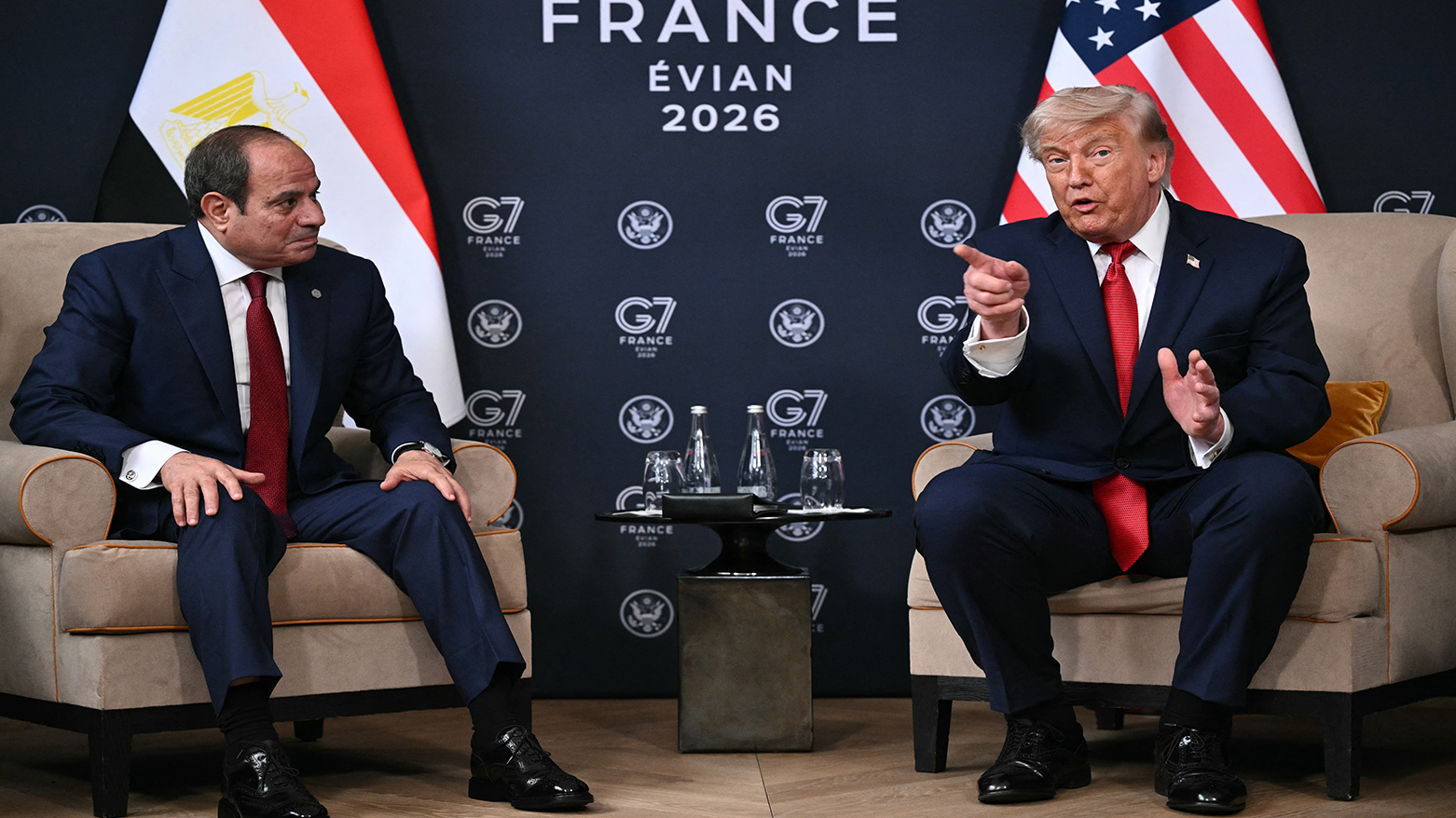
ERBIL (Kurdistan24) — U.S. President Donald Trump on Wednesday warned Iran that military action could resume if Tehran fails to comply with a framework agreement intended to end months of conflict between the two countries, as world leaders voiced support for the accord ahead of its planned signing in Switzerland.
Speaking on the sidelines of the G7 summit alongside Egyptian President Abdel Fattah el-Sisi, Trump stressed that the agreement expected to be signed on Friday is not yet a final settlement.
“No, it's not final. It's a memorandum of understanding,” Trump said.
“If I don't like it, we will go back to shooting at them,” he added. “If they don't behave, we'll go right back to dropping bombs right smack in the middle of their head.”
Trump said the United States would closely monitor Iran's conduct during the implementation of the agreement and throughout the upcoming negotiations aimed at resolving disputes over Tehran's nuclear program.
The accord is expected to be signed Friday at a resort near Switzerland's Lake Lucerne, after which U.S. and Iranian negotiators will begin a 60-day period of talks intended to produce a comprehensive agreement addressing Iran's nuclear activities, sanctions relief, and regional security concerns.
The war between the United States, Israel, and Iran began on Feb. 28 and dramatically reshaped the geopolitical landscape of the Middle East. Since then, diplomatic efforts led by multiple international mediators have sought to secure a ceasefire and establish a framework for broader negotiations.
Despite the uncertainty surrounding the final terms, leaders of the Group of Seven industrialized nations formally endorsed the agreement on Wednesday.
In a joint declaration issued at the summit in France, G7 leaders described the deal as a “historic opportunity to prevent Iran from acquiring any nuclear weapon and tackling the threats related to its regional and ballistic activities.”
The leaders also pledged support for the implementation of the agreement, although neither Washington nor Tehran has publicly released the full text.
Trump sought to reassure skeptics by insisting that preventing Iran from obtaining a nuclear weapon remains the central objective of the negotiations.
“Here's what it says: Iran will never have a nuclear weapon. It won't have one to buy, to develop — it will not have a nuclear weapon,” Trump said. “And I would say that's about 99.9% of what I wanted.”
One of the most significant elements of the framework is the planned reopening of the Strait of Hormuz, through which roughly one-fifth of the world's oil and natural gas trade passed before the conflict disrupted maritime traffic.
The G7 statement endorsed an international maritime mission led by France and the United Kingdom to help secure shipping routes, protect commercial vessels, and verify the removal of naval mines from the strategic waterway.
The reopening of Hormuz is widely viewed as critical to stabilizing global energy markets after months of disruption that contributed to rising fuel prices and concerns over supply shortages.
However, questions remain about the exact scope of the agreement and how it will be enforced.
Differences have already emerged between Washington and Tehran regarding the interpretation of key provisions, particularly concerning Lebanon and the role of the Iran-backed Hezbollah movement.
Iranian Foreign Minister Abbas Araghchi argued that Israel's continued military presence in southern Lebanon would be inconsistent with the spirit of the agreement.
“Without the withdrawal of Israeli forces from the territories they occupied during this war, the war has not fully come to an end,” Araghchi said.
The G7 declaration called for an immediate and robust ceasefire in Lebanon and voiced support for Lebanese efforts to disarm Hezbollah while preserving the country's sovereignty and territorial integrity.
Trump, meanwhile, indicated that Israeli military operations against Hezbollah would not necessarily derail the broader agreement but acknowledged growing concerns over the prolonged conflict.
“I’m not happy with the way Israel has handled themselves with Lebanon and with Hezbollah,” he said.
“Israel’s fighting Hezbollah too long, and too many people are being killed.”
The Lebanon conflict has become one of the most sensitive aspects of the emerging diplomatic framework. Fighting that began in early March has killed thousands of people and displaced more than one million residents, according to international estimates.
The agreement also faces political challenges in Washington, where some Republican lawmakers remain skeptical that Iran will fully comply with restrictions on its nuclear activities.
For Trump, securing a durable settlement with Tehran could represent one of the most consequential foreign policy achievements of his presidency. Yet the success of the agreement will depend on whether both sides can navigate decades of mistrust during the intensive negotiations set to begin immediately after Friday's signing ceremony.
As diplomats prepare to gather in Switzerland, the world will be watching whether the tentative accord can hold and whether it can evolve into a broader settlement capable of ending one of the Middle East's most dangerous confrontations.