Trump Says Islamic Republic 'Will No Longer Exist' if Iran Violates Ceasefire Again
A single social media post and a series of surgical strikes have pushed the Pakistan-mediated ceasefire to its breaking point, as Washington and Tehran trade blows across the Persian Gulf.
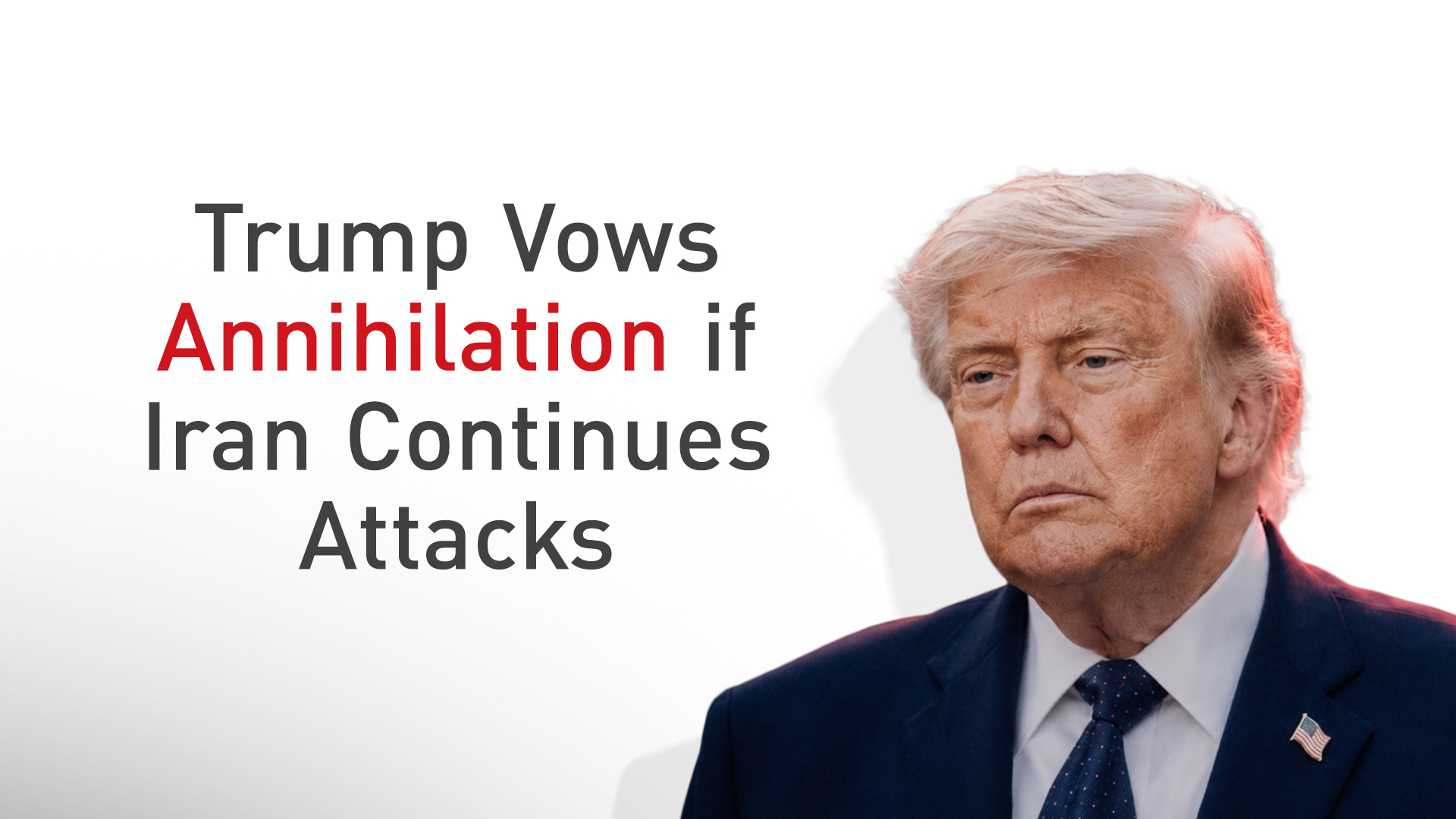
ERBIL (Kurdistan24) - On Sunday, the tenuous peace that had briefly quieted the Persian Gulf was shattered not just by the thunder of American aircraft, but by a digital ultimatum that signaled a return to the precipice of total war.
In a statement of extraordinary gravity, U.S. President Donald Trump used his Truth Social platform to announce fresh military strikes against Iranian soil, pairing the tactical update with an existential warning: "If that happens, the Islamic Republic of Iran will no longer exist!"
The President's statement, appearing on Sunday morning, marks a dramatic escalation in a conflict that many hoped had been contained by a Pakistan-brokered memorandum of understanding signed only weeks ago.
Trump revealed that U.S. aircraft had targeted Iranian missile and drone storage facilities, alongside coastal radar installations, in direct response to what he characterized as repeated violations of the ceasefire agreement.
"There may come a point when we are no longer able to be reasonable," the President wrote, suggesting that the United States is prepared to "militarily complete the job" started in February.
This latest exchange of ordnance and threats underscores the profound fragility of the regional peace process.
According to reports from Agence France-Presse (AFP), the U.S. military operation was a retaliatory strike following a drone attack on the Panama-flagged oil tanker Kiku, which was carrying two million barrels of crude.
U.S. Central Command (CENTCOM) specified that its aircraft targeted surveillance infrastructure, communication systems, and minelaying capabilities in southern Iran, specifically near the Sirik and Qeshm regions.
However, the battlefield is no longer confined to the Iranian coast. In a move that significantly broadens the theater of conflict, Iran's Revolutionary Guards (IRGC) announced on Sunday that they had launched their own retaliatory strikes against U.S. interests in neighboring Gulf states.
The IRGC claimed to have destroyed eight "important" military facilities at the Ali al-Salem base in Kuwait and the Fifth Fleet naval base at Port Salman in Bahrain.
The strikes prompted air raid sirens to wail twice in Bahrain, according to the nation's interior ministry, bringing the reality of the war to the doorsteps of Washington's regional allies.
The crisis has turned the Pakistan-mediated ceasefire, intended to provide a 60-day window of de-escalation, into a document of mutual grievance.
Both Washington and Tehran now accuse each other of "blatant violations" of the mid-June agreement, which had prohibited the initiation of military operations or the use of force.
While the deal was designed to secure shipping through the vital Strait of Hormuz, the IRGC has instead asserted tighter control over the waterway, warning that any vessel failing to follow Tehran's coastal corridor will be "dealt with firmly."
The geopolitical landscape is further complicated by the parallel conflict in Lebanon.
While Israel and Lebanon signed a U.S.-backed peace agreement on Friday, Hezbollah leader Naim Qassem has already rejected the deal as a "humiliating surrender," calling instead for the full implementation of the Washington-Tehran truce.
This internal friction, paired with Israeli Prime Minister Benjamin Netanyahu's insistence on maintaining a security zone in southern Lebanon, suggests that the regional war is far from a singular resolution.
As H.A. Hellyer of the Royal United Services Institute observed to AFP, Tehran appears to be engaging in "calibrated, low-level coercive activity" to maintain pressure on international shipping without immediately triggering a full-scale conflagration.
Yet, with President Trump now threatening the very existence of the Iranian state, the margin for calibration has all but vanished.
While diplomacy technically remains on life support, the transition from surgical strikes to existential threats has left the future of the Middle East increasingly dictated by the next exchange of fire.
|
Summary President Trump has issued an existential warning to Tehran, stating the "Islamic Republic of Iran will no longer exist" if U.S. forces are compelled to finish the war. The threat follows fresh U.S. strikes and Iranian retaliation in Kuwait and Bahrain, leaving the regional ceasefire in tatters. |