Al-Sharaa Finalizes Syria's First Post-Assad Parliament, Set to Convene July 6
Ahmed al-Sharaa has named the final 70 members of Syria's new People's Assembly, completing the formation of the country's first parliament since the fall of Bashar al-Assad, with the chamber's inaugural session scheduled for July 6.
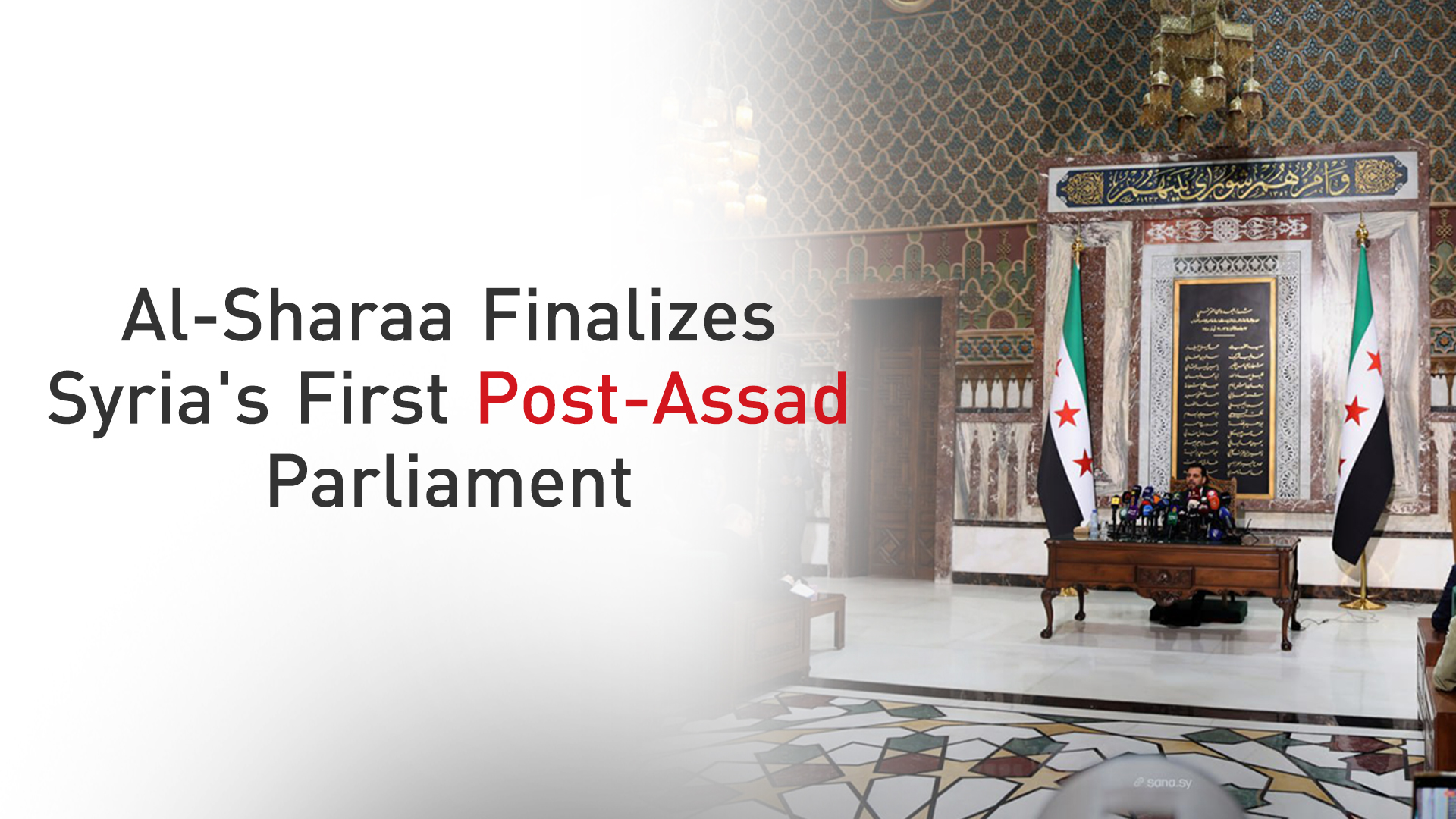
ERBIL (Kurdistan24) - Syrian President Ahmed al-Sharaa finalized on Wednesday the formation of Syria's first parliament of the post-Assad era, authorities said, with the 210-member People's Assembly set to hold its first session on Monday, July 6.
Of the 70 lawmakers appointed directly by the president, 15 are women and 55 are men, and 13 had previously been held in prison under the toppled Assad government.
These 70 members represent one-third of the legislature, appointed under the president's constitutional authority. The remaining 140 members, or two-thirds of the assembly, were selected through Syria's electoral college system.
The announcement was delivered by Mohammed Taha Ahmed, head of Syria's High Elections Commission, during a press conference at the People's Assembly building in Damascus on Wednesday.
Ahmed read out Presidential Decree No. 143 of 2026, signed by al-Sharaa, and confirmed the new assembly's term will run for two and a half years, or 30 months, with the possibility of extension under Syria's Constitutional Declaration.
Kurdish Names Among The Appointees
Among the 70 presidentially appointed members are two Kurdish figures: Dr. Abdulhakim Bashar, a prominent Kurdish politician; Dr. Mustafa Abdi, a writer and media figure; and Yasser Suleiman Mansour, from Qamishlo, who also serves on the presidential team tasked with implementing the Jan. 29 agreement with the Syrian Democratic Forces (SDF).
The presidentially appointed members were distributed across Syria's provinces as follows: Aleppo received 14 seats; Hasaka, 7; Homs and Deir al-Zor, 6 each; Damascus, Damascus countryside, Idlib and Hama, 5 each; Latakia and Daraa, 4 each; Raqqa, 3; and Tartus, Sweida and Quneitra, 2 each.
Under Article 24 of Syria's Constitutional Declaration, the president holds the authority to designate one-third of the assembly's members, a mechanism intended to ensure that diverse societal components and specialists are represented within the legislature. Wednesday's decree follows just over a year after Presidential Decree No. 66 of 2025, which had tasked the High Elections Commission with overseeing the broader electoral process.
The temporary electoral framework, approved in August 2025, divided Syria into administrative electoral districts and restricted candidacy to members of the electoral colleges.
Kurdish Representation in Context
Before Wednesday's appointments, nine Kurdish lawmakers had already secured seats among the 140 elected members.
They include Radwan Othman Sido, Kim Hussein Ibrahim and Ahmad Murad, elected from the Qamishlo and Jazira district; Fasla Yousef, elected from Hasaka; Farhad Anwar Shahin, elected from Kobani; Rangin Abdo, Sheikh Saeed Zadeh and Mohammed Sido, elected from Afrin; and Omar Gharibo, elected from the Tal Aran and Tal Hasel district.
With the addition of Abdulhakim Bashar, Mustafa Abdi, and Yasser Suleiman Mansour Kurdish representation in the People's Assembly now stands at 12 seats out of 210.
As Syria's first post-Assad parliament prepares to convene, its composition offers an early signal of how the new political order intends to balance electoral representation with direct presidential appointment. Whether that balance translates into meaningful influence for Kurdish lawmakers and other communities inside the chamber remains a question the assembly's first months in session will begin to answer.