Kurdistan Region President, Iranian President Hold Talks During Tehran Visit for Khamenei Funeral
Kurdistan Region President Nechirvan Barzani met Iranian President Masoud Pezeshkian in Tehran for the funeral procession of Iran's slain Supreme Leader, Ayatollah Ali Khamenei, discussing ties, trade, regional stability, and hopes for lasting peace through U.S.-Iran dialogue.
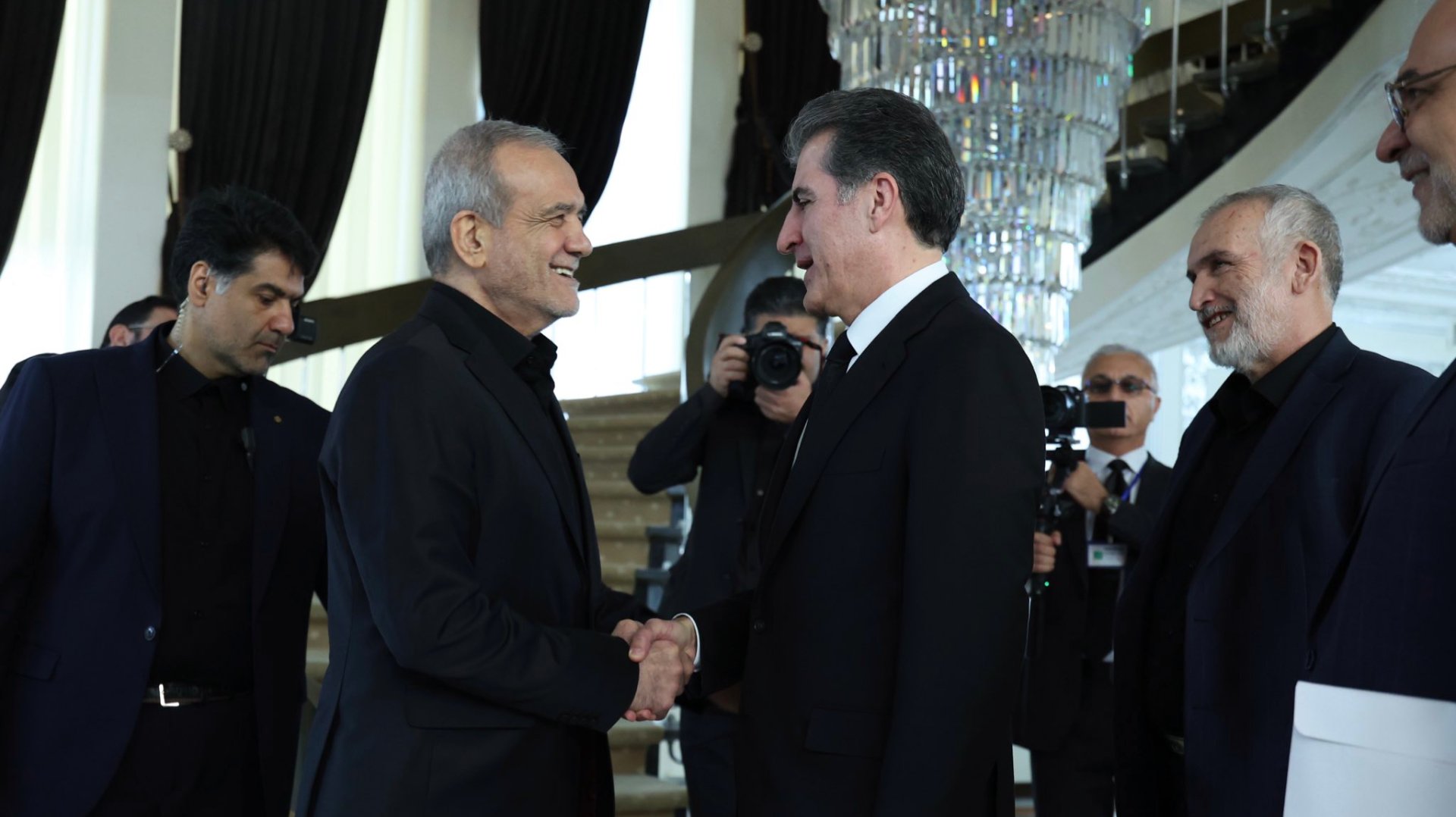
ERBIL (Kurdistan24) - Kurdistan Region President Nechirvan Barzani held high-level talks with Iranian President Masoud Pezeshkian in Tehran on Friday, using a visit initially centered on the funeral ceremonies of Iran's late Supreme Leader Ali Khamenei to discuss bilateral relations, economic cooperation and the evolving security landscape following recent diplomatic developments between Tehran and Washington.
The meeting took place shortly after Kurdistan Region President Barzani arrived in the Iranian capital at the invitation of President Pezeshkian to participate in the official mourning ceremonies for Khamenei, whose death during the recent U.S.-Israeli strikes marked one of the defining moments of the regional conflict.
Following the meeting, President Nechirvan Barzani said in a post on his official X account that the discussions focused on strengthening relations between the Kurdistan Region, Iraq, and Iran, particularly through expanded economic cooperation and deeper engagement based on longstanding historical, cultural, and neighborly ties.
"I am delighted to meet President Pezeshkian in Tehran this morning," he wrote. "We discussed ways to further strengthen relations between the Kurdistan Region, Iraq, and Iran, with particular emphasis on expanding economic cooperation, and building on the historical, cultural, and neighborly ties that have long connected our peoples."
I am delighted to meet President @drpezeshkian in Tehran this morning.
— Nechirvan Barzani (@IKRPresident) July 3, 2026
We discussed ways to further strengthen relations between the Kurdistan Region, Iraq, and Iran, with particular emphasis on expanding economic cooperation, and building on the historical, cultural, and… pic.twitter.com/ubL610AI9D
According to a statement issued by the Kurdistan Region Presidency, the two leaders reviewed relations between the Kurdistan Region, Iraq and the Islamic Republic of Iran, placing particular emphasis on expanding economic cooperation and increasing bilateral trade while preserving the long-standing historical, cultural and social ties that have connected neighboring communities for generations.
The discussions extended beyond economic issues to encompass broader regional developments, with both leaders stressing that dialogue and peaceful engagement remain the most effective means of resolving disputes at a time when the Middle East is emerging from one of its most volatile periods in recent history.
Both sides also expressed hope that the cessation of hostilities between Iran and the United States, together with the continuation of diplomatic engagement between the two countries, would ultimately contribute to durable peace, greater regional stability and stronger relations among neighboring states.
The Presidency's statement added that several additional issues of mutual concern were also discussed during the meeting, although no further details were immediately released.
The talks unfolded against the backdrop of an extraordinary moment in Iran's modern political history, as Tehran prepares for what officials expect could become the largest state funeral the country has ever witnessed.
Earlier on Friday, the body of Supreme Leader Ali Khamenei arrived at Tehran's Grand Mosalla, where it will lie in state ahead of Saturday's official funeral ceremony.
Read More: Khamenei's Body Arrives in Tehran Ahead of State Funeral Expected to Draw Millions
As previously reported by Kurdistan24, Iranian authorities postponed the funeral during the height of the conflict, choosing instead to hold the ceremonies after a fragile ceasefire and preliminary diplomatic understandings reduced immediate military tensions across the region.
State media broadcast images of Khamenei's coffin, draped in Iran's national flag, being carried into the Grand Mosalla while thousands of mourners dressed in black gathered inside the vast ceremonial complex. The hall had been specially prepared with extensive floral arrangements as security forces intensified measures around the venue in anticipation of unprecedented crowds.
Iranian officials estimate that between 15 and 20 million people could attend the funeral events over the coming days, potentially making them the largest state mourning ceremonies in the Islamic Republic's history.
The Grand Mosalla is expected to host Khamenei's body for three days before burial. The bodies of several members of his family, who were also killed during the strikes, are likewise being honored during the national mourning period.
Preparations have accelerated throughout Tehran as authorities finalize arrangements for the arrival of foreign dignitaries and official delegations.
Pakistan has confirmed that Prime Minister Shehbaz Sharif will attend the ceremonies, while China, Afghanistan and several neighboring countries in the Caucasus have also announced plans to send official representatives.
The funeral has therefore evolved beyond a national ceremony into a significant diplomatic gathering, bringing together regional leaders at a moment when broader geopolitical relationships are being reassessed following the end of active hostilities.
Kurdistan Region President Barzani's participation reflects the longstanding relationship between the Kurdistan Region and the Islamic Republic of Iran, whose shared border has fostered extensive political, economic and cultural interaction over many decades.
Friday's discussions with President Pezeshkian likewise underscored the importance both sides attach to maintaining regular political dialogue despite wider regional uncertainty.
The emphasis on expanding trade cooperation comes as both governments continue exploring opportunities to strengthen cross-border commerce and economic integration while addressing common security and development challenges.
The meeting also carried added significance because it occurred during an important phase in regional diplomacy.
Following weeks of military confrontation, Iran and the United States have entered a renewed period of negotiations aimed at transforming a preliminary understanding into a more comprehensive framework for long-term stability.
Although those negotiations remain separate from Friday's bilateral meeting in Tehran, both Kurdistan Region President Barzani and Iranian President Pezeshkian highlighted the importance of sustaining dialogue as a means of preventing renewed conflict.
Their shared call for peaceful solutions reflects a broader regional desire to consolidate recent diplomatic gains after months of instability that affected multiple countries across the Middle East.
For the Kurdistan Region, preserving stability remains closely tied to maintaining constructive relations with neighboring states while supporting initiatives that reduce regional tensions and facilitate economic growth.
Kurdistan President Barzani's visit therefore combined two complementary dimensions: participation in a major state funeral marking the passing of one of the Middle East's most influential political and religious figures, and high-level diplomatic consultations focused on the future relationship between Erbil and Tehran.
As mourning ceremonies continue throughout the weekend, the meeting between Kurdistan Region President Barzani and Iranian President Pezeshkian highlights how moments of national remembrance frequently provide opportunities for broader diplomatic engagement.
With foreign leaders gathering in Tehran and regional diplomacy entering a new phase following the recent conflict, Friday's discussions reflected both governments' intention to strengthen bilateral cooperation while encouraging dialogue as the principal path toward lasting peace and stability across the Middle East.
|
Summary Kurdistan Region President Nechirvan Barzani met Iranian President Masoud Pezeshkian in Tehran on Friday during a visit to attend Ali Khamenei's funeral ceremonies, with the leaders discussing bilateral ties, trade, regional stability and hopes that renewed U.S.-Iran dialogue will bring lasting peace. |