Who Really Made the New Generation-PUK Agreement? A Resigned Leader Just Named Him
Sebur Mantk tells Kurdistan24 that Rayan Kaldani designed the PUK pact while Shaswar Abdulwahid was detained, and that 15 parliamentary seats were the currency traded for personal freedom and business protection.
ERBIL (Kurdistan24) - Imagine a big political party that spent years telling voters, "We are different. We are not like the old parties." Then, one day, that party suddenly joins hands with one of the very parties it used to criticize. That is what has happened with the New Generation Movement and the Patriotic Union of Kurdistan (PUK).
Now, a man who used to be one of New Generation's own leaders is saying “the deal was not made the normal way — in meetings, with everyone's agreement. Instead, he says, it was built quietly, and one person in particular helped design it: a man named Rayan Kaldani.”
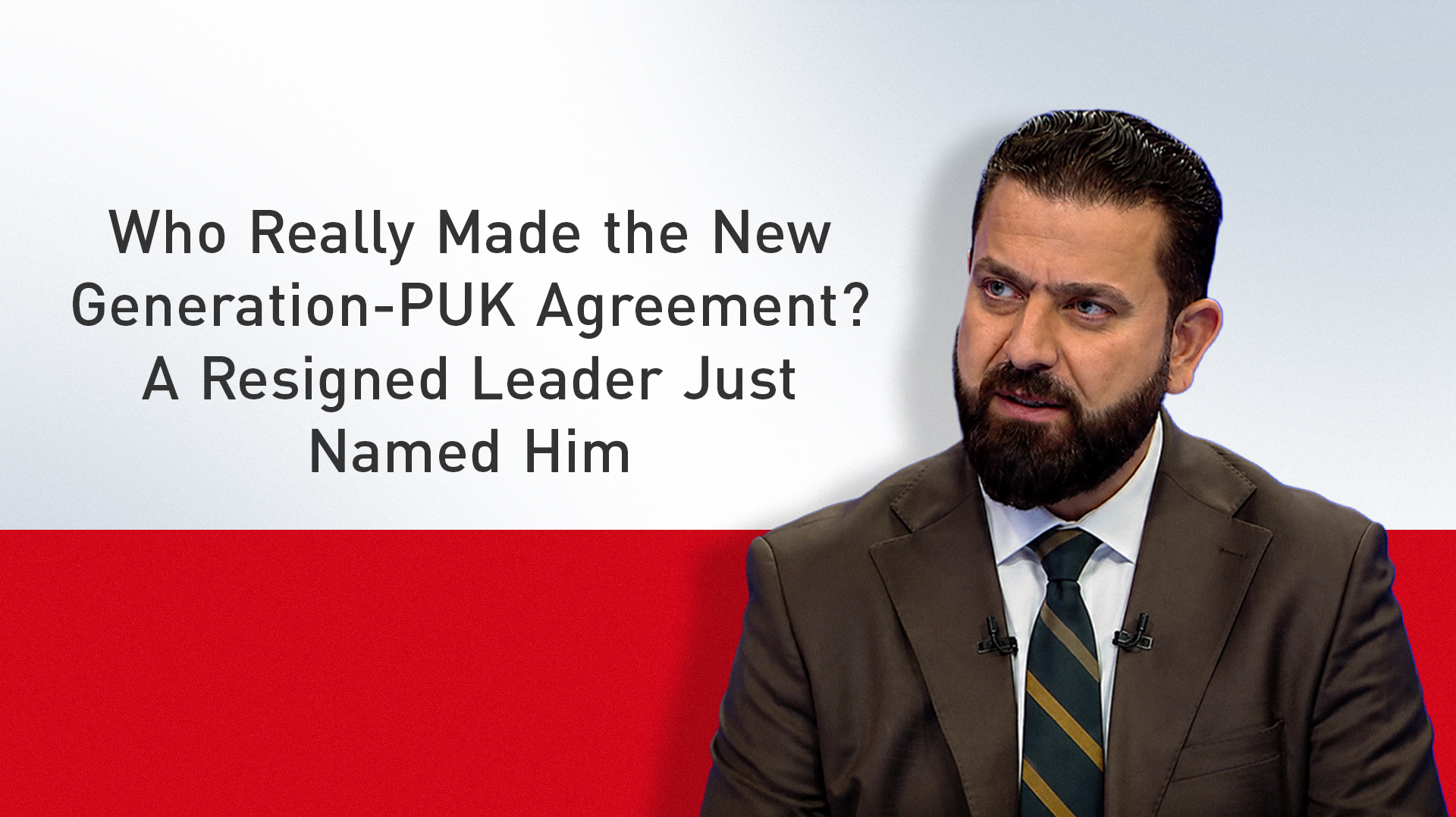
Sebur Mantk, the former head of New Generation's office in Erbil, made the claim in an interview with Kurdistan24 on Friday. He was explaining why he, and many other New Generation members across the Kurdistan Region, decided to leave the party.
"New Generation" is a Kurdish political party that started about 10 years ago. It became popular because it told people it would fight corruption and stand up for ordinary citizens against Kurdistan's older, more powerful parties.
The PUK is one of those older parties — it has been part of Kurdistan Region politics for decades.
Why he says he left
Mantk said the real reason he and other officials resigned is simple: he believes New Generation's leader, Shaswar Abdulwahid, broke his promises to the people who voted for him.
"Our reason for resigning goes back to Shaswar Abdulwahid not being honest with his promises," Mantk said. He went further, saying Abdulwahid handed over the "entire movement" — meaning the voters' trust and the party's 15 seats in the Kurdistan Region parliament — to the PUK, in order to benefit himself personally.
A parliamentary seat is like a chair reserved for someone who represents voters in the region's law-making body. Fifteen seats is a large number — enough to shift the balance of power between competing parties. Mantk claims those seats became part of a bargain rather than a reflection of what voters wanted.
A deal made in prison, with Rayan Kaldani as the architect
The most striking part of Mantk's account is about where and how the agreement was actually built.
He said the agreement between New Generation and PUK was reached while Abdulwahid was in prison, and that the person who engineered it was Rayan Kaldani.
According to Mantk, in the period before the deal became public, Rayan Kaldani met in Baghdad with Srwa Abdulwahid, who is Shaswar Abdulwahid's sister, to discuss the arrangement. Mantk said the central idea of that meeting was this: in exchange for closing Shaswar Abdulwahid's legal cases in court, New Generation would give its 15 parliamentary seats to the PUK.
What happened while Shaswar Abdulwahid was in prison
Mantk also described what he says happened during Abdulwahid's time in detention. He said Srwa Abdulwahid contacted him directly and told him: "By the decision of Bafel Talabani-head of the PUK party-, Shaswar was unjustly imprisoned."
Mantk said Srwa Abdulwahid also asked him to publicly criticize Talabani in the media, telling him to say that Talabani makes decisions "like a mafia" and controls "all the freedoms of Sulaimani."
Mantk said his worry, and the worry of many voters and party workers, was that Abdulwahid should never have signed an agreement with PUK from inside prison — especially, he said, if the goal was to protect Abdulwahid's own private business projects and to keep shareholders of the Chavyland project quiet. Chavyland is a business project connected to Abdulwahid.
What Mantk thinks the agreement is really about
New Generation and PUK have reportedly called their arrangement a "Revival Agreement." But Mantk rejects that name. He said the deal is really only about reviving Abdulwahid's personal projects, his personal gains, his business shares, and what he called Abdulwahid's own pockets — meaning, he said, that the true purpose is to make Abdulwahid personally wealthier. He added that he believes the coordination is also connected to silencing the shareholders of the Chavyland project.
"He used to say he'd hang Mam Jalal's sons — now he speaks for Bafel Talabani"
Mantk also pointed to what he described as a dramatic change in Abdulwahid's own words over time. He said: "Shaswar used to say, many times, in meetings and seminars, that he would hang the sons of Mam Jalal — but now he has become the spokesperson for Bafel Talabani." ("Mam Jalal" is a nickname Kurds use for the late PUK founder, Jalal Talabani, Bafel Talabani's father.)
Mantk believes this shift will cost New Generation the trust of voters. He said he does not think citizens will trust New Generation in the next election, and that they will not vote for the party, because he believes Abdulwahid can no longer convince voters with his words the way he once did.
In Mantk's view, Abdulwahid's political career has come to an end, and what he called the "flame" of the New Generation Movement has gone out.
Nobody else in the party was consulted, he says
Perhaps the most serious accusation Mantk made was about how the decision was reached internally. He said that neither New Generation's High Council, nor its Political Council, nor its members of parliament, were informed about the agreement, consulted on it, or included in making it. According to Mantk, only Abdulwahid and his sister, Srwa Abdulwahid, made the decision — on their own, without the rest of the party.
How this fits into the bigger picture
Mantk's resignation and his claims are part of a much larger story that has been unfolding in Kurdistan Region politics. New Generation's alliance with the PUK has already caused other senior party figures to step down. Bashdar Sangawi, the movement's coordinator for the Garmian region, resigned after eight years, calling the alliance a betrayal of the party's founding principles. Rahman Ghareeb, of the Metro Center for Journalists' Rights and Advocacy, accused Abdulwahid of trying to silence critics of the deal.
Officials from the Kurdistan Democratic Party (KDP), have also criticized the timing of the agreement, since it came together shortly after Abdulwahid's detention and release. Some KDP officials have gone as far as calling it a "prison agreement." Veteran politician Azad Jundiyani has argued that under Kurdistan's election law, real political blocs are supposed to come from what voters choose at the ballot box — not from deals made afterward.
All of this is happening while the Kurdistan Region's parliament remains unable to meet and a new government still has not been formed, months after the October 2024 election.
Sebur Mantk's account adds a new and very specific claim to an already tense political story: that the alliance between New Generation and the PUK was not simply a political decision made by party leaders in the open, but something engineered quietly, with Rayan Kaldani named as the person who helped design it, and reached, he says, while Abdulwahid was behind bars.