Venezuela Earthquake Death Toll Nears 3,000 as Rescue Gives Way to Recovery
Venezuela earthquake death toll has risen to nearly 3,000, AFP reports, as rescue efforts transition into a humanitarian crisis. International response, recovery challenges, missing persons and reconstruction now dominate the disaster's next phase.
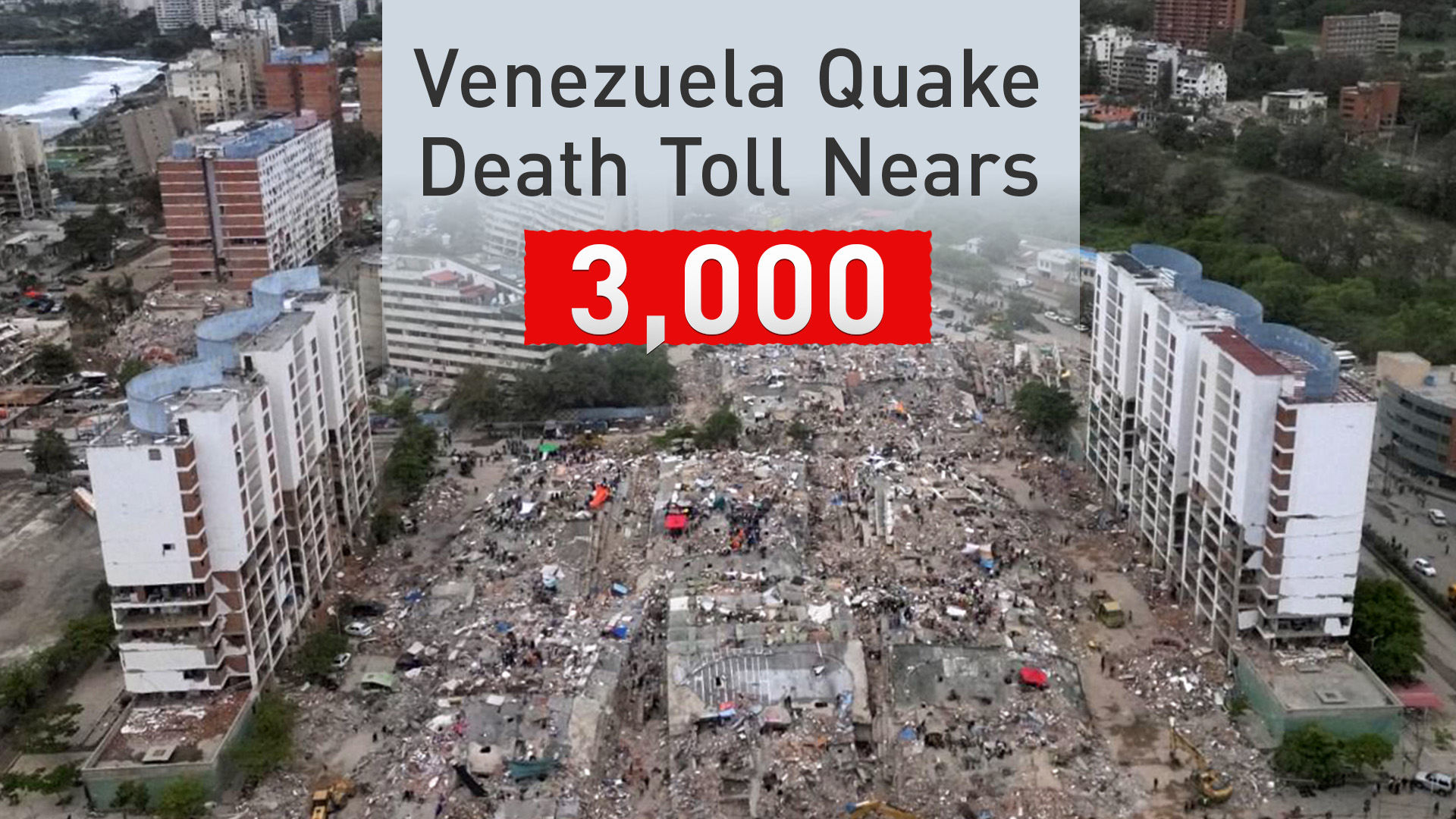
ERBIL (Kurdistan24) - Nearly two weeks after twin earthquakes shattered Venezuela's Caribbean coast, the country's tragedy has entered a quieter, more difficult chapter. The urgency that defined the first frantic days, when rescuers clawed through collapsed apartment blocks in search of voices beneath the rubble, is gradually yielding to the painstaking work of identifying the dead, supporting the displaced and confronting a reconstruction effort likely to stretch for years.


According to Agence France-Presse (AFP), Venezuela's official death toll climbed to 2,954 on Saturday, an increase of more than 300 fatalities from the previous day.
Tens of thousands remain unaccounted for, while the United Nations has estimated that as many as 50,000 people could still be missing after the powerful magnitude 7.2 and 7.5 earthquakes struck just 38 seconds apart on June 24.

The rising toll tells only part of the story.
It reflects a disaster moving beyond the narrow window when lives can most often be saved and into a prolonged humanitarian emergency in which uncertainty, displacement and recovery become the defining realities.
Families continue searching for loved ones even as many international rescue teams begin preparing to leave, underscoring the painful shift from hope to acceptance that accompanies major earthquakes around the world.
That transition follows well-established patterns in disaster response.
Reporting by BBC News journalist Alys Davies explains that international urban search-and-rescue operations are designed around the first several days after a collapse, when the probability of finding survivors is highest.
Yet sophisticated searches rarely stop abruptly.
Even after those critical days have passed, rescue specialists continue working methodically, deploying highly trained dogs, sensitive listening equipment, search cameras and aerial drones because isolated pockets of survivable space can still exist beneath mountains of concrete.
The odds diminish, but they never disappear entirely, making each remaining search increasingly painstaking and emotionally charged.

AFP reported that rescue teams from several countries, including the United States and across South America, have begun concluding operations after repeated searches detected no signs of life.
The Los Angeles County Fire Department rescue contingent, along with teams from Florida and Virginia, is among those ending deployments as Venezuelan authorities increasingly shift resources toward recovery and debris removal.
The symbolism of that transition was evident when interim President Delcy Rodriguez honored foreign rescue teams and their search dogs, acknowledging the international effort while describing a nation overwhelmed by grief.
AFP quoted Rodriguez as saying Venezuelan families continue hoping that relatives might still be found alive even as many have already lost everything.
For many communities, however, the emotional reality remains intensely personal.
In the coastal state of La Guaira, where the earthquakes inflicted their greatest destruction by flattening residential buildings and damaging critical infrastructure, heavy machinery is beginning to replace the painstaking hand searches that dominated the first week.
Volunteers continue recovering bodies so families can begin funerals rather than rescues.

AFP cited volunteer Francisco Sasquia describing the exhausting work of retrieving victims from collapsed homes after days of continuous searching.
Nearby, another resident, Víctor Colivert, refused to leave the side of his nephew's recovered body, fearing it might disappear amid the administrative chaos that often follows disasters of this scale.
His determination illustrates how, even after rescue operations fade from international headlines, thousands of individual tragedies continue unfolding beyond television cameras.
Those human stories are accompanied by growing questions about preparedness and governance.
Many Venezuelans have criticized what they describe as a delayed official response, arguing that local residents spent the earliest hours digging through debris with their bare hands before significant outside assistance reached devastated neighborhoods.
Rodriguez has defended the government's actions, saying thousands of soldiers and emergency personnel were rapidly deployed.

The debate extends beyond political accountability.
It also reflects the broader challenge confronting countries whose emergency systems have been weakened by years of economic hardship.
AFP notes that Venezuela entered the disaster after decades of political instability and economic crisis that had already strained public infrastructure and health services.
Earthquakes do not strike societies equally; existing vulnerabilities often determine how destructive they ultimately become.
The financial implications are equally sobering. The United Nations estimates physical damage at approximately $6.7 billion, roughly six percent of Venezuela's gross domestic product.
Beyond destroyed homes and businesses, transport infrastructure has also suffered.
Maiquetia International Airport, the country's principal gateway serving Caracas, has partially reopened for humanitarian flights while commercial operations remain suspended.
Venezuelan authorities say international partners are expected to assist with restoring the airport, recognizing that transportation networks are indispensable both for immediate relief and longer-term economic recovery.
Modern disaster response increasingly depends on international cooperation that transcends politics.

As BBC reporting has highlighted, today's search operations combine specialized dogs capable of detecting human scent deep beneath rubble with seismic and acoustic sensors sensitive enough to capture faint movements, cameras that probe inaccessible voids, thermal imaging systems and miniature drones that navigate spaces too dangerous for rescuers.
Heavy machinery then complements those technologies by clearing massive concrete slabs once precise searches have been completed.
Together, these tools demonstrate both remarkable advances in humanitarian response and the unavoidable limits imposed by time.
For the international community, Venezuela's earthquake is more than another devastating natural disaster.
It is a reminder that catastrophic events test not only national resilience but also the effectiveness of cross-border humanitarian coordination, urban planning, infrastructure standards and long-term recovery financing.
Rescue expertise, engineering knowledge and emergency assistance increasingly flow across political boundaries because disasters themselves recognize none.

As the last foreign rescue teams prepare to depart, Venezuela's most demanding work is only beginning.
The search for survivors may be nearing its conclusion, but the larger effort, to rebuild communities, restore confidence and help thousands of grieving families recover from profound loss, will define the country's future long after the rubble has been cleared.