Buried Cash, Luxury Vehicles Recovered in Iraq's Widening Oil Corruption Investigation
The discovery of nearly three billion Iraqi dinars and luxury vehicles in Salahuddin Province has broadened scrutiny of an already expansive corruption investigation that now extends beyond Iraq's borders.
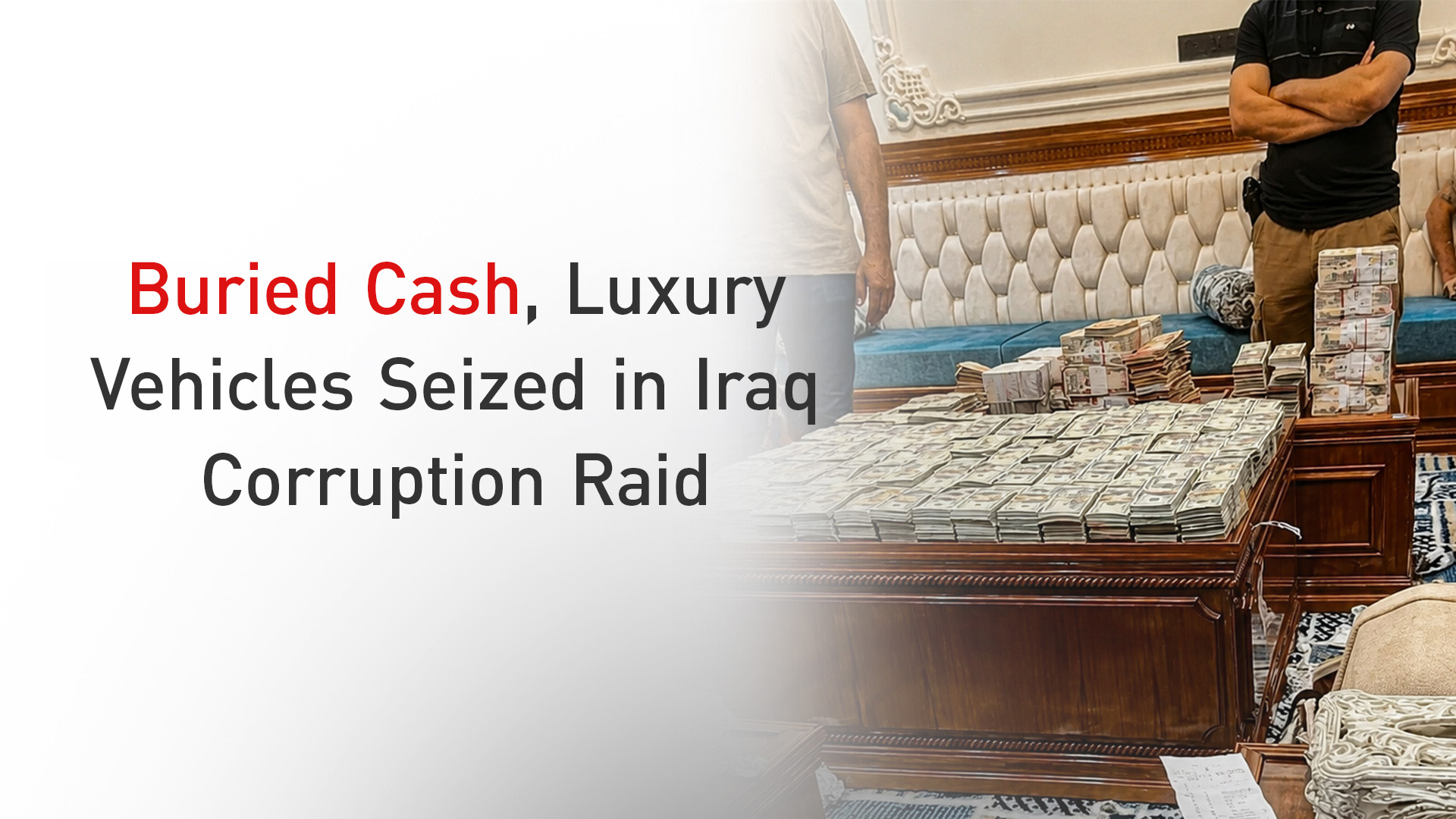
ERBIL (Kurdistan24) - Iraqi security forces have uncovered nearly three billion Iraqi dinars buried beneath a residence in Salahuddin Province and seized four luxury vehicles in a raid linked to one of the country's most significant corruption investigations, underscoring both the scale of the alleged scheme and the increasingly sophisticated methods authorities say were used to conceal suspected illicit wealth.
The discovery was made during a search operation in the Shirqat sub-district as investigators pursued evidence connected to former Ministry of Oil Undersecretary for Refining Affairs Adnan al-Jumaili.
A security source told Iraqi media that approximately three billion Iraqi dinars were recovered from beneath the home of an employee at the Baiji Refinery. Authorities also confiscated a Toyota Hilux, BMW, Chevrolet Tahoe and Cadillac believed to be connected to the ongoing investigation.
The latest seizure represents another milestone in an inquiry that has steadily expanded since al-Jumaili's arrest.
While judicial proceedings remain ongoing and allegations against suspects have not been adjudicated in court, investigators continue to trace assets they believe may have been acquired through corruption, with each operation revealing additional evidence and broadening the scope of the case.
The significance of the discovery extends beyond the amount of money recovered.
Investigators increasingly face the challenge of locating assets allegedly concealed through unconventional means, whether hidden underground, placed in private properties or dispersed across financial networks.
Such methods illustrate the complexity of modern corruption investigations, in which recovering public funds often requires painstaking forensic work alongside traditional criminal inquiries.
The operation stems from testimony obtained after al-Jumaili's detention, which authorities say prompted a broader investigation involving dozens of current and former officials, parliamentarians and political figures.
Those investigations remain active, and no findings of criminal liability have yet been reached against individuals whose cases are still before the courts.
Earlier statements from Iraq's Supreme Judicial Council indicated that assets recovered in connection with the investigation have surpassed 98 billion Iraqi dinars and $11 million, while inquiries into additional associates continue.
The latest seizure adds to that total and suggests that investigators are still identifying previously undisclosed assets allegedly linked to the case.
For international observers, however, the investigation has evolved into more than a domestic anti-corruption campaign.
In an earlier Kurdistan24 report, Communications Minister Mustafa Sanad said two suspects wanted by the Iraqi judiciary had allegedly fled to France with approximately $500 million connected to the broader investigation. Those allegations remain under investigation and have not been proven in court.
Read More: Iraq's Anti-Corruption Drive Reaches France as $500 Million Probe Widens
According to the minister, Prime Minister Ali Faleh al-Zaidi has directed Iraqi authorities to pursue the suspects through international legal channels while seeking the recovery of assets believed to have been transferred abroad.
The Iraqi judiciary has issued Interpol Red Notices as part of efforts to locate the suspects and facilitate possible extradition proceedings, although any transfer would depend on legal processes in multiple jurisdictions.
That international dimension highlights why the case carries implications well beyond Iraq.
Once suspected proceeds of corruption move across borders, investigations become significantly more complex, requiring cooperation among prosecutors, financial intelligence units, foreign courts, banking regulators and international law enforcement agencies.
Asset recovery frequently depends not only on criminal investigations at home but also on mutual legal assistance and cross-border judicial coordination.
The outcome therefore matters to governments, investors and international institutions alike.
Successful recovery of public assets can strengthen confidence in governance reforms and demonstrate institutional capacity to pursue complex financial crimes regardless of where assets are allegedly hidden.
Conversely, failure to recover funds transferred overseas can expose the practical limitations of domestic enforcement when confronted with international financial networks.
The investigation also reflects the Iraqi government's broader effort to reinforce institutional accountability through judicial rather than purely political mechanisms.
Officials have repeatedly emphasized that corruption cases should proceed through established legal channels, with evidence tested in court and defendants afforded due process before any determination of guilt.
As the campaign advances, each new operation has produced discoveries that have captured public attention for the unusual ways in which alleged illicit wealth has reportedly been concealed.
Behind those vivid images lies a far more consequential reality. Every dinar recovered represents public money that authorities allege was diverted from the Iraqi state.
The enduring measure of Iraq's anti-corruption campaign will not be the spectacle of buried cash or hidden assets, but whether investigations withstand judicial scrutiny, alleged stolen funds are recovered through due process, and confidence in the country's institutions is strengthened both at home and abroad.
|
Summary Iraqi authorities seized nearly three billion dinars buried underground and four luxury vehicles in a raid tied to a major corruption investigation. The discovery adds to a widening probe that now includes international asset recovery efforts and alleged suspects in France. |