Khamenei Message Pledges Vengeance as U.S.-Iran Tensions Deepen
Mojtaba Khamenei's newly published funeral message ties martyrdom, resistance and retaliation to a wider standoff with Washington, as Trump warns of overwhelming U.S. force and diplomacy remains fragile.
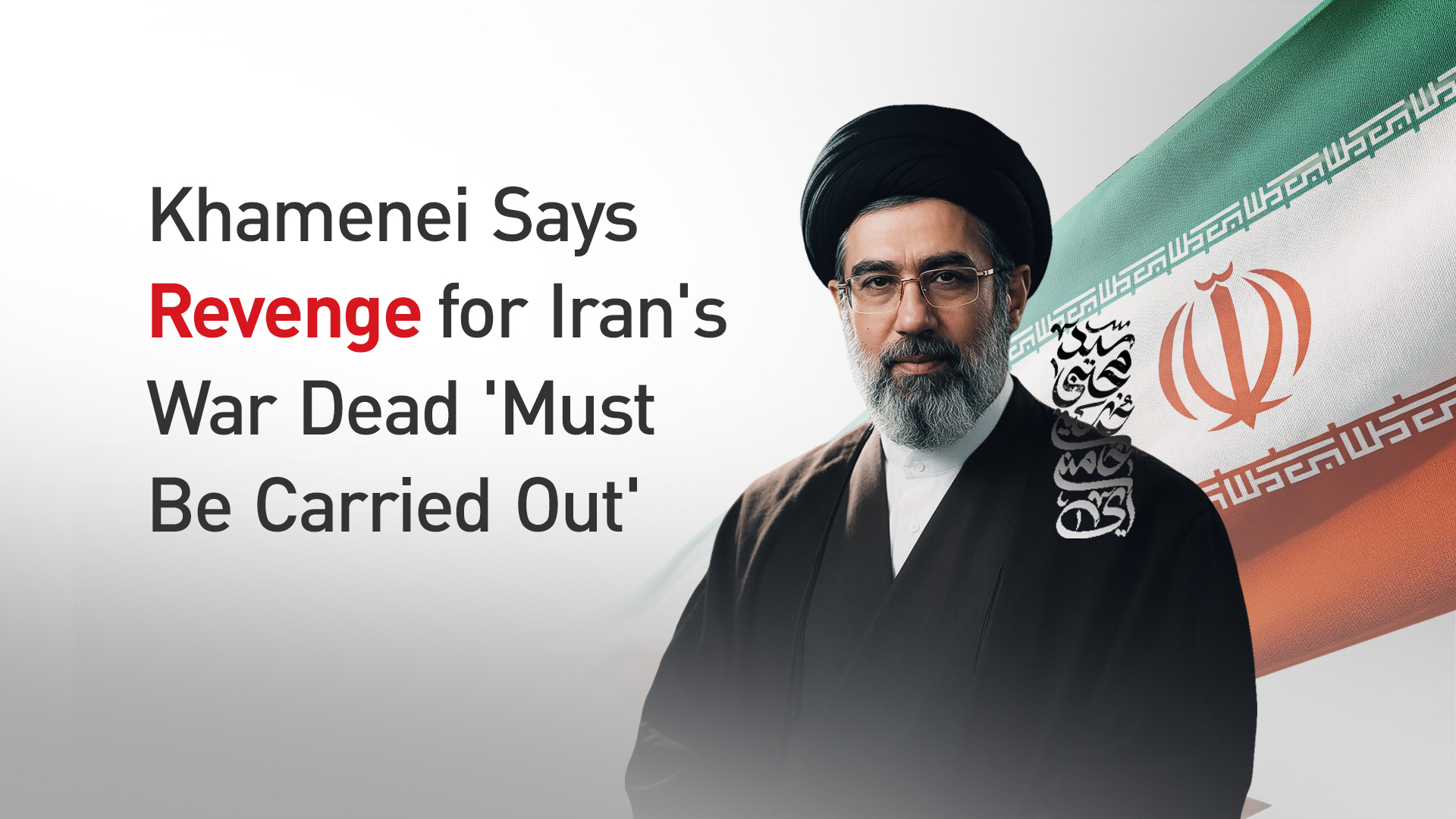
ERBIL (Kurdistan24) - A newly published message from Seyyed Mojtaba Hosseini Khamenei has turned what was already a politically charged funeral season in Iran into a renewed vow of retaliation, with the supreme leader's text pledging vengeance for what it describes as the blood of "martyrs" and framing the latest confrontation with Washington in the language of faith, sacrifice and resistance.
"We pledge to take vengeance for your pure blood and for all the martyrs of these two wars from the criminal and disgraced killers," he said, adding, "This vengeance is the demand of our nation and must inevitably be carried out."
Khamenei also underlined that, "These criminals, a list of whom exists from top to bottom, will take their wish for a peaceful death in their beds to their graves."
"They must know that this matter is not dependent on my person or other officials. Whether we are here or not, this matter shall be fulfilled, and soon, individuals from among the free people of the world will each perform a part of this divine mission," the message read.
Dated July 9 and published on July 11, the message does more than mourn the dead.
It casts the funeral and burial ceremonies as a political and religious demonstration, praises what it calls a vast public turnout across Iranian and Iraqi cities, and makes clear that the response to the latest war will not be limited to mourning.
The language is deliberately absolutist: vengeance, the text says, is not a personal desire but a national duty that must be carried out.
That tone matters because it arrives at a moment when the ceasefire framework between Washington and Tehran is already fraying.
According to Agence France-Presse (AFP), the two governments have been accusing one another of violating the memorandum of understanding that was meant to slow the conflict and open space for negotiations.
AFP reported that President Donald Trump has said the ceasefire is effectively over, even as his administration has kept diplomatic channels open. Tehran, for its part, insists it has honored its commitments.
Khamenei's message is steeped in Shiite symbolism.
It repeatedly invokes Karbala, Ashura and the figure of Imam Hussein, weaving the recent dead into a religious narrative that links present-day conflict to a much older tradition of martyrdom and resistance. In that reading, the message is not simply commemorative; it is mobilizing.
It presents the fallen as participants in a continuing struggle, and the living as trustees of that struggle.
The text also seeks to broaden the circle of obligation beyond any single leader. It states that retaliation is not dependent on Khamenei as an individual or on other officials, and that others will continue the mission if needed.
That formulation is significant. It suggests an effort to frame retaliation as institutional, enduring and embedded in the state's political identity rather than tied to one decision-maker.
In effect, the message tries to place future action inside a moral framework that can survive leadership changes and diplomatic pressure.
The message's praise for mass attendance in Tehran, Qom, Najaf, Karbala and Mashhad is also politically revealing.
By describing the public as enormous, unified and overwhelming, it turns funeral participation into a form of legitimacy.
That is a familiar theme in Iranian political messaging, but the scale and tone of this text give it added weight.
The message presents the crowds not as passive mourners but as proof that the state's narrative remains intact after war, sanctions and renewed threats from abroad.
The broader regional context makes the statement harder to ignore. Trump has warned that the United States is prepared to respond with overwhelming force if Tehran ever tries to carry out threats against him.
In a separate post on Truth Social, he said the U.S. military was ready to retaliate on a scale that would "completely decimate" Iran.
His remarks came as Washington maintained a heavy military posture in the Gulf and linked further diplomacy to maritime security in the Strait of Hormuz, a strategic passage central to global energy shipments.
AFP reported that U.S. and Iranian officials are still expected to pursue talks in Oman, even as both sides exchange accusations over the ceasefire and over attacks on shipping. Washington has demanded that Tehran publicly affirm the strait remains open to commercial navigation and stop attacks on merchant vessels.
The U.S. has also kept pressure on Iran through sanctions and military deployments, while insisting that any longer-term arrangement must begin with a halt to maritime attacks.
That backdrop gives Khamenei's message added force. It is not only a funeral statement; it is a political signal sent while diplomacy is still technically alive but visibly weakened.
The rhetoric of vengeance, martyrdom and divine duty places the confrontation in moral rather than transactional terms, making compromise harder to sell at home and more difficult to shape abroad.
For Washington, the challenge is that the Iranian message and Trump's warning now operate in parallel. Each side is speaking in absolutes. Iran speaks of vengeance as inevitability; Trump speaks of overwhelming retaliation as pre-emption.
That leaves the narrow diplomatic path in Oman, and any discussion of the Strait of Hormuz, under intense pressure before negotiations even begin.
Khamenei's message suggests that Tehran sees the present moment not as a pause in confrontation, but as a stage in a longer struggle.
Whether that posture becomes strategy or remains rhetoric will depend on the next round of talks, the fate of maritime security in the Gulf and whether both capitals decide that another escalation would cost more than either is prepared to pay.
Full text of Iran's Supreme Leader Mojtaba Kahamenei's Message:
Salutations to the Imam whose life-giving call for uprising extended the great and resonant echo of the Prophetic Mission (Be’that) into the depths of history, and through whose influence the Islamic Revolution of Iran emerged—a revolution that was Husseini at its core and was built and flourished upon the slogans and path of [Imam] Hussain.
The Martyred Gentleman of Iran also grew up within this very path. He was a Husseini; he thought like a Husseini, acted like a Husseini, performed Jihad and resistance like a Husseini, lived like a Husseini, and ultimately offered his blood in the way of Hussain's school of thought and achieved martyrdom.
Among the ranks of the Husseinis are those who, when their blood is shed oppressed on the path of Hussain and for his school of thought, the Islamic Ummah is set into motion; at that moment, they connect to Ashura, and at that place, they connect to Karbala.
Now, that same Husseini fervor has given a new brilliance to the path of the Great Khomeini and the Martyred Khamenei. This is that life-giving clamor that echoes the cry of the oppressed Hussain (PBUH) and the call of “Is there any helper to help me?” in Iran, and subsequently in Iraq and other countries, creating an earthquake in the foundations of falsehood.
On this occasion, I sincerely express my deepest gratitude for the tens of millions-strong, awe-inspiring, enemy-shattering, and historic presence of the people in the cities and villages of Iran and Iraq, particularly in Tehran, Qom, Najaf, Karbala, and Mashhad.
Our nation seeks vengeance for Hussain. For years, this great nation has sacrificed its children on the path of Hussain and in the war against the enemies of Hussain and the Husseini way. And now, it seeks vengeance for him and the Husseinis of this era.
Now I say to our martyred leader: O oppressed martyr! O honorable oppressed one! O righteous servant of God! Now that we bid farewell to your body with tearful eyes and broken hearts, we pledge to you that we will guard your school of thought and walk with steadfastness upon that "Straight Path" (Sirat al-Mustaqim) which you drew for us. We shall not fear hardships on this path, and like you, we fix our hearts upon the glad tidings and promises of God.
We pledge to take vengeance for your pure blood and for all the martyrs of these two wars from the criminal and disgraced killers. This vengeance is the demand of our nation and must inevitably be carried out. These criminals, a list of whom exists from top to bottom, will take their wish for a peaceful death in their beds to their graves. They must know that this matter is not dependent on my person or other officials. Whether we are here or not, this matter shall be fulfilled, and soon, individuals from among the free people of the world will each perform a part of this divine mission.
O father of the martyred nation! May drinking the nectar of martyrdom—which you yearned for all your life—be pleasant for you. May wearing the raiment of martyrdom with a body that bears the marks of your pure mother Zahra (PBUH) and your grandfathers Ababdillah al-Hussain and Abalfazl al-Abbas (PBUT) be a blessing to you.
And you, O his oppressed companions, who were attacked by the enemy by surprise and achieved martyrdom: blessed are you, for you are now the guests of that Master whom you had perhaps felt the kindness and grace of many times before. That Gentleman who is the Gate of Divine Mercy for everyone, especially the people of this land, is now your host, and their secure sanctuary has become your home.
And you, O high-ranking master! O Great one! O Kind Imam! O Abul-Hassan al-Reza al-Murtaza! May the highest blessings of God be upon you. Now, the torn body of a servant among the servants of Your Eminence and the Pure Progeny—after years of tireless effort, struggle, and Jihad—alongside the bodies of martyrs from his family, each of whom reminds us of a martyr of the plains of Karbala, comes to rest in this holy soil until that day when, by the command of the Divine, the world-illuminating sun, the Imam of the Time (Hazrat Baqiyatallah—may Allah hasten his reappearance), shall emerge from behind the clouds of occultation and shine the light of Divine Mercy upon the inhabitants of the earth.
On that day, which we hope arrives very soon, stars from among the truthful ones, the martyrs, and the saints shall accompany His Eminence. We hope our Martyred Gentleman is one of them, displaying once again brilliant and pure scenes of struggle and loyalty to the First Covenant, and perhaps these companions shall accompany him on that day as well.
O Kind Master! We entrust our Gentleman—who spent everything he had on your path—and his martyred companions to you and to your grace and favor, so that just as they benefited from your kindness in their earthly lives, they may enjoy it henceforth in the same way, and indeed even higher and greater.
In the end, we once again offer our condolences to our master, the Imam of the Time (Hazrat Baqiyatallah—may Allah hasten his reappearance), and we ask that Kind Master to direct his pure prayers toward the Martyred Gentleman of Iran and his martyred companions and all the martyrs. We ask the Almighty and Sublime God for the elevation of the ranks for all martyrs, and for patience and reward (Ajr) for their survivors, and for a definitive and imminent victory and triumph for the oppressed nation of Iran, God willing.
Seyyed Mojtaba Hosseini Khamenei
July 9, 2026 (18 Tir 1405)
|
Summary Iran's Supreme Leader Mojtaba Khamenei's vengeance pledge sharpens U.S.-Iran tensions as Trump warns of overwhelming retaliation, while ceasefire strains, Hormuz demands and planned Oman talks keep diplomacy alive but fragile. |