Erbil Green Belt Project Enters Phase Two as Kurdistan Advances Long-Term Climate Strategy
Following the completion of its first phase, the Erbil Green Belt Project has launched a new planting campaign that expands the Kurdistan Region's broader sustainability agenda under the Ninth Cabinet, with a focus on climate resilience, afforestation, and environmental planning.
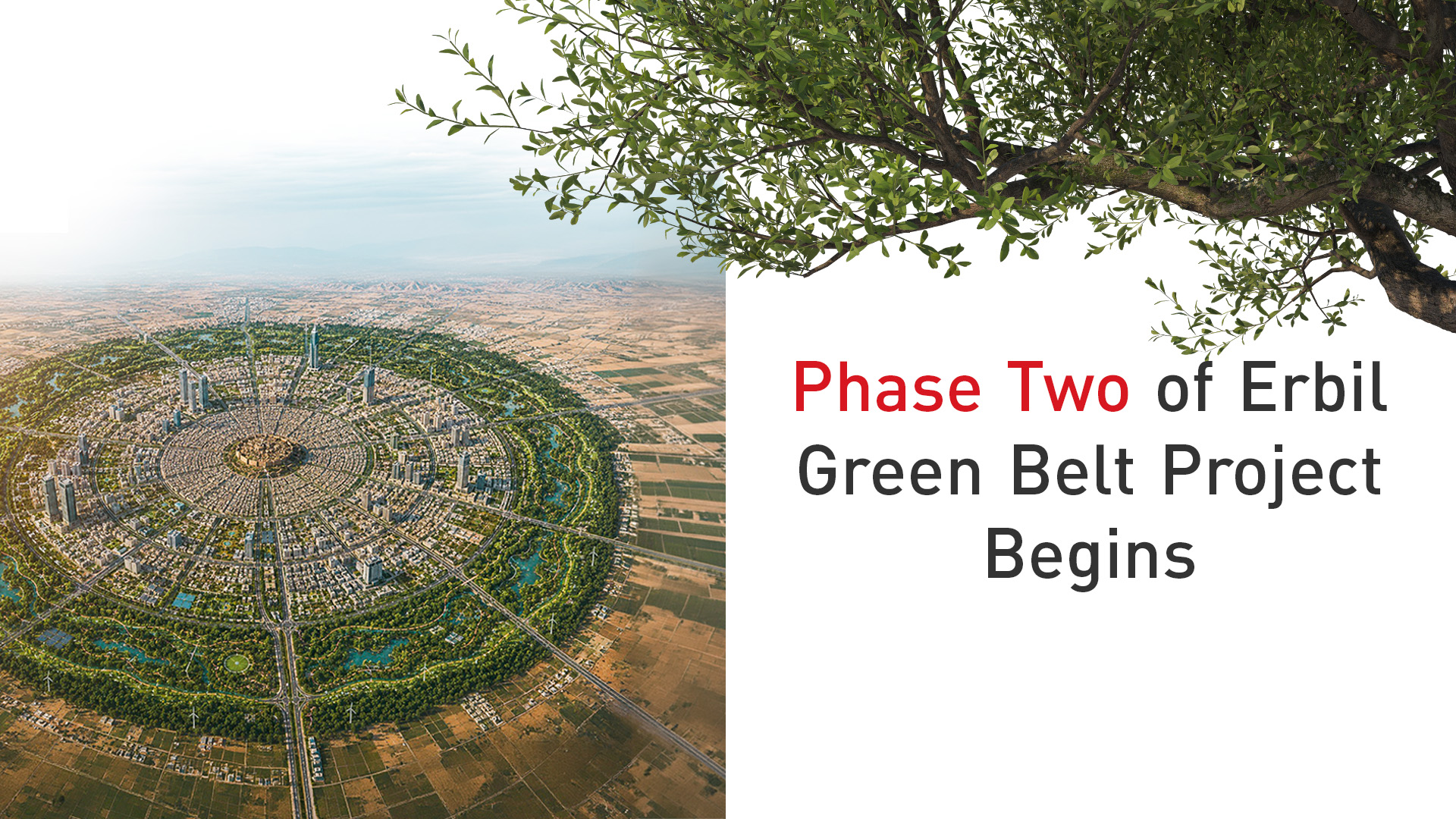
ERBIL (Kurdistan24) - The second phase of the Erbil Green Belt Project officially began on Saturday, marking a new stage in one of the Kurdistan Regional Government's largest environmental initiatives as authorities expand efforts to combat desertification, strengthen climate resilience, and reshape the ecological landscape surrounding the regional capital.
The launch follows the successful completion of the project's first phase, which established the foundation for an ambitious, multi-year afforestation program designed to encircle Erbil with a broad belt of productive forestland.
Officials say the initiative combines environmental restoration with agricultural development, reflecting a broader shift toward long-term sustainability planning across the Kurdistan Region.
Karwan Meski, Executive Director of the Erbil Green Belt Project, told Kurdistan24 that work on Phase Two commenced Saturday along the Duhok-Mosul road, where engineering crews have begun preparing the site before large-scale planting begins.
According to Meski, the initial stage of construction focuses on clearing land and installing perimeter fencing. Irrigation infrastructure will follow before planting operations get underway, highlighting the project's emphasis on water management alongside afforestation.
The second phase will extend across approximately 2,700 acres (11,000 dunams) and is expected to include the planting of more than 500,000 olive trees.
Meski said the new stage will also introduce an additional tree species while continuing cultivation of olive orchards, with work projected to take about a year to complete because of the scale of construction and agricultural preparation involved.
He noted that Phase Two presents greater logistical challenges than the opening stage, requiring more extensive engineering work before saplings can be planted.
The project's first phase was completed after 10 months of work and covered roughly 3,750 acres (15,200 dunams), according to figures provided by Meski.
During that period, workers planted around 700,000 olive trees alongside 7,000 orange trees, completing the initial stage in full before moving to the next section of the environmental corridor.
Beyond its immediate planting targets, the Green Belt is intended to create a long-term ecological buffer around Erbil that can reduce dust, improve air quality, expand agricultural production and help slow the advance of desertification, an increasingly pressing concern as climate pressures and prolonged drought affect Iraq and the wider Middle East.
The initiative also illustrates how environmental policy in the Kurdistan Region is increasingly linked to infrastructure planning.
Large-scale irrigation systems, reservoirs and supporting engineering works are designed to ensure that newly planted areas can be sustained over the long term rather than functioning as isolated tree-planting campaigns.
That broader approach is reflected in the Kurdistan Regional Government's recently published statistical review of the Ninth Cabinet's work between 2019 and 2026.
Released by the KRG Department of Media and Information, the report presents the Green Belt as one of the administration's flagship environmental projects within a wider strategy encompassing water security, sustainable urban planning and climate adaptation.
According to the government report, the full Green Belt program is planned as an eight-phase initiative that will eventually surround Erbil with a forest corridor approximately two kilometers wide.
Once completed, it is expected to include roughly 7.7 million olive, pistachio and orange trees, supported by 10 ponds and reservoirs that will provide irrigation and strengthen water resilience.
Read More: KRG Report Details Ninth Cabinet Projects and Reforms, 2019-2026
The government says the project is designed not only to expand green space but also to reduce carbon dioxide emissions by an estimated 140,000 to 210,000 tons annually, while creating employment opportunities, increasing agricultural output and improving environmental conditions around the rapidly growing capital.
The Green Belt also complements a series of wider environmental reforms undertaken by the Ninth Cabinet.
According to Kurdistan24 reporting based on official KRG data, the Region has reduced carbon dioxide emissions by more than one million tons annually through combined environmental initiatives, including expanded green infrastructure and major changes to the electricity sector.
A central component of that effort has been the Runaki Program, which has expanded access to round-the-clock electricity while enabling the retirement of thousands of neighborhood diesel generators that had long contributed to urban air pollution.
Read More: How Kurdistan Cut More Than 1 Million Tons of CO₂ While Transforming Its Cities
Government figures indicate that the transition has significantly reduced greenhouse gas emissions while improving air quality across several cities.
Together, the Runaki Program and the Green Belt represent complementary elements of a broader environmental strategy: one focused on reducing emissions at their source through cleaner electricity, the other on increasing natural carbon absorption while expanding urban green space.
The environmental benefits also carry wider economic implications.
Olive and fruit cultivation can strengthen agricultural production, while improved green infrastructure may help mitigate the effects of rising temperatures, reduce soil degradation and support biodiversity in areas surrounding Erbil.
As climate change places growing pressure on water resources and ecosystems throughout the region, projects integrating afforestation, irrigation and long-term land management are becoming increasingly central to public planning.
With Phase Two now underway, the Erbil Green Belt Project enters another critical stage in a long-term effort to reshape the capital's environmental future.
While significant work remains across the project's remaining phases, the latest expansion underscores the Kurdistan Regional Government's continued emphasis on sustainable development, climate resilience and ecological planning as part of its broader governance agenda.
|
Summary Erbil Green Belt Project Phase Two has officially begun after completion of Phase One, expanding the Kurdistan Region's flagship afforestation initiative under the Ninth Cabinet. The project strengthens environmental sustainability, green infrastructure, and climate resilience across Erbil. |