Iran Warns Regional Infrastructure Could Become Target as Gulf Tensions Deepen
Iran's latest warning over regional infrastructure comes as military exchanges spread across the Gulf, maritime security deteriorates, and the region confronts growing risks to critical civilian and energy assets.
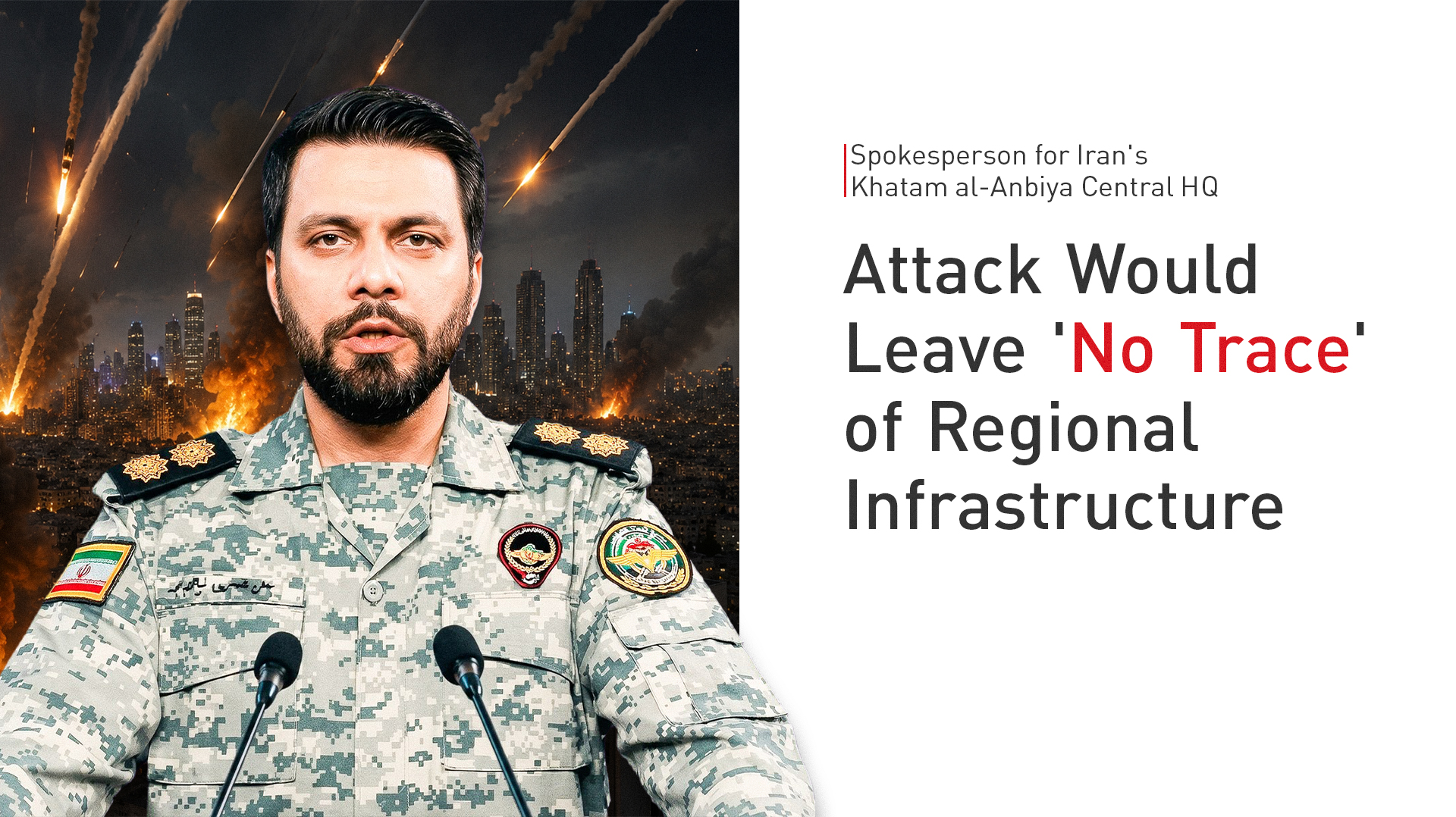
ERBIL (Kurdistan24) - Iran's latest warning that it could target infrastructure across the Middle East if its own facilities come under attack marks a notable escalation in the increasingly volatile confrontation between Tehran and Washington, shifting the focus of the conflict beyond military installations to the civilian systems that sustain economies and daily life throughout the region.
Speaking on Thursday, Ebrahim Zolfaghari, spokesperson for Iran's Khatam al-Anbiya Central Headquarters, declared that the Strait of Hormuz remains a strategic red line for Tehran, warning that "under no circumstances and in no way will we allow the United States... to interfere in the Strait of Hormuz."
He described any foreign military involvement in the waterway as unacceptable, underscoring Iran's determination to defend what it considers a core national security interest.
His remarks went further than previous official statements by directly linking any attack on Iranian infrastructure to potential retaliation against critical facilities across the wider region.
Responding to recent warnings from Washington, Zolfaghari said "every piece of infrastructure in this region is squarely in the crosshairs" of Iran's armed forces should Iranian infrastructure be targeted.
He added that, in such a scenario, "the region's entire infrastructure will be destroyed," portraying the warning as a deterrent against an expanded U.S. military campaign.
The statement reflects an evolution in Tehran's messaging.
Rather than focusing solely on military bases or strategic defense assets, Iran is now publicly framing regional infrastructure itself as a potential battlefield, raising concerns over energy installations, transportation networks, ports, airports, communications systems and public utilities that underpin economic activity across the Gulf.
The warning comes as the United States has intensified military operations aimed at degrading Iranian capabilities associated with threats to commercial shipping, while Tehran has responded with attacks targeting U.S. military facilities in several Gulf countries.
The widening exchange has transformed what began as a bilateral confrontation into a broader regional security crisis with increasingly significant economic implications.
At the center of that confrontation remains the Strait of Hormuz, one of the world's most strategically important maritime corridors for oil and liquefied natural gas exports.
Iran has repeatedly asserted its authority over the waterway, while Washington has maintained that freedom of navigation must be preserved. The competing positions have elevated the strait into both a military flashpoint and a barometer of wider regional stability.
Military developments over the past 24 hours illustrate how rapidly the confrontation has spread beyond the immediate vicinity of Iranian territory.
Iran said it launched attacks against U.S. military facilities in Kuwait, Bahrain and Jordan in response to continued American operations. Gulf states, meanwhile, reported that their air defense systems intercepted incoming drones and missiles before they reached their intended targets.
Kuwait and Bahrain each announced fresh interceptions on Thursday, reinforcing concerns that the conflict's geographic scope continues to expand even as governments seek to shield both military and civilian infrastructure from its effects.
Maritime security has also come under increasing pressure.
A drone struck a cargo vessel near Iraq's southern waters off Basra, highlighting growing risks to commercial shipping operating close to one of the region's principal energy export routes.
Iraqi authorities said port operations continued normally while investigations into the incident remained underway, but the attack nevertheless underscored the vulnerability of maritime trade as hostilities intensify.
Together, the aerial exchanges, maritime incidents and repeated warnings over the Strait of Hormuz have heightened concerns that disruptions to regional infrastructure could have consequences extending well beyond the immediate combatants, affecting energy markets, international shipping and broader economic stability.
Those concerns have become increasingly relevant for Iraq and the Kurdistan Region, where recent developments have demonstrated that strategic infrastructure is already being affected by the deteriorating security environment.
On Wednesday evening, the Kurdistan Region's Directorate General of Counter Terrorism (CTD) announced that International Coalition air defense systems intercepted and destroyed eight explosive-laden drones over Erbil before they reached their intended targets.
Officials reported no casualties or damage, while confirming that airport operations continued without interruption.
Although the attempted attack caused no physical damage, it reinforced the importance of protecting civilian infrastructure as regional tensions escalate.
Iraqi Prime Minister Ali Faleh al-Zaidi subsequently condemned the incident, pledging continued cooperation between Baghdad and the Kurdistan Region's security institutions to prevent similar attacks and safeguard stability.
The broader security climate has also begun affecting the Region's energy sector.
Dana Gas announced Thursday that it had temporarily suspended operations at the Khor Mor gas field because of what it described as credible security threats and the worsening regional situation.
The precautionary shutdown reduced gas supplies to electricity generation stations, prompting the Kurdistan Region's Ministry of Electricity to announce a decline of approximately 2,500 megawatts in power production while efforts continue to restore supplies.
The temporary suspension illustrates how regional instability is already influencing operational decisions surrounding critical infrastructure, even in the absence of direct damage.
Alongside the military escalation, diplomatic efforts continue to seek an off-ramp from the crisis.
Pakistan has renewed calls for Washington and Tehran to resume negotiations under the memorandum of understanding brokered last month, urging both sides to reduce hostilities while emphasizing the importance of preserving freedom of navigation through the Strait of Hormuz.
Islamabad has also warned that prolonged disruption could have significant consequences for global energy supplies, international trade and food security.
Whether diplomacy can regain momentum remains uncertain as military exchanges continue across multiple theaters.
For now, Iran's warning stands as one of the clearest indications that critical infrastructure has become central to the strategic messaging surrounding the conflict.
The Khatam al-Anbiya spokesperson's assertion that Iran's response would be "more intense, more widespread, and more destructive than ever before" reflects a confrontation whose implications increasingly extend beyond military calculations to the civilian systems that support economic life across the Gulf, Iraq and the Kurdistan Region.
|
Summary Iran's warning that regional infrastructure could become a target marks a new phase in the escalating U.S.-Iran confrontation. As attacks spread across the Gulf and security incidents reach Iraq and the Kurdistan Region, concerns are mounting over energy facilities, shipping, and civilian infrastructure. |