From "Stone Ages" to "No Longer a Threat": A Chronicle of Trump's Speeches on Iran
From a 48-hour Hormuz ultimatum to a primetime address on Chinese voter file hacks, Trump's public communications on Iran reveal a conflict that has repeatedly defied his predictions and resisted his deadlines
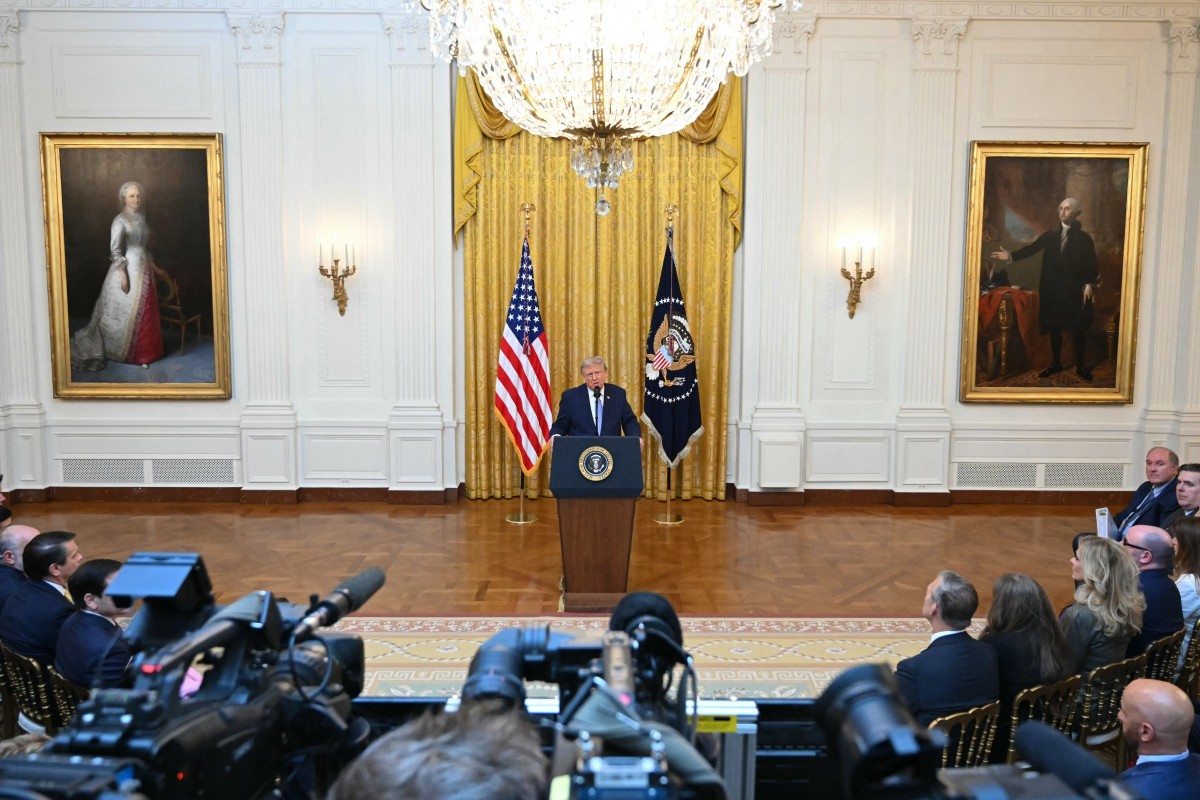
ERBIL (Kurdistan 24) - Since the United States and Israel launched strikes on Iran on Feb. 28, 2026, President Donald Trump has delivered a series of major addresses and public statements that have sought to define, justify, and in some cases obscure the trajectory of the most consequential military engagement of his second term. Taken together, they form a portrait of a president managing a conflict that has repeatedly exceeded his stated timelines, defied his declared victories, and produced consequences that no single speech has been able to fully contain.
March 22: The 48-Hour Ultimatum
The first major Trump public statement directly threatening Iran with escalation came on March 22, 2026, when Axios reported that Trump gave Tehran a 48-hour ultimatum to open the Strait of Hormuz or face US strikes on Iranian power plants. The ultimatum reflected the early phase of the conflict, in which Washington believed that the combination of military pressure and economic isolation could force a rapid Iranian capitulation on the waterway. The deadline passed without full compliance, and the conflict entered a more protracted phase.
April 1: "Core Strategic Objectives Are Nearing Completion"
Trump delivered his first national primetime address in defense of the war on April 1, 2026, speaking from the Cross Hall of the White House after 32 days of US military operations. As Euronews reported on April 2, 2026, Trump told the American public that "core strategic objectives are nearing completion" and promised to "finish the job" soon. He also warned that Iran would continue to face heavy strikes in the short term. "We are going to hit them extremely hard over the next two to three weeks," Trump said. "We're going to bring them back to the Stone Ages, where they belong."
The address came as Trump faced plunging approval ratings, economic anxiety over soaring fuel prices, and diplomatic fallout from the war. Polling at the time showed many Americans felt the US military had gone too far in Iran.
April 2: "Iran Is Really No Longer a Threat"
The following day, April 2, 2026, Trump told a national audience in a separate address that after 32 days of US military operations, Iran is "really no longer a threat," as Reuters reported via Malaysia Mail on April 2, 2026. The declaration proved premature. Iran continued launching missiles at Gulf states, commercial vessels, and US military positions in the weeks that followed, and the conflict extended well beyond the two-to-three week timeline Trump had projected.
2026 State of the Union: Drawing a Nuclear Red Line
During his 2026 State of the Union address, Trump made several significant statements on Iran, drawing a direct red line on Tehran's nuclear programme. He said Iran is "working to build missiles that will soon reach the United States of America" and praised his negotiating team, including Steve Witkoff, Jared Kushner, and Secretary of State Marco Rubio, for their work on Iran and Gaza negotiations. He also stated he was on "a diplomatic path with Iran," a characterization that White House press secretary Karoline Leavitt later echoed in media briefings.
June 8: "The Ceasefire Is Over"
Following Iran's attacks on three commercial vessels on July 6 and 7, and CENTCOM's strike on approximately 80 Iranian military targets, Trump declared the ceasefire "over" on Wednesday, July 8, 2026, as the Washington Post confirmed on the same date. He then reversed course the following day, signaling openness to returning to diplomacy and stating the exchanges would not lead to long-term military action, a pattern of alternating threat and restraint that has characterized his Iran communications throughout the conflict.
July 16: The Primetime Address on Elections and Iran
Thursday night's address, delivered from the White House at 8 p.m. Central Time, was billed by the White House as covering both election integrity and Iran. As CNN reported on Thursday, Trump used the address primarily to accuse China of acquiring 220 million US voter files in what he described as the largest election data breach in history, while simultaneously providing a framing of the Iran conflict as a matter of national security that connects foreign adversaries across multiple domains, from the Strait of Hormuz to American ballot boxes.
The address comes as CENTCOM completed its sixth consecutive night of strikes against Iran on the same evening, hitting dozens of targets including coastal surveillance and air defense sites, military logistics infrastructure, and maritime capabilities, with more than 50,000 US service members deployed across the Middle East.
A Conflict That Has Outlasted Every Prediction
What the arc of Trump's Iran speeches reveals, more than any single address, is the persistent gap between the president's public declarations and the conflict's actual trajectory. The war that was meant to end in two to three weeks has now stretched nearly five months. The ceasefire declared "over" was also declared resumable within 24 hours. The strait declared open has been repeatedly attacked. And the adversary declared "no longer a threat" in April, fired missiles at Jordan, commercial ships, and US military bases in July.
Whether Thursday's primetime address, combining election security claims with an Iran update on the sixth night of consecutive strikes, marks a turning point in how the administration frames the conflict or simply another chapter in a war that has consistently resisted the narrative frames placed around it remains to be seen.
|
BRIEF: |