Full Transcript of Prime Minister Masrour Barzani's Press Conference in Erbil
During his opening remarks and an extended Q&A with journalists, Prime Minister Masrour Barzani addressed regional security, ties with Baghdad, salary payments, government formation, electricity and fuel challenges, drone attacks, and other key political and economic issues.
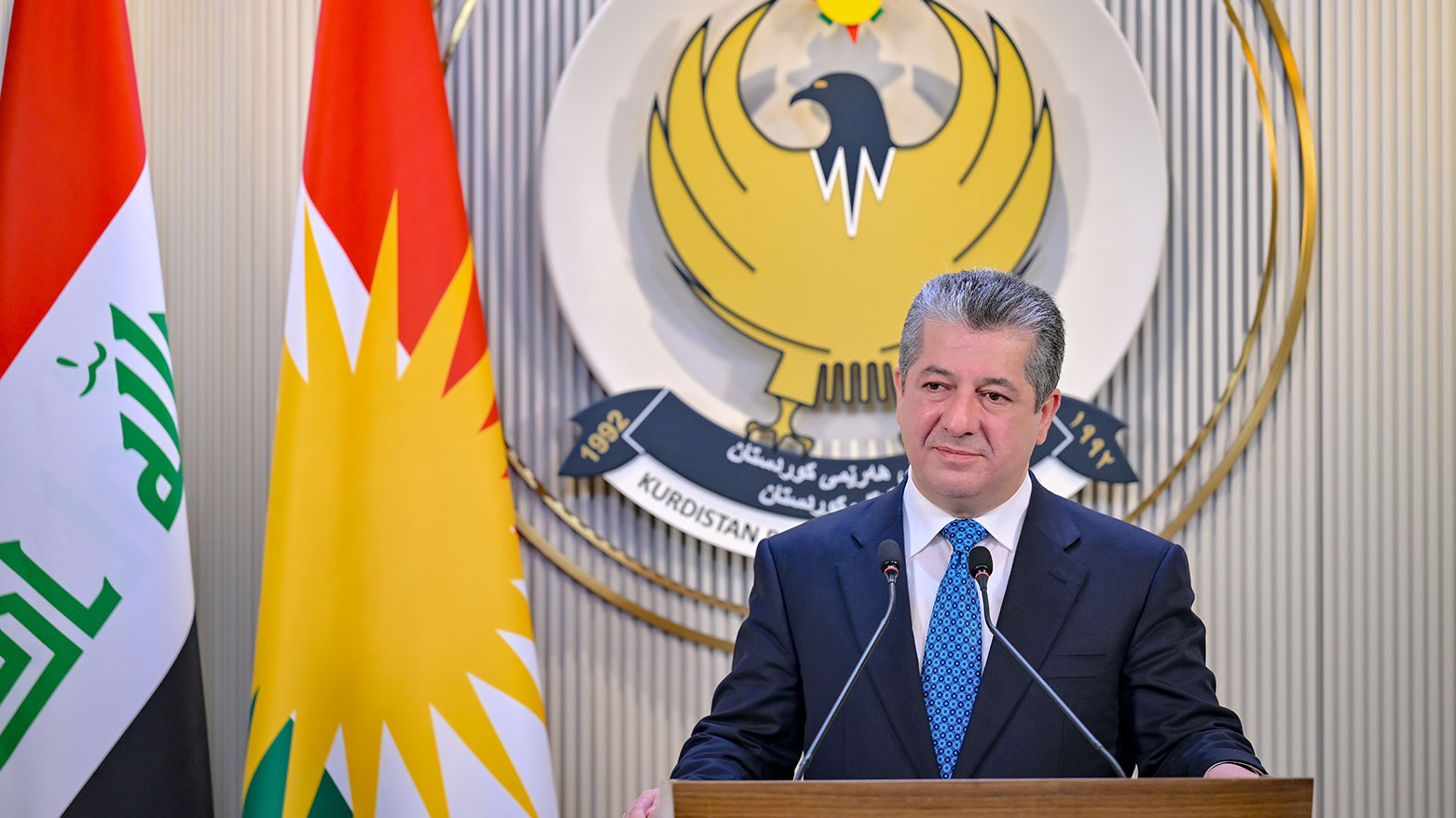
ERBIL (Kurdistan24) - The following is the full transcript of a press conference delivered by Kurdistan Region Prime Minister Masrour Barzani in Erbil on Monday.
During his opening remarks and an extended question-and-answer session with journalists, the prime minister addressed regional security, relations with Baghdad, salary payments, government formation, electricity and fuel challenges, drone attacks on the Kurdistan Region, and other key political and economic issues facing the Region.
The transcript is published in full for accuracy and public record.
Transcript of Prime Minister Masrour Barzani's Press Conference:
"Good afternoon... I am pleased to be with you today to discuss several critical issues concerning the current state of Kurdistan, particularly for the citizens of the Kurdistan Region.
As you are well aware, a portion of these issues stems from the broader regional situation. The tensions, conflicts, and clashes across the Middle East have yet to subside. This ongoing instability has generated widespread anxiety and apprehension throughout the region, simultaneously triggering economic crises that have impacted every corner of the Middle East—and certainly, we are not immune to these effects. However, the Kurdistan Region's stance remains exceptionally clear: we are firmly committed to the peaceful resolution of all disputes. We do not support the continuation of war and violence in the region, and unequivocally, the Kurdistan Region is not a party to any of these conflicts. Our objective is to see regional issues resolved peacefully.
We recognize the profound impact this has had on our citizens' daily lives. Therefore, I want to take this opportunity to express my deepest gratitude for the resilience and principled stance of the people of Kurdistan. You have always demonstrated a profound understanding of the situation, continuously showing your support for the Regional Government with remarkable patience. You know that the Regional Government is your government, and we will spare no effort to serve the best interests of the people of Kurdistan.
Amidst the crises currently engulfing the region, we are the true representatives of the people, and we care more deeply about their well-being than anyone else. I thank our citizens, fully acknowledging that life has become somewhat more difficult and unpleasant. Prices have risen, and the region is grappling with multiple cascading crises. The Kurdistan Region is an integral part of a Middle East navigating these turbulent times. However, our people must rest assured that we have overcome far greater crises in the past, and this too shall pass. I am highly confident that a brighter, more prosperous future awaits our people. I urge our citizens not to succumb to anxiety or panic; God willing, this situation is moving toward a resolution.
Regarding our relations with Baghdad, I want to reiterate our firm support for the current federal government led by Prime Minister Ali al-Zaidi. We have actively participated in this government and will continue to support its policies aimed at structural reform, combating corruption, and improving Iraq's economic conditions. Unfortunately, Iraq—like all countries in the region—is navigating a severe economic crisis exacerbated by the closure of the Strait of Hormuz, the primary artery for regional and Iraqi oil exports. This has induced an economic crisis across the entire region. Nevertheless, we are fully prepared to assist the federal government and Prime Minister Al-Zaidi in any way possible, ensuring that the Kurdistan Region plays an effective role in resolving these ongoing crises. I reiterate our steadfast support for His Excellency, and we are hopeful that the outstanding issues will soon move toward a final resolution.
We are making serious efforts regarding trade and the ASYCUDA [Automated System for Customs Data] system issue, which remains pending but is nearing a resolution, God willing. This will significantly facilitate commerce in the Kurdistan Region and help boost revenues for both the Region and all of Iraq. We hope this will reach a conclusive resolution very soon.
Regarding the issue of salaries, as you know, we have been in continuous engagement with the federal government to ensure timely disbursements. Under a previous decision, a financial obligation of 120 billion dinars was imposed on the Kurdistan Region, requiring the KRG to provide this sum. Whenever domestic revenues have been sufficient, we have consistently fulfilled this obligation. However, when trade stalls or when revenues across the Kurdistan Region and all of Iraq decline, it inevitably impacts our domestic income. This reality necessitates that the federal government review its previous decision so that we can assist one another. Our proposed solution is to boost revenues so that the KRG can contribute not just the 120 billion, but potentially more, to assist the federal government. But this requires mutual cooperation: trade volume in the Kurdistan Region must be increased, and domestic revenues must be enhanced so that we, in turn, can offer greater support to Baghdad.
In all other areas, we are currently coordinating more closely with the federal government. From both a security and political perspective, tensions are de-escalating, and thank God, many issues are fading away. We hope to take even better steps in this relationship moving forward and to assist each other further. We are satisfied with the current state of our relations and are pleased that ties between the Kurdistan Region and the federal government are now at a much better level.
On the domestic front, as you are aware, it has been nearly 20 months since we held elections, yet regrettably, a new Kurdistan Regional Government has not yet been formed. The government belongs to the people, just as the parliament belongs to the people. We firmly believe that reactivating the parliament and forming a government is, above all else, in the supreme interest of the people of Kurdistan. However, the ultimate responsibility rests heavily on the political parties that, as representatives, hold the mandate of the voters. Therefore, I reiterate what I have advocated since day one: the parliament must commence its work promptly, and a government must be formed that genuinely reflects the feelings and aspirations of the people of Kurdistan. Today, we reaffirm the absolute necessity of reactivating the parliament and forming the government. This government will serve the people, and the public expects a service-oriented cabinet that operates comprehensively across all of Kurdistan without discrimination. Therefore, I direct my call to all responsible political parties who consider themselves caretakers of the people of Kurdistan: step forward, so that together we can reactivate the parliament and form a government that meets the high expectations of our citizens.
During this period, as you know, there are specific crises I must address. One of them is the electricity issue. We previously promised the people of Kurdistan—and we remain committed to that promise—that we will provide 24-hour electricity. The project was, and continues to be, executed in a highly organized and efficient manner. However, we are facing an issue regarding the supply of natural gas, which is the primary source of electricity generation for all of Kurdistan. The majority of our gas is supplied by Dana Gas from the Khor Mor field. Recently, citing certain security concerns, the company unilaterally decided to reduce its gas output. This has drastically cut the volume of gas available in the Kurdistan Region, directly and severely impacting electricity production. The project itself is flawless; the disruption in electricity supply is entirely due to the shortage of gas. I hope that—despite our earnest efforts engaging with Dana Gas and other secondary gas suppliers—this crisis will soon be resolved. God willing, we expect to see progress in the coming days, leading to increased gas production, which will consequently boost our electricity output. This will also lead to an increase in condensate production, positively impacting the availability of gasoline and fuel for the people of Kurdistan.
I want to assure you that the government remains resolute in defending the rights of the people of Kurdistan. We are engaged in discussions with the companies. I recognize that every company, merchant, and business owner has their rights, but the people of Kurdistan have rights as well. We do not want anyone’s rights to be violated, but conversely, no one should act irresponsibly at the expense of others' rights. As a government, we are the protectors of the people's rights, and I want the public to be absolutely certain that we defend their rights more fiercely than anyone else.
Regarding gasoline and fuel, as you have heard, fuel prices have recently increased. This is partly due to the ongoing regional conflicts and tensions, which have driven up global oil prices, inevitably impacting domestic fuel costs. The cost of extraction remains unchanged; it does not decrease. I will elaborate on this further, but rest assured, the crisis engulfing the region has heavily impacted all of Iraq, including the Kurdistan Region. Naturally, when fuel prices rise, citizens demand reductions. We have been working closely with the Ministry of Natural Resources—and held a comprehensive meeting today—to determine the best possible price for citizens, one that is realistic and factors in the actual costs of oil extraction.
There is a lot of talk going around; many people speak without having the data. I want to clarify a few points very transparently so the people of Kurdistan understand the reality. In the Kurdistan Region, the cost of oil extraction is borne by the oil companies. The federal government allocates billions of dollars in sovereign expenses to cover oil extraction costs, but unfortunately, the Kurdistan Region does not benefit from any of the extraction funds provided by Baghdad. Consequently, these costs fall entirely on the shoulders of the KRG, which is contractually obligated to cover the extraction costs with the operating companies. Therefore, fuel prices in the Kurdistan Region are not inherently higher; rather, Iraq heavily subsidizes its fuel by billions of dollars, absorbing massive financial losses to provide fuel for domestic use.
We have requested that the Kurdistan Region receive its rightful, proportional share of petroleum products for domestic consumption. The Iraqi government currently allocates one million barrels of oil for internal use. Based on the 12.6% ratio that the federal government currently applies to our dealings, the Kurdistan Region is entitled to 126,700 barrels of oil. This is the legitimate quota of fuel that should be available to the people of Kurdistan. However, unfortunately, a previous administration in Baghdad imposed a cap, declaring that we were only entitled to 50,000 barrels for domestic use and nothing more.
This is profoundly unjust. Therefore, we have instructed the Ministry of Natural Resources, and we are currently negotiating with the federal government, to rectify this ratio and correct this historical injustice. I am hopeful that, given our currently positive relations with the federal government, this inequity will be reviewed, and the people of Kurdistan will be allocated their rightful share. We are currently utilizing 50,000 barrels domestically in the Kurdistan Region. The remaining quota must either be met by allowing us to increase domestic production for internal use, or—as some colleagues in Baghdad have suggested—we formally request the federal government to supply the outstanding 70,000 barrels. This would undoubtedly have a massive impact on lowering prices and securing the necessary fuel supply currently required by our citizens.
The current domestic fuel supply in the Kurdistan Region falls short of public demand, which is why fuel was previously imported. However, rising global prices have directly impacted the local market. We have strived to ensure that the people of Kurdistan benefit the most while suffering the least amount of harm. Therefore, we have directed the Ministry of Natural Resources to review the pricing structure so that the government-subsidized price for 'Normal' gasoline remains fixed—as I believe was previously announced—at 750 dinars, and the commercial rate does not exceed 850 dinars. Regarding 'Muhassan' (High-Octane) and 'Super' gasoline, I have asked the relevant authorities to conduct a thorough review and hold discussions to find an appropriate solution, as it is evident there is a shortage of these grades in the market.
Ultimately, what I want to convey is that we remain steadfast. We stand with the people, we share their pain, and we hear their demands. We will continue to do everything in our power to secure their rights. Whether through negotiations with the federal government or serious domestic initiatives, we will do whatever it takes to resolve these issues. Regarding the government's status, I reiterate: to resolve all these current crises, political unity, mutual understanding, and cooperation among all political parties are needed now more than ever. We must stand together to confront these crises and remain faithful to the promises we have made to the people of Kurdistan.
Thank you once again for your attendance. I am now at your disposal for any questions."
Question-and-Answer Session:
Journalist: Thank you, Mr. Prime Minister. I have two questions. First, over the past two months, there has been a shortfall in the distribution of salaries to Kurdistan Region civil servants. If Baghdad once again fails to separate the 120 billion dinars from the salaries of the Kurdistan Region’s civil servants, what is the KRG’s contingency plan, and how will salaries be distributed? Second, regarding the domestic political situation: following the initiative proposed by the Kurdistan Islamic Union (KIU), how are relations currently between the KDP and the PUK? Have positive steps been taken toward realizing this initiative, and if a date for a meeting has been set, could you share it with us? Thank you.
Prime Minister: What we desire is one thing; what we are practically capable of is another. We want salaries to be distributed in full and on time. Unfortunately, the government in Baghdad frequently complains about a lack of liquidity, noting that the ongoing economic crisis affects all of Iraq. Often, when we urge them not to delay the Kurdistan Region’s salaries, their response is that disbursements to some of their own federal ministries have also been delayed. We hope this issue can be resolved comprehensively. However, I can assure you that we will exert every effort to ensure that no wage-earner in the Kurdistan Region loses their rightful dues; their salaries may be delayed, but they will not be lost or canceled. I can offer that definitive assurance to the people of Kurdistan.
Regarding the domestic situation, we have put forward numerous initiatives. From the very beginning, President Barzani urged all political parties to convene and prioritize the supreme interests of the people of Kurdistan, urging political factions and individuals to give greater consideration to the public's well-being. Subsequently, our colleagues in the Kurdistan Islamic Union and other political entities made similar appeals. Given that there is a mutual desire and that all political parties are requesting these meetings, I frankly do not understand what is causing the delay! We are calling for it, the other parties are calling for it, so the meeting should take place. I hope it happens as soon as possible, but truthfully, a specific date has not yet been scheduled. I reiterate here that, starting today, we are ready to sit down with any party that is willing to meet.
Journalist: Regarding the drone attacks targeting the Kurdistan Region, what is your stance? The Kurdistan Region has been subjected to near-daily drone attacks recently. Are there any efforts underway to prevent this and to secure air defense systems for the Kurdistan Region? My second question concerns those responsible for these attacks against the Kurdistan Region, specifically the Iraqi armed groups.
Prime Minister: It is deeply regrettable. The Kurdistan Region has never been a party to this conflict, yet it has been targeted and attacked. These attacks occurred previously on a daily basis, and over the past 10 to 15 days, the Kurdistan Region has once again come under fire. It is truly unfortunate. We hope that the sovereignty of Iraq, and specifically that of the Kurdistan Region, will be respected. We have appealed to the federal government, foreign nations, and the international community to respect Iraqi sovereignty, and by extension, the sovereignty of the people of the Kurdistan Region. We are not part of this problem; I do not understand why they are trying to drag us into it by force. We have exercised immense restraint, preventing the Kurdistan Region from being drawn into this conflict, and we will maintain this policy.
In terms of securing the necessary defensive equipment, we have made substantial efforts. We have engaged with foreign nations and the federal government to ensure the Kurdistan Region has the fundamental right and means to defend itself. Regrettably, the air defense systems required to protect the Kurdistan Region are not yet adequately available to us. This is not for a lack of requesting or trying on our part; rather, we have thus far not been permitted to procure these systems for ourselves. However, we will persist in these efforts. Ultimately, our hope is that instead of merely providing us with defense systems, the root cause of the problem is eradicated entirely, ensuring the Kurdistan Region is never attacked by any faction in the first place.
Unfortunately, yesterday, the day before, or within the last two to three days, a portion of the drones that attacked the city of Erbil were launched from within Iraq itself, specifically from the direction of Mosul. We have once again petitioned the federal government—and we reiterate it now—that it is their fundamental responsibility to neutralize these sources of threats and risks targeting the Region. They must not allow these outlawed individuals to jeopardize the security and stability of the Kurdistan Region, and consequently, all of Iraq.
Journalist: Greetings, Prime Minister. In your remarks, you discussed domestic revenues in connection with the fuel issue. I have two questions. First, out of the 180,000 barrels of oil that constitute the Kurdistan Region's legitimate share of fuel, why is the Iraqi government only sending 50,000 barrels? And how will the remaining deficit be covered, given that this amount meets only 27% of the fuel market demand in the Kurdistan Region? Second, regarding domestic revenues, have you reached any agreement with the Iraqi government? The Iraqi government has significantly reduced its own revenues, yet it demands that the Kurdistan Region’s revenues be handed over in the exact same manner as before. Will this have any impact on the provision of salaries for KRG civil servants?
Prime Minister: Regarding the Kurdistan Region's fuel quota, as I previously explained, it depends on the metric used. If the federal government is currently allocating one million barrels of oil daily for domestic consumption across Iraq, and if our share is calculated at 14%, that amounts to 140,000 barrels. If calculated at 12.6%, it comes to 126,000 barrels. We had previously requested 115,000 barrels to meet our needs at the time, but unfortunately, the previous federal administration rejected this figure. Now, we are demanding that justice be served and that the people of the Kurdistan Region be treated equally with all other Iraqi citizens, without discrimination. The allocation must be calculated based on the 12.6% ratio, which equates to 126,000 barrels. If this is implemented, the fuel crisis in the Kurdistan Region will undoubtedly be resolved. Why haven't they done this? That was the policy of the previous administration. With the current government, we remain in active negotiations to reach a conclusive outcome. I hope they address this issue and grant the people their rightful share. As for the remaining deficit, we must either be allowed to meet it through our own domestic production, or the federal government should send us the outstanding balance (the 70,000 barrels) from Baghdad.
Overall revenues in Iraq have declined. Previously, the Iraqi government exported over 4 million barrels per day; that is no longer the case. The volume of oil transiting through the Kurdistan Region is significantly lower and in no way compensates for the massive financial losses the Iraqi government is incurring due to the closure of the Strait of Hormuz. However, the Iraqi government is a federal government, and the constitutional responsibility for paying salaries rests solely with them. Therefore, we demand that the people of the Kurdistan Region be treated exactly like all other Iraqi citizens. We have not asked for special or preferential treatment, but we absolutely refuse to be treated as lesser citizens. Our situation mirrors that of the rest of Iraq; if there are salaries for the people of Iraq, there must be salaries for the people of Kurdistan. If there are none, then let us reach a mutual understanding and figure out how we can collaboratively and fairly devise a solution.
Journalist: Greetings, Mr. Prime Minister. I have two questions. We know there is currently a set of suspended issues between Erbil and Baghdad—for instance, the issues surrounding revenues, the 120 billion dinars, the ASYCUDA system, salaries, etc. Resolving these requires coordination and mutual understanding. You previously visited Baghdad, and I believe you received assurances and promises. However, given what has now emerged regarding fuel prices and salaries, the people of Kurdistan are likely waiting to know when you will sit down with Baghdad again to discuss the details and reach a final resolution. That is my first question. My second question: I want to address a specific point, particularly regarding the decision to lower gasoline prices. Unfortunately, I have noticed a recurring pattern—from the COVID-19 pandemic, to the Runaki project, the construction of ponds and dams, and the Khas water project...
This pattern has repeated across these projects. Certain media outlets are directed—and frankly, I want to say they don’t know or care what the future holds for that project or decision. Only one thing matters to them: the decision was issued by Masrour Barzani, so they must oppose it. For example, during the rollout of the Runaki project, one satellite channel purchased a highly advanced lens from abroad, brought it in, assigned a crew, and spent money on it with the sole hope of filming an alley in Erbil to say, "Look, the lens makes the area look dark; the Runaki project is darkness!" My question is, what is your view on this? Will this affect your future work and the decisions you make for the benefit of the people? Additionally, regarding the decision to lower gasoline prices, there was a noble and commendable stance taken by merchants and gas station owners who stepped forward, absorbing the costs and losses from their own pockets. I want to know what your message is both to those who didn't, and to the citizens and merchants who stepped up in this manner?
Prime Minister: Thank you. We do not want anyone to suffer financial losses—not the refinery owners, not the companies, and not the gas station owners. However, we also refuse to allow them to impose their demands at the expense of the public, and we absolutely will not tolerate anyone monopolizing the market or exploiting the government's decisions for personal gain. The government is committed to defending everyone's rights, ensuring that one party's rights do not infringe upon another's. There are hard facts: Iraq's oil exports have decreased significantly, causing liquidity issues. This economic crisis is not confined to the Kurdistan Region; it affects Iraq and the broader Middle East. However, within the Kurdistan Region, we aim to minimize the damage and ensure our rights are protected. We have proposed solutions to Baghdad, and the Iraqi Prime Minister has been highly responsive and attentive to the rights of all his citizens without discrimination. The relationship between us and the federal government is healthy, and we will continue working together to find appropriate solutions.
Regarding the other point you raised, frankly, I do not wish to waste time responding to individuals who lack a sense of responsibility or who speak solely to advance their own specific agendas. I have said this before: we do our job, which is to serve the people; their job is simply to talk. Ultimately, the people of Kurdistan are the final judges, and they will decide who genuinely cares for their well-being and who is trying to manufacture crises for personal gain. I just want to assure the public that we will always be honest with them and will stand by them through both the good times and the bad.
Journalist: Thank you, Mr. Prime Minister. You spoke very clearly and dotted the i's and crossed the t's. I would like to ask: Can this positive relationship between your government and the new government in Baghdad, which you highlighted, resolve the long-standing, historical disputes? Because during previous administrations, in 2003 and 2005, issues like Article 140, the equipping of the Peshmerga, and genuine power-sharing were discussed, and promises were made but never fulfilled. My second question: Honestly, outside the Kurdistan Region and in the Article 140 territories, all Kurdistanis in other parts view your government as their own. Do you have a specific message for those Kurdistanis outside the Kurdistan Region? Thank you very much.
Prime Minister: Thank you very much. We will continue to work with the Prime Minister and the current government to resolve the legacy issues we have inherited from the past. Naturally, this requires time and genuine intent. From what I sense, the Prime Minister and the current administration possess the genuine intent to resolve these disputes. For our part, we are ready to do what is required of us, and we will firmly demand what is rightfully ours. As you all know, the current situation is extraordinary; wars and tensions persist in the region. Our hope is that if these regional tensions de-escalate, Iraq's internal situation will stabilize further, allowing these issues to be resolved much faster. The crucial element is that there is a mutual, bilateral desire to resolve the problems.
My request to all Kurdistanis, wherever they may be, is this: support us so we can continue to serve our people and protect the political entity of the Kurdistan Region. We always advocate for the peaceful resolution of disputes, regardless of which neighboring country is involved. Every Kurd, no matter where they are, should demand the peaceful resolution of their issues, and we stand firmly in support of our people's rights.
Journalist: Mr. Prime Minister. My first question: The Kurdistan Region, which previously remained insulated from the unfolding events in the Middle East, is now periodically targeted by armed groups. What are the KRG's measures to protect its institutions and the citizens of the Region? My second question concerns the Strait of Hormuz: due to the crisis between the US and Iran, oil exports through that route have been severely disrupted. Is the Kurdistan Region prepared to assist Iraq in exporting its oil? Thank you.
Prime Minister: Thank you very much. Regarding the first question, that is absolutely not the case; the US government has not placed any pressure on us whatsoever, and I don't know where those rumors originated, but they are entirely false.
Regarding whether the KRG will assist Baghdad: Yes, from day one we have demonstrated our readiness, and we remain ready. However, the volume of oil that can currently be exported from the Kurdistan Region is extremely limited. The oil originating from the Kurdistan Region itself, or Kirkuk oil transiting through the Region, barely reaches a maximum capacity of 700,000 barrels. Even if all of it were exported, it is only that much, and it cannot possibly compensate for Iraq's 4 million barrels. Nevertheless, we stand ready to do our part to help the federal government navigate this crisis. This is also why we have requested that commercial trade issues at the border crossings be resolved, as this would provide further assistance to the federal government. We are on the same page as the federal government, we are supportive, and we want to help Baghdad in any way we can.
Journalist: Prime Minister Masrour Barzani, the formation of the new cabinet was mentioned, and the public is looking forward to its establishment—and it is clear to the public that you will be leading it. What are your plans and projects to ensure that the challenges faced during the Ninth Cabinet are not repeated? I have another question: previously, election results were the benchmark for determining which party would form the government, but now that seems to have been inverted. Can a new government or cabinet be formed without the KDP, which is the winning party and the most influential force in the political arena of the Kurdistan Region? Thank you.
Prime Minister: Thank you very much. We want the government to be formed, and from the very beginning, we have demanded that all parties act in accordance with their responsibilities to both form the government and ensure it is a comprehensive, service-oriented administration. Our agenda is for the government to be the people's government, striving for the interests of the people and the land of the Kurdistan Region. Therefore, we do not have a radically different approach from what we have done up to now, because we have fulfilled all our promises and have consistently placed the supreme interests of the people and the land of Kurdistan above our own. We will continue on this path. Regarding your second question, without the KDP? No, the government cannot be formed without the KDP.
Journalist: Mr. Prime Minister, I have two questions. First, if the Iraqi government fails to take any steps forward, how will the gasoline issue be resolved? Particularly in the last few days, we saw that following the decision to reduce the prices of Muhassan (improved fuel) and Super gasoline, merchants in the market stated they can secure very little supply at these prices. My second question is regarding gas production: is it clear to you when gas production will resume? And have any guarantees been received from the Iraqi government ensuring that these attacks on the Kurdistan Region's energy infrastructure will not be repeated?
Prime Minister: Yes. As I mentioned, we have attempted to resolve the fuel crisis from several angles. Part of it rests with the federal government, but internally, we have made serious efforts and held extensive meetings with the Ministry of Natural Resources to tackle this crisis. When the public complained about rising fuel prices, the government intervened to lower them. However, on the flip side, Muhassan and Super gasoline disappeared from the market under the pretext that they could not be supplied at the new mandated price. Part of this issue revolves around determining what constitutes a fair and appropriate price. We can control what happens internally, but external factors are beyond our jurisdiction. We currently have two different experiences: prices are higher in Sulaymaniyah, lower in Erbil, and there are complaints from both sides. Therefore, we have tasked the Ministry of Natural Resources to conduct a comprehensive review to ensure that fuel is adequately available and prices are reasonable. All parties must shoulder their responsibilities to ensure the citizens do not suffer unduly.
What was your second question? (Dana Gas). Ah, Dana Gas. We have made serious efforts with both the federal government and the company itself to resume and increase their gas production. Citing security risks, they state they have reduced their output. We hope this threat dissipates, allowing them to resume full gas production in the near future, which will have a positive impact on both fuel and electricity availability.
Journalist: Mr. Prime Minister, I have one question. Has the Kurdistan Regional Government had any recent discussions with the US and the Coalition regarding the provision of air defense systems for the Kurdistan Region to protect it from these drone and missile attacks?
Prime Minister: We've had this conversation and these discussions with all our friends, including the Americans, and we have raised our concerns about the vulnerability of Kurdistan region, especially that we are defenseless. We don't have adequate defense systems against incoming drones or missiles. We have asked for adequate protection for all of our peoples and institutions.
We are still trying to get those weapons and those systems in place. So far, they have been providing protection because of their own presence, but of course after the departure of these troops, there will be a different situation, and we are trying to speak with both Baghdad and also Washington to see what would be – what the status be after the departure or the end of the coalition mission here in Iraq at the end of September. And your next – your other question was the Dana Gas and the protection.
I understand that many of these companies have already asked for their own systems, and they have been in discussions with both the coalition forces and also the Iraqi federal government. I have not heard that there has been resistance or they haven't allowed any of the systems to be in place. It's just, I think, a matter of logistical issue that hopefully will be resolved sometime soon.
Thank you all very much. Good luck and much success to you all."