Kurdish Artist Ashna Dawlat Showcases Migration and Identity at Polish Exhibition
Her abstract work explores the emotional distance between homeland and life abroad, drawing on memories, Kurdish architectural motifs and the experience of living between two cultures
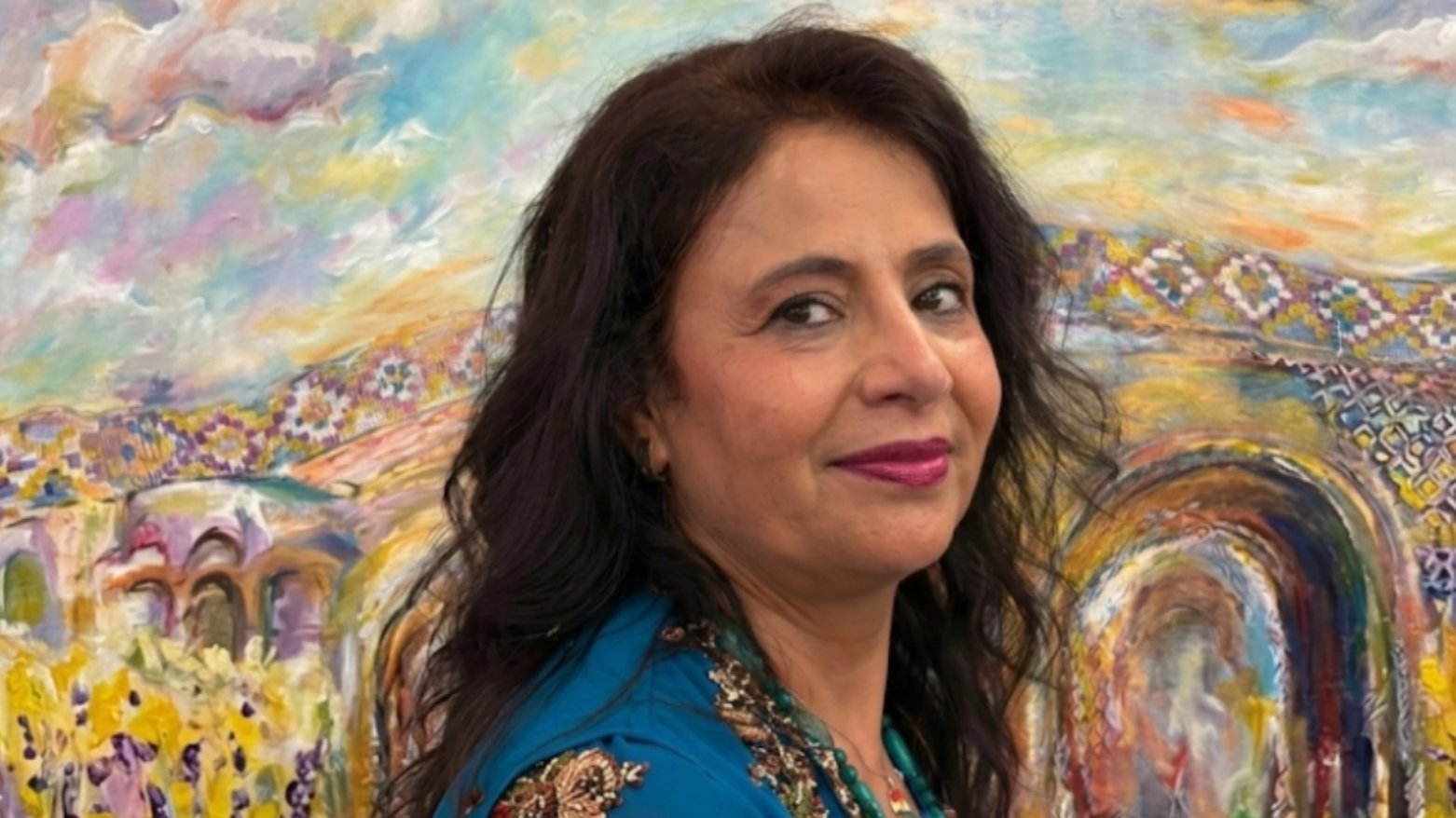
ERBIL (Kurdistan24) — Kurdish visual artist Ashna Dawlat has taken part in a joint art exhibition titled “Art Without Borders” in Poland, presenting a work that explores homeland, memory, identity and the emotional experience of migration.
The exhibition was recently opened at the Węgrzynowice Cultural House in Poland, bringing together nearly 13 Kurdish artists from Sweden and elsewhere.
According to Dawlat, the participating artists regularly come together in Stockholm to organize cultural and artistic activities aimed at presenting Kurdish identity and culture through their work.
“From Stockholm in Sweden, a group of Kurdish artists continuously come together through artistic activities, and we try to present Kurdish identity and culture through our works,” Dawlat told Kurdistan24.
She said some of the artists were unable to attend the exhibition in person because they live in Sweden and the distance made travel difficult, but their artworks were sent to Poland for display.
Art as an expression of displacement
For Dawlat, the work displayed at the exhibition is closely connected to personal memories and the experience of being separated from homeland.
“Through this painting, I have tried to express some of my inner feelings, thoughts and memories, particularly those connected with homeland, home, identity and the life of a migrant,” she said.
Dawlat described leaving one’s homeland, family and the city where one grew up as an experience that can create a profound sense of loss.
“For me, this distance has become a source of many of the thoughts and feelings within my works,” she said.
She explained that returning to Kurdistan after many years can produce a striking contrast between remembered places and their present reality. Streets, houses and buildings may remain deeply preserved in memory, while their physical appearance can change considerably over time.
“This difference between what has remained in our memory and what exists in reality creates a particular feeling within me, and I want to express it through art,” Dawlat said.
The symbolism of home
Architecture plays an important role in Dawlat’s work. Houses, buildings, doors, curtains, patterns and elements inspired by traditional Kurdish heritage appear symbolically throughout her painting.
For the artist, however, a home represents far more than a physical structure.
“Home for me is a symbol of peace, security and certainty, and the place where a person feels that they belong and can be themselves,” she said.
She therefore views separation from home and homeland as more than a physical distance.
“It is also a kind of psychological distance,” she said.
That idea is central to the experience explored in her work: the migrant is physically removed from familiar surroundings while continuing to carry them internally through memory, emotion and imagination.
Living between two worlds
Dawlat also highlighted what she describes as the complex psychological position of migrants, who can find themselves between their homeland and their adopted country.
“A migrant often lives between two worlds,” she said. “In their homeland, they may feel like a stranger because places and times have changed, while in the host country they may sometimes experience a sense of difference and foreignness.”
This condition, she added, can lead to a persistent question about belonging: Where am I, and where is my true place?
Dawlat sees this not simply as an individual experience but as one shared by many Kurdish migrants.
Large Kurdish communities have lived outside Kurdistan for decades, with migration shaped by political upheaval, conflict, economic circumstances, education and other factors.
For many Kurdish families, this has created lives that span more than one country and culture.
Dawlat particularly pointed to the experience of second-generation migrants, who can maintain a connection with the culture and heritage of their parents while simultaneously growing up within the language, social environment and culture of their host country.
Cold landscapes and inner conflict
The atmosphere of Dawlat’s painting also carries symbolic meaning.
She said the coldness and emptiness of nature depicted in the work represent an internal emotional state — that of someone searching for an inner sense of truth while still struggling to determine their place in the world.
“The cold and silent nature is, for me, an image of a feeling that I have carried within myself for years,” she said.
The painting was created using acrylic paint in an abstract style, combining elements of the landscape of a foreign country with memories of her homeland and her own imagination.
Dawlat said she sought to translate this internal struggle into the visual language of colors, forms and images.
‘Art knows no geographical borders’
Dawlat described her participation in the Polish exhibition as important because it allows Kurdish artists living abroad to communicate aspects of their identity and experiences to international audiences.
“Art knows no geographical borders,” she said. “If an artist can transfer a feeling from the heart of one person to the heart of another, then the message has reached its destination, even if the languages, homelands and cultures are different.”
The theme of “Art Without Borders” consequently reflects one of the central ideas behind Dawlat’s work: that personal experiences of displacement and belonging can transcend national and cultural boundaries.
For Kurdish artists living in the diaspora, international exhibitions also provide a platform through which elements of Kurdish heritage, memory and contemporary experience can enter wider cultural conversations without being separated from the individual stories behind them.
About Ashna Dawlat
Ashna Dawlat, a Kurdish visual artist, was born in 1969 and completed her art studies at the Institute of Fine Arts in Sulaimani.
She moved to Sweden in 1994 and, alongside her professional work in water engineering and water management, has remained active in painting and the visual arts.
Dawlat held her first solo exhibition in Sweden in 1995 and has since participated in exhibitions and artistic activities in Kurdistan, Sweden and several other countries.
She has also served as a founder and organizer of international artistic gatherings in Sulaimani, contributing to efforts to connect Kurdish artists with wider international artistic networks.
Her latest participation in Poland adds another chapter to that work, using abstract art to examine a deeply personal question that extends beyond geography: how a person continues to carry a homeland within them even after years of living elsewhere.

