Kurdistan Interior Minister Calls for Sinjar Agreement to Be Implemented, Rejects Military Administration
Rebar Ahmed urges implementation of the Sinjar Agreement and demands the Kurdistan Region’s 14.1 percent share of Iraq’s federal budget
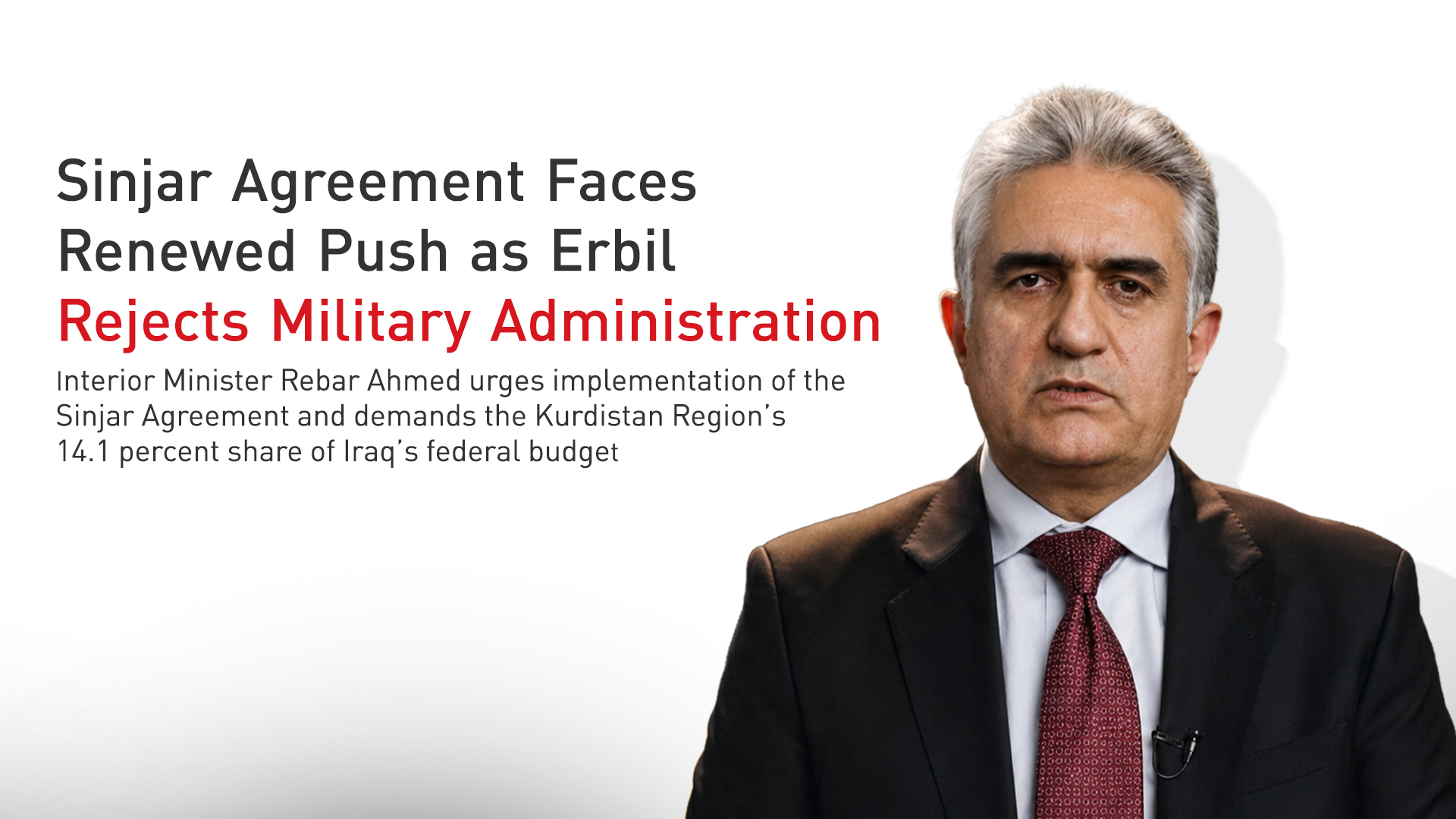
ERBIL (Kurdistan24) — Kurdistan Region Interior Minister Rebar Ahmed on Thursday highlighted several sensitive issues between Erbil and Baghdad, including implementation of the Sinjar Agreement, the withdrawal of international coalition forces, the resumption of oil exports, and the Region’s share of the federal budget.
Sinjar Agreement Should Be Implemented
Ahmed described the situation in Sinjar as complex and said the Sinjar Agreement remains the best and most appropriate solution to the area’s problems, calling on federal government institutions to take swift and practical steps to implement its provisions.
“What is important to us is not the title of the agreement, but the implementation of the provisions that were agreed upon,” Ahmed said, pointing to the normalization of the situation, restoration of stability, removal of armed forces from the city, transferring security responsibilities to local police, appointing a new district administrator, and restoring public services.
The interior minister strongly rejected the possibility of appointing a military administrator in Sinjar, describing it as the “worst option.”
He said the issue should instead be addressed through a political and administrative agreement involving the Nineveh Provincial Council, the governor of Nineveh, and political parties to establish a new administration capable of restoring services and reconstruction in Sinjar.
Coalition Withdrawal Raises Security Concerns
Regarding the withdrawal of forces from the international coalition against ISIS, Ahmed reaffirmed the Kurdistan Region’s support for Iraq’s sovereignty and independence in political decision-making.
He said the withdrawal was the result of previous agreements between the federal government and the international coalition, while warning against the emergence of security gaps following the departure of coalition forces.
“We hope the withdrawal of these forces will not have a negative impact on security and stability and will not create a security vacuum,” Ahmed said.
“Maintaining security is a comprehensive issue and cannot be divided. The security of Iraq and the Kurdistan Region are interconnected, so coordination between the security forces of Iraq and the Kurdistan Region, together with international partners, is very important,” he added.
Kurdistan Region Ready to Resume Oil Exports
On oil exports, Ahmed said the Kurdistan Regional Government is fully prepared to resume exports through the pipeline and is awaiting further steps from Baghdad.
“The Kurdistan Regional Government (KRG) is very serious about resuming oil exports. We are ready, but at present we are waiting for the final agreement between the federal government and the oil companies,” he said.
Ahmed added that some oil companies are currently operating to meet domestic needs, but said outstanding issues remain, including the lack of full security guarantees for oil companies, particularly protection systems against drone attacks.
Erbil Seeks 14.1 Percent Budget Share
Ahmed also addressed the Kurdistan Region’s financial rights and its share of Iraq’s federal budget, saying the latest census conducted in 2025 put the Region’s population, excluding disputed areas, at 14.1 percent of Iraq’s total population.
“The Kurdistan Region’s delegation in Baghdad insists that the Region’s share should be determined on the basis of this 14.1 percent,” Ahmed said.
He argued that the figure was produced by the federal authorities themselves and should therefore be reflected in the Region’s constitutional financial rights.
“We are asking for a comprehensive budget, not merely the sending of salaries,” he said.