Iran’s President Vows Country Will “Never Surrender” as War with US and Israel Escalates
Pezeshkian rejects Trump’s demand for unconditional surrender while apologizing to Gulf neighbors amid widening regional conflict
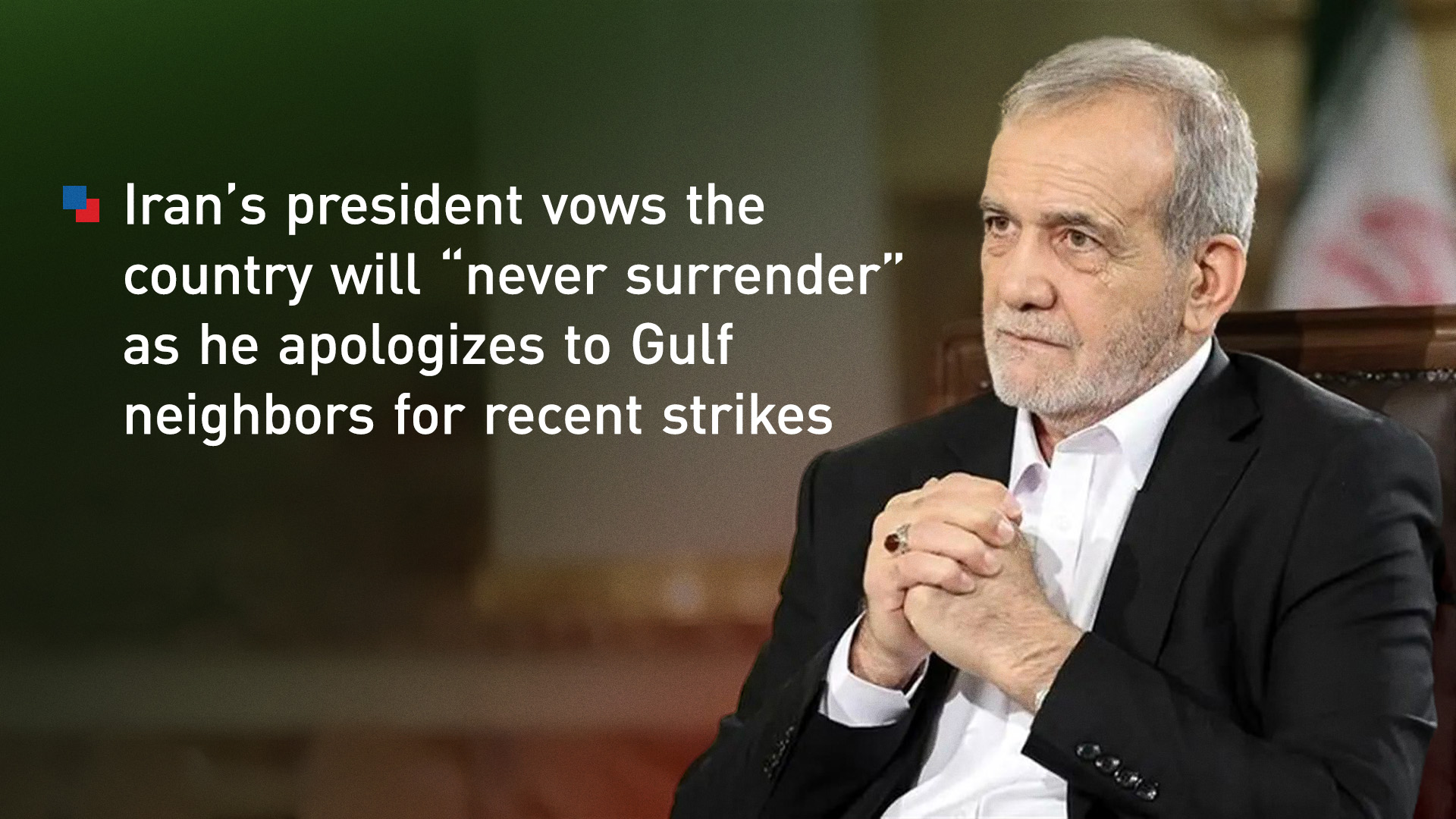
ERBIL (Kurdistan24) — Iran’s President Masoud Pezeshkian said on Saturday that his country would “never surrender,” rejecting calls from U.S. President Donald Trump for Tehran’s unconditional capitulation as the regional war entered its second week.
Speaking in a televised address, Pezeshkian struck a defiant tone while responding to Trump’s remarks that only Iran’s “unconditional surrender” could bring an end to the conflict.
“Iran’s enemies must take their wish for the unconditional surrender of the Iranian people to their graves,” Pezeshkian said in the speech broadcast on state television.
At the same time, the Iranian president sought to ease tensions with Gulf countries, some of which host major U.S. military bases, saying Tehran does not intend to target them unless their territories are used to launch attacks against Iran.
Pezeshkian issued an apology to Iran’s Gulf neighbors, stating that they would only become targets if their lands were used as launchpads for strikes against the Islamic Republic.
Trump has rejected calls for renewed negotiations with Tehran. Writing on his Truth Social platform on Friday, the U.S. president said there would be “no deal with Iran except UNCONDITIONAL SURRENDER.”
White House Press Secretary Karoline Leavitt reinforced that stance, saying that once Washington determines Iran no longer poses a threat and military objectives are achieved, “Iran will essentially be in a place of unconditional surrender, whether they say it themselves or not.”
Trump also suggested that the United States would help rebuild Iran’s economy if Tehran installs a leader “acceptable” to Washington following the killing of Iran’s supreme leader, Ayatollah Ali Khamenei.
Iran’s ambassador to the United Nations, Amir Saeid Iravani, rejected any suggestion of foreign involvement in determining Iran’s future leadership.
“The selection of Iran’s leadership will take place strictly in accordance with our constitutional procedures and solely by the will of the Iranian people, without any foreign interference,” Iravani said.
Now entering its second week, the war began after joint U.S. and Israeli airstrikes last Saturday killed Khamenei and destroyed large parts of Iran’s military, administrative, and security infrastructure.
Since then, the conflict has spread across multiple countries, including Lebanon, Cyprus in the European Union, Türkiye, and Azerbaijan. The fighting has also reached waters near Sri Lanka, where U.S. forces sank an Iranian warship with a torpedo, highlighting the widening scope of the confrontation.