Prime Minister Nechirvan Barzani says in reality, “Iraq is not one”
“Our question is ,if the referendum is such a bad thing, then what will be the alternative,” Barzani said.
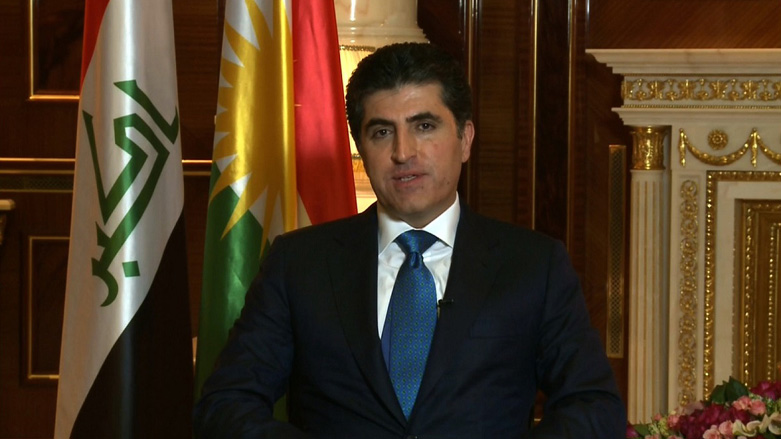
WASHINGTON DC, United States (Kurdistan 24) – Nechirvan Barzani, Prime Minister of the Kurdistan Regional Government (KRG), discussed the Independence Referendum on Monday in a lengthy interview with the Moscow-based television station, Russia Today (RT).
The Prime Minister explained, “Until this very moment, there is no decision” to delay the referendum as the Kurdistan Region’s High Council for the Independence Referendum had reaffirmed on Sunday.
Last week’s visit of US envoy, Brett McGurk, to the Kurdistan Region, and the Kurdish rejection of his plan, has triggered a parade of Western dignitaries, visiting Erbil to repeat McGurk’s message.
So far, all of them seem to have heard the same thing from the Kurdish leadership: “We have decided to go to the people in order to decide their future,” as Barzani told RT.
The Prime Minister repeatedly emphasized that holding the referendum does not mean that the KRG will declare independence immediately afterward. Rather, “We would like to enter into serious dialogue with Baghdad” on “all the pending issues.”
Barzani suggested that the significance of the referendum had been “exaggerated” by the international community. “It should be seen for what it is and what purpose it serves.”
The Prime Minister also explained that the international community, led by the US, was telling the Kurdish leadership that the referendum should not take place or should be delayed.
“Our question is: if the referendum is such a bad thing, then what will be the alternative,” Barzani said. “And if the timing is not right, can you say what the right time for us would be?”
“So far, we have not had a response to these questions,” he explained. All that we have been told is that the referendum should be postponed,” while they do not offer any alternative.
Barzani also noted that the international community “continuously emphasizes” the unity of Iraq. “As a slogan, this may be the approach of politicians.”
“In reality, on the ground, Iraq is not one,” he said. But as Kurds, we “are not the ones to blame” for Iraq’s situation or for the “wrong direction” that the country has taken.
Speaking about Kirkuk, Barzani explained that its future “will be left entirely to the population,” and “we will not impose any solutions.”
Kirkuk has a “special status” because of its mixed population, and it can be “a region of self-administration” that recognizes the “special status” of its component communities.
The Kurdish leader also sought to reassure Ankara. The KRG enjoys “good relations with Turkey,” he said, and “we do not want to spoil this.”
“We hope that there would be more understanding and communications, and we are ready to communicate further about this issue.”
In illustrating Baghdad’s mistreatment of the Kurdistan Region, the Prime Minister gave two examples.
The Shiite militias, known as the Hashd al-Shaabi, received what they needed from Baghdad to fight the Islamic State. However, the Peshmerga who were “in the same trenches” and “offered the same sacrifices” received nothing.
Barzani also noted that the International Monetary Fund and the World Bank have provided loans and assistance to Baghdad, but “unfortunately, none of that was passed on to the Kurdistan Region.”
Editing by G.H. Renaud