UN Envoy Highlights Kurdish Representation SDF Integration And Kurdish IDPs At Security Council
Deputy Special Envoy for Syria told the UN Security Council that discussions on integrating SDF forces into Syria’s national institutions are advancing, while organized returns to Afrin and unresolved displacement issues remain central challenges in Western Kurdistan
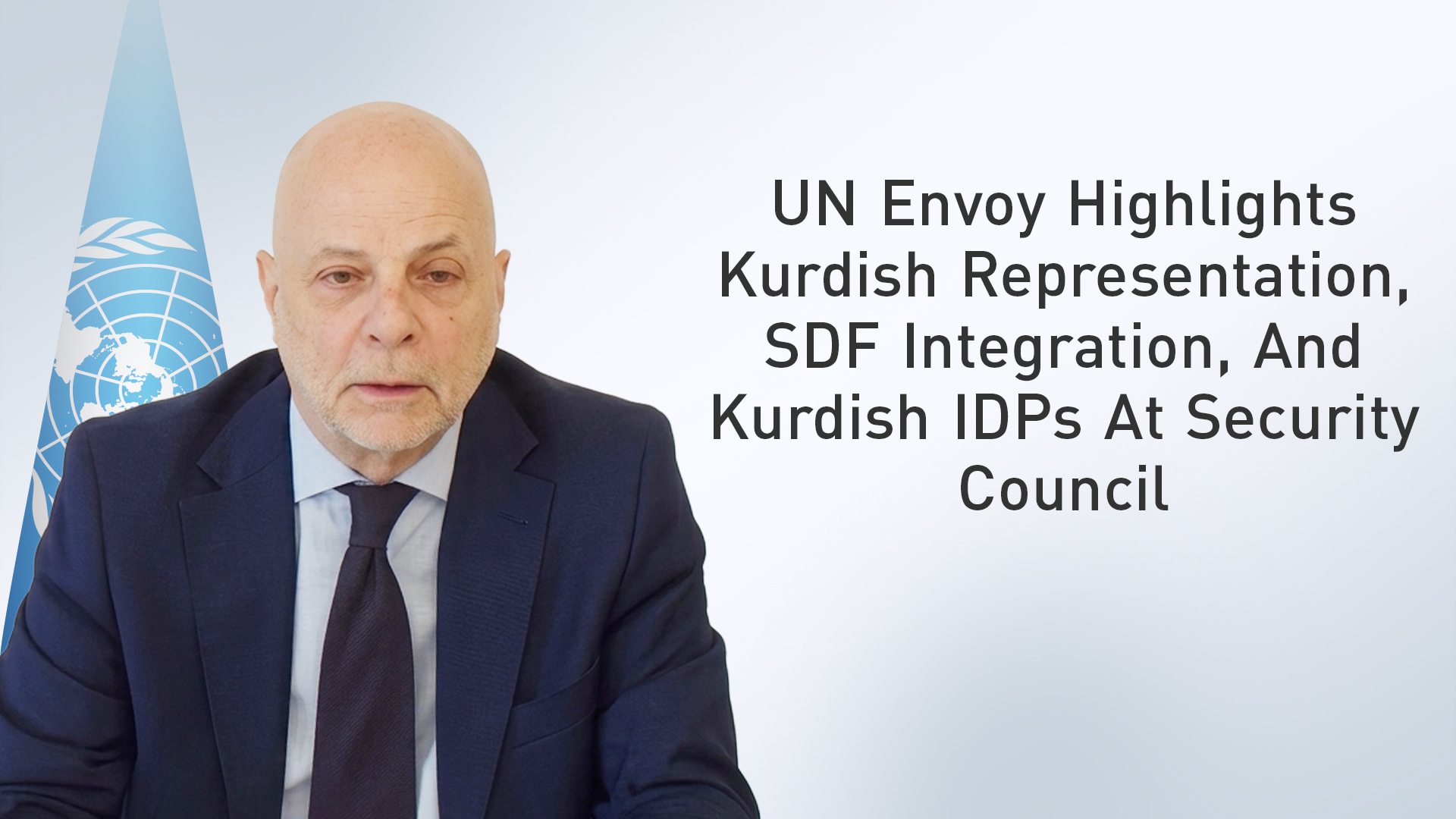
ERBIL (Kurdistan24) - Kurdish-majority areas, the future of the Syrian Democratic Forces (SDF), and the return of displaced residents to Afrin emerged as key themes during a United Nations Security Council briefing on Syria delivered by Deputy Special Envoy for Syria Claudio Cordone.
Speaking during the Security Council’s 10151st meeting, Cordone said Syria’s political transition requires broader representation and functioning institutions, while warning that instability, unresolved displacement, and governance challenges continue to affect northeastern Syria.
Elections in Kurdish-majority areas
Cordone announced that Syria’s Supreme Committee for Elections had appointed electoral subcommittees on May 6 for the three districts of Hasakah Governorate and for Ain al-Arab, also known as Kobani.
According to the UN envoy, indirect elections for 11 seats in those areas have yet to take place, while authorities are still expected to announce a voting date.
“We understand that the announcement of the 70 presidential appointees and the convening of the first session of the People’s Assembly will follow thereafter,” Cordone told the council.
He stressed that the Syrian transition requires a legislature capable of functioning “without delay,” emphasizing the need for “meaningful participation of serious women and diverse communities.”
Cordone added that broader inclusion remains necessary to ensure “legitimacy and stability” during the ongoing political transition.
SDF integration talks gain momentum
Focusing on northeastern Syria, Cordone said implementation of the Jan. 29 agreement between Damascus and the SDF had gained momentum through repeated meetings between SDF representatives and the Syrian government.
“In the Northeast, the implementation of the 29 January agreement gained momentum with repeated visits by the SDF representative to Damascus for discussions with the government on advancing military and institutional integration,” he said.
Cordone stated that current discussions include integrating four brigades into the Syrian national army structure, while negotiations continue regarding additional SDF formations, including the women’s military unit.
“It is our understanding that four brigades will be integrated into the national army structure, while discussion continues on the integration of additional SDF forces, including the female military unit, as well as on broader civilian integration and education curriculum,” he said.
The UN official also revealed that authorities in Hasakah had agreed on a preliminary local roadmap to implement the Jan. 29 agreement, expressing hope for faster progress, including the release of prisoners.
Afrin returns and unresolved property disputes
Cordone also addressed the issue of displacement and returns to Afrin in Western Kurdistan.
“I welcome the continuation of organized returns to Afrin, including the return this month from Hasakah and Qamishli of 1,200 displaced,” he said.
The envoy described the returns as “a positive step towards addressing protracted displacement and unresolved property issues.”
According to the figures referenced in the report, five separate convoys of displaced residents have returned to Afrin so far in 2026.
The first convoy arrived on March 9 and included around 400 families
followed by a second convoy on April 4 carrying approximately 200 families
A third convoy reached Afrin on April 14 with around 800 families
The fourth convoy arrived on May 9 with nearly 1,200 families
A fifth convoy entered the region on May 10 carrying approximately 1,400 families
Despite the ongoing returns, displaced residents continue to face persistent challenges, particularly due to the continued occupation of a large number of homes belonging to local residents of the region.
His remarks come amid continuing concerns among displaced Kurdish residents regarding housing, property ownership, and return conditions in Afrin.
Instability and local autonomy demands
Despite ongoing return efforts, Cordone warned that northeastern Syria continues to face political and security instability.
“Syria faces persistent political and security instability, with weekly demonstrations over demands for the release of detainees, the return of displaced persons, and greater local autonomy,” he said.
According to the UN envoy, approximately 20,000 displaced people have returned to their areas, while more than 150,000 remain displaced.
He added that rehabilitation and education challenges continue to hinder stabilization efforts.
Thousands of students face uncertainty
Cordone also highlighted disputes between local authorities and Damascus over educational administration in northeastern Syria.
“The future of maybe 13,000 students remains uncertain due to disagreements between local and central authorities over logistical and security arrangements for administering their exams,” he said.
The envoy stressed that resolving the issue in line with students’ interests would help restore “trust and stability,” alongside broader dialogue, accountability measures, rehabilitation efforts, service provision, and security arrangements.
Cordone emphasized that all such efforts should take place “in full respect of Syria’s unity and territorial integrity.”
Transitional justice and accountability
Beyond northeastern Syria, the UN official also focused heavily on accountability efforts linked to crimes committed during the Syrian conflict.
Cordone highlighted the May 10 court appearance of Atif Najib, who is facing trial over crimes committed during the early stages of the uprising in Daraa in 2011, while former Syrian President Bashar al-Assad and Maher al-Assad are being tried in absentia in the same case.
He also referenced the arrest of Amjad Youssef in connection with the 2013 Tadamon massacre and the arrest of former Major General Ahmed Aboud Hidwad over the Eastern Ghouta chemical attack.
Cordone described the developments as an important step toward accountability and urged Syrian authorities to ensure due process and fair trial standards.
As Syria navigates a fragile political transition, Cordone’s briefing underscored the growing importance of northeastern Syria and Kurdish-majority regions in shaping the country’s future political and security landscape.