White House acknowledges US may be illegally arming Shia militias
“We have seen reports that some US-origin military equipment is being operated by Iraqi militia units that are not the approved end-users,” a spokesman for the White House National Security Council told the Washington Free Beacon.
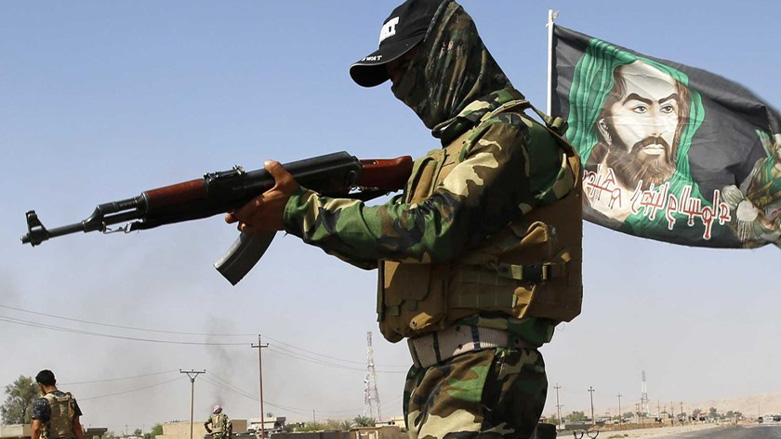
WASHINGTON DC, United States (Kurdistan 24) – A White House spokesman acknowledged that Iraqi Shia militias may be using US military equipment, contrary to US laws.
“We have seen reports that some US-origin military equipment is being operated by Iraqi militia units that are not the approved end-users,” a spokesman for the White House National Security Council told the Washington Free Beacon.
The sale and transfer of US arms are tightly regulated, and one important regulation involves the “end-use” of such material. It must remain in the hands of that party that received the equipment, and the equipment cannot be transferred without US permission.
“End-use monitoring is an integral component of the process for US-origin defense articles delivered to any recipient nation,” a State Department Spokesperson told Kurdistan 24.
“This is to make sure that US-origin defense articles are being used in the manner intended and are consistent with our legal obligations, foreign policy goals, and values,” the spokesperson added.
Congressmen are increasingly pressing the administration over Iraqi Shia militias’ use of US military equipment, including M-1 Abrams tanks, against Peshmerga forces.
The initial response of US spokespersons, whether the Defense or State Departments, following Baghdad’s Oct. 16 assault on Erbil, was to deny knowledge of the involvement of the Iranian-backed militias and their use of US weapons in the initial attack and the fighting that followed.
Rep. Duncan Hunter (R, California) arrived at a Capitol Hill press conference earlier this month with pictures protesting such ignorance.
“There’s the M-1 Abrams tank, with the Hezbollah flag,” Hunter said, “I don’t care what the State Department says, they can’t argue with this.”
The head of Iraq’s Kata’ib Hezbollah, Abu Mahdi al Muhandis, is a US-designated terrorist. He is also the Deputy Commander of Iraq’s Popular Mobilization Forces (PMF), the formal name for the Shia militias under the Iraqi Army.
At the press conference, Hunter stressed the role that Iran had played in the assault on Kirkuk. “Here’s the IRGC [Islamic Revolutionary Guard Corps] commander,” Hunter said, pointing to another picture, “with the militias that we’re equipping, training and sending into combat.”
On Oct. 13, days before the assault on Kirkuk, President Donald Trump designated the IRGC, and its affiliates, a terrorist organization.
Rep. Ron DeSantis (R, Florida) told the Washington Free Beacon that Congressional pressure on the administration is increasing.
“The State Department should not be making common cause with the IRGC, Qassem Soleimani, the Quds Force or Shia militias,” DeSantis said.
The Washington Free Beacon also reported that “photographs and other open-source intelligence” strongly suggests that “Iraqi Prime Minister Haider al-Abadi is aware that Iran is cashing in on US programs.
“We investigate all potential end-use violations and take appropriate action,” the State Department told Kurdistan 24. Possible responses include “increased monitoring, suspension of deliveries of defense items already ordered, or even refusal to allow new orders.”
The White House told the Washington Free Beacon, “We urge the Government of Iraq to expeditiously return [the US] equipment to the full control of the Iraqi Army.”
However, an Iraqi parliamentarian advised Kurdistan 24 that was most unlikely to happen.
“PMF leaders have said, 'It is not up to Abadi to disarm us.' They listen to [Ayatollah] Sistani or Iran,” the lawmaker explained.
He also described a meeting last year in which a senior Iraqi official described to lawmakers yet one more way that Iran exploits the Shia militias and Iraq’s funding of them.
The PMF claim to have enrolled over 120,000 men in their ranks, the senior Iraqi official told the members of parliament. But less than half that number—not more than 50,000—really exist.
“The rest are fake names, and their salaries go to Iran,” he said, where Tehran uses them to pay Shias whom it recruits from around the world to fight in Syria where it backs the regime of Bashar al-Assad.
Editing by Nadia Riva