Concerns mount over lack of transparency in Kirkuk expenditures as federal budget share grows
Concerns are on the rise among citizens and members of Kirkuk Provincial Council (KPC) over lack of transparency in the administration’s expenditures, with Kirkuk receiving a larger budget from Baghdad than previous years.
ERBIL (Kurdistan 24) – Concerns are on the rise among citizens and members of Kirkuk Provincial Council (KPC) over lack of transparency in the administration’s expenditures, with Kirkuk receiving a larger budget from Baghdad than previous years.
Kirkuk has recently received IQD 63 billion (about $53 million) from Baghdad as part of its petrodollar budget. The local administration is also expected to receive an additional IQD 436 billion (over $366 million) as the province’s budget share from the federal government of Iraq.
Since the attack and military takeover of Kirkuk by Iraqi forces and Shia militias on Oct. 16, 2017, Rakan al-Jabouri, a Sunni Arab, has been acting as the governor of the province. Baghdad had ousted then-governor Najmaldin Karim, a popular figure across all groups in the diverse province, in the wake of the Kurdistan Region’s referendum on independence which was also held in the disputed territory.
Since then, half of the KPC’s members, including the head, Rebwar Talabani, have fled to the autonomous Kurdistan Region, with the KPC failing to convene for lack of quorum. As a result, the KPC has been unable to monitor the financial expenditures of the Governo’s office or issue any budgetary decisions.
Kirkuk is a disputed territory claimed by both the Kurdistan Regional Government (KRG) and the federal government of Iraq. Its population is made of Arabs, Turkmen, and Christians with a Kurdish majority.
Kurds complain that the predominantly Kurdish inhabited neighborhoods in Kirkuk have been ignored in terms of public services since the new administration took over in 2017.
“This is really unfair,” Fayeq Qadir, a Kurdish resident in Kirkuk told Kurdistan 24, complaining about lack of services in his neighborhood.
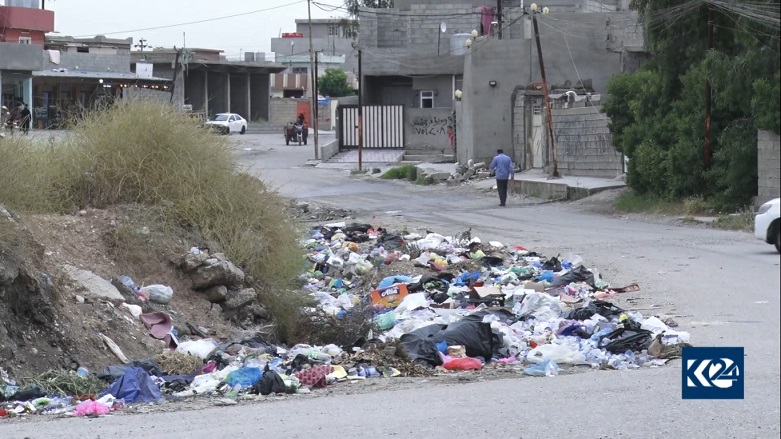
“Don’t even talk about trash-collection. It takes a month or more to send a truck to gather garbage… Nobody knows where the money of this province goes.”

Shafiq Sidiq is another Kurdish resident who stated that the amount of money Kirkuk receives does not matter as the people do not reap the benefits.
“Poverty and lack of services dominate Kurdish neighborhoods… We are powerless, what can we possibly do?” Sidiq added.
Over the past few months, the KPC tried to convene and discuss the spending mechanisms of Kirkuk’s budget, but all attempts have failed since a quorum wasn’t met.
“We have reviewed the budget and listed our concerns,” Ahmed Askari, a member of the Brotherhood bloc in KPC, responded to Kurdistan 24’s question during a press conference.
“There are so many violations, and under no condition do we accept this inequality in budget distribution,” he added.

The Arab faction in the KPC, headed by al-Jabouri himself, refuses to attend KPC sessions for different reasons.
Recently, the faction also removed its KPC member, Ramla Hamid, from the committee overseeing projects carried out in Kirkuk following her raising concerns regarding budget expenditures in the province.
“I will issue legal complaints against members of the Arab faction for removing me. My removal was triggered by me speaking the truth,” Hamid recently told reporters at a press conference.
“We will not let hundreds of thousands of dollars be spent based on one sentence, without details, and nobody can forbid us from the right to oversee expenditures,” she continued.

The member also noted that although the KPC had failed to convene, it certainly rejects the budget being spent without their approval.
“Kirkuk’s budget aims and specific details about its expenditures remain unknown,” Hamid added.
The fate of Kirkuk was constitutionally determined based on Article 140, which requires a referendum to be held in the province for people to decide on the future of the province: whether it should be part of the KRG or the federal government.
The date of the referendum was set to December 2007, but over a decade has since passed. The article goes unimplemented and is one of the long-standing disputes between Erbil and Baghdad.
Editing by Nadia Riva
(Additional reporting by Hemin Dalo)