Raymond Odierno, top US general in Iraq, dies at 67
Odierno’s first tour in Iraq was in 2003-4, during the war’s initial phase, when he commanded the 4th Infantry Division (4th ID.)
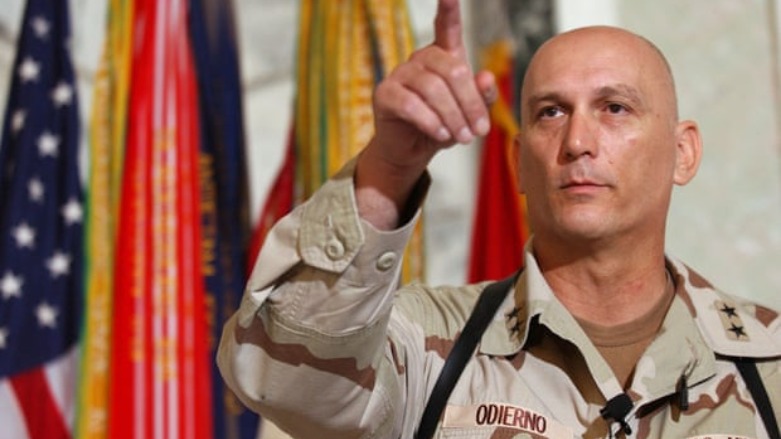
WASHINGTON DC (Kurdistan 24) – Gen. Raymond Odierno, who first proposed the US “surge” during Operation Iraqi Freedom (OIF), passed away on Thursday, The Washington Post reported. His death was due to cancer.
Odierno served three times during OIF and, in 2006, was behind the drive to increase the number of US troops in Iraq to rescue a flailing war effort. Secretary of Defense Donald Rumsfeld had opposed the idea, as did the Joint Chiefs of Staff. President George W. Bush, however, overrode the Pentagon brass.
Bush accepted Odierno’s proposal for more troops and a new strategy. His subsequent order, implemented after Rumsfeld was asked to resign, resulted in what became known as the “surge,” which Odierno executed as the commander of US forces in Iraq and then as commander of the entire coalition, Multi-National Force-Iraq (MNF-I.)
Odierno was subsequently promoted to Chief of Staff, the US Army’s top military post. In that position, in his last official remarks Odierno suggested that the partition of Iraq “might be the only solution” to the country’s chronic violence, provoking strong, but not unexpected, protest from then Iraqi Prime Minister, Haider al-Abadi.
US President Joe Biden and his wife issued a statement of tribute to Odierno, following news of his passing.
“We are devastated to learn of the death of General Raymond Odierno,” they said. “Ray was a giant in military circles—dedicated first and always to the service members he commanded and served alongside.”
Biden’s elder son, Beau, was a military lawyer in the Delaware National Guard and served in Iraq under Odierno. Beau died of brain cancer in 2015, at the age of 46.
“We will be forever grateful for the words and the kindness that Ray shared when we spoke at the funeral of our beloved son Beau and awarded him with the Legion of Merit,” the Bidens said. “Today is a sad day for our nation. We have lost a hero of great integrity and honor.”
Odierno in Iraq
Odierno’s first tour in Iraq was in 2003-4, during the war’s initial phase, when he commanded the 4th Infantry Division (4th ID.)
The 4th ID was supposed to lead the “northern front” and enter Iraq from Turkey. However, in March 2003, less than three weeks before OIF began, the Turkish parliament, in a narrow vote, refused to let US forces attack Iraq from their country. So ships and supplies were re-routed, and the 4th ID entered Iraq through Kuwait.
Headquartered near Tikrit, the 4th ID was involved in the operation that captured Saddam Hussein, who had gone into hiding, as Baghdad fell in April 2003 to the US-led coalition in April 2003.
Saddam was found later that year, in December, hiding in a hole in the ground on a farm south of Tikrit. Odierno remarked then that Saddam had been “caught like a rat. When you’re in the bottom of a hole, you can’t fight back.”
Odierno’s second deployment began in 2006, when he commanded US forces in Iraq. Odierno pushed for an additional 20,000 troops to bolster the Coalition’s ability to fight the insurgency—what became known as “the surge.”
“If Petraeus… was the public face of the troop buildup, he was only its adoptive parent,” the Post reported. “It was Odierno,” the paper said, “who was the surge’s true father.”
That approach would turn around the course of the war—at least while US forces remained in Iraq.
In 2008, Odierno replaced Petraeus as the top over-all commander in Iraq and became the Commander of MNF-I.
Odierno was promoted to Army Chief of Staff in 2011, and under President Barack Obama he oversaw the final stage of the withdrawal of US forces, which occurred that December.
Odierno believed that the US had left behind a largely stable situation, which the Iraqis could maintain.
However, with the chaos of the Syrian civil war, ISIS arose amid that conflict. In 2014, it burst across the border into Iraq, seizing one-third of the country and threatening Baghdad, as well as Erbil.
“It’s disappointing to all of us to see the deterioration of the security inside of Iraq,” Odierno said then. “I believe we left it a place, where it was capable to move forward.”
In his last public remarks as Army Chief of Staff, at an August 12, 2015, Pentagon press briefing, Odierno was asked how the US might promote reconciliation between Sunnis and Shia in Iraq.
“There might be some alternative solutions that might have to come into this sometime in the future, where Iraq might not look like it did in the past,” Odierno responded. “But we have to wait and see how that plays out.”
“Are you talking about the possibility of partitioning?,” the journalist continued.
“That is something that could happen. It might be the only solution, but I’m not ready to say that yet,” he replied.