Blinken speaks with Sudanese PM, after strong criticism of military coup
They “condemned” the military takeover in Sudan and “its effect on the stability of Sudan and the region"
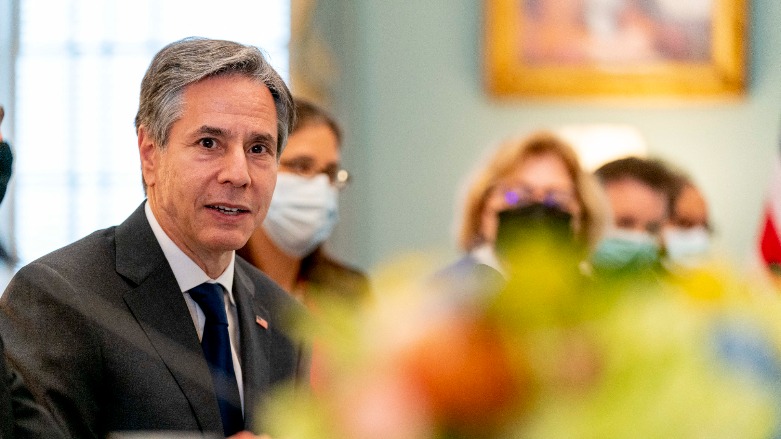
WASHINGTON DC, United States (Kurdistan24) – US Secretary of State Antony Blinken spoke with Sudan’s Prime Minister, Abdallah Hamdok, on Tuesday, following a military coup in Khartoum the day before.
Hamdok was arrested on Monday, along with his wife, and other senior Sudanese officials.
On Tuesday, Hamdok and his wife were released, although they remain detained in their home under heavy armed guard. Other officials are still under arrest.
The US immediately denounced the move against the country’s transitional government by the Sudanese military, which was led by Gen. Abdel Fattah al-Burhan, Commander-in-Chief of the Sudanese armed forces.
On Monday, Burhan dissolved the Sovereignty Council, which included both military and civilian leaders and which was to lead a transition to civilian democratic government.
The Council was established last August, following the ouster of Omar al-Bashir, who, as a brigadier general, had ousted Sudan’s last democratically-elected government in 1989 and then ruled the country for the next 20 years.
Following Monday’s coup, Secretary of State Antony Blinken issued a lengthy statement that day, strongly condemning “the actions of the Sudanese military forces.”
“We firmly reject the dissolution of the civilian-led transitional government and its associated institutions and call for their immediate restoration,” Blinken said. “The arrest of Prime Minister Hamdok and other civilian leaders is unacceptable.”
Blinken also denounced the use of violence against protestors demonstrating against the coup.
“We are gravely concerned by reports that Sudanese security forces have used live ammunition against peaceful protesters,” he stated. “Security officials should immediately cease the use of violence against peaceful protesters.”
At least seven protestors have been reported killed in demonstrations against the coup. The protests have continued, although in much smaller numbers.
Blinken also called on Sudanese authorities to restore internet services, which they have blocked.
Blinken’s statement also explained that the US was “immediately pausing the delivery of $700 million in emergency Economic Support Funds to Sudan, which were intended to support the country’s democratic transition.”
Humanitarian aid, however, will continue, as State Department Spokesperson Ned Price explained.
US National Security Advisor Jake Sullivan spoke similarly on Tuesday, telling journalists, “We’ve been in close contact with regional leaders, including in the Gulf, to make sure that we’re closely coordinating and sending a clear message to the military in Sudan that they should, first and foremost, cease any violence against innocent civilians; that they should release those who have been detained; and they should get back on a democratic path.”
Indeed, Blinken spoke on Tuesday with the Saudi Foreign Minister, Prince Faisal bin Farhan Al Saud. They “condemned” the military takeover in Sudan and “its effect on the stability of Sudan and the region,” according to a State Department read-out of their discussion.
The European Union similarly denounced the coup strongly, while threatening economic sanctions.
“This attempt to undermine Sudan's transition to democracy is unacceptable,” Josep Borrell, the EU’s top diplomat, said. “If the situation is not reversed immediately, there will be serious consequences for the EU's commitment, including its financial support.”
Both the African Union and Arab League also criticized the Sudanese military.
The UN Security Council met on Tuesday in a closed session to consider the situation in Sudan. However, the Council failed to reach any agreement. No statement was issued, because Russia and China are seeking weaker language in criticizing the Sudanese military.
The stalemate in the Security Council prompted unusual criticism from UN Secretary General Antonio Guterres, who warned on Tuesday that the Council’s "difficulties in taking strong measures” were contributing to "an environment in which some military leaders feel that they have total impunity, they can do whatever they want, because nothing will happen to them."