AUK Hosts Third Robotics Competition, Showcasing Student Ingenuity in Duhok
American University of Kurdistan (AUK) in Duhok hosted its 3rd robotics competition, featuring 8 student-built machines, showcasing innovation and a drive to join global tech progress.
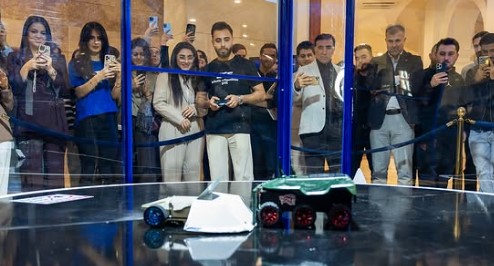
ERBIL (Kurdistan24) – The campus of the American University of Kurdistan (AUK) in Duhok transformed into a vibrant arena of technological prowess and engineering creativity this week, as the university successfully hosted its third annual robotics competition, "ETE Battle Bot Competition". Organized by the Department of Electrical and Communications Engineering, the event served as a significant platform for the region's next generation of engineers to bridge the gap between theoretical classroom knowledge and practical, high-stakes application.
Amid the hum of electric motors and the strategic maneuvering of student-built machines, the competition highlighted a growing determination within the Kurdistan Region to align with global scientific advancements and foster a culture of innovation that can address real-world societal challenges.
The competition featured the participation of eight distinct robots, each conceptualized, designed, and constructed by the university’s students. These machines were not merely static displays but dynamic entities built to compete, maneuver, and withstand physical challenges.
The event underscored the university's commitment to adapting to rapid technological advancements, pushing students to master complex principles of electronics, mechanics, and physics. By bringing these creations to life, the students demonstrated that the youth of the Kurdistan Region are eager to become active participants in the world's technological progress rather than mere consumers of it.
Among the standout creations was a sophisticated electronic car designed in the form of a robot, a collaborative project by two ambitious students from the AUK. This machine, powered by a robust 12-volt energy system, was engineered for high mobility and tactical resilience.
Controlled remotely via a specialized communication device, the robot possessed the ability to move and apply force in all directions, a feature that proved critical in the competitive environment. The design philosophy behind this machine prioritized durability and continuous operation, ensuring that it could remain effective even under duress.
Mahshad Murad, a student at the American University of Kurdistan and one of the creators involved in the event, provided detailed insight into the engineering behind this specific entry. "The robot works on battery power and weighs 2.5 kilograms," Murad explained to Kurdistan24.
He described the robot's primary function as offensive, noting that "its job is to push other robots." However, the design also incorporated significant defensive capabilities. Murad highlighted a unique engineering feature that ensures operational continuity: "During an attack on it by another robot, it defends itself. Also, even if it is upside down, it still does its job."
This invertibility suggests a sophisticated chassis design, likely ensuring that the wheels or drive mechanisms remain in contact with the ground regardless of the robot's orientation, a crucial advantage in the chaotic environment of a robot competition.
Beyond this resilient electronic car, the competition showcased seven other robots, each representing a unique approach to engineering challenges. The diversity of designs reflected the students' ability to draw inspiration from various sources, including the natural world.
One of the most intriguing entries was a robot inspired by the biological armor and strength of a rhinoceros. This biomimetic approach allowed the students to translate the defensive characteristics of the animal into mechanical form.
Songul Salam, a student at the university who worked on this nature-inspired machine, elaborated on the creative process. "We got our idea from the rhinoceros animal so that it would be strong in defending itself," Salam stated.
She emphasized that the conceptualization went beyond mere aesthetics, influencing the structural integrity of the machine. "The materials used in its creation help in achieving this goal," she added, indicating a thoughtful selection of components to withstand impacts and maintain stability, much like the animal that served as its muse.
Another formidable contender in the arena was a robot designed with complex mechanical articulation. Hazhi Dler, a student participant, described a machine built for power and manipulation. "Our robot has the ability to push with the help of four motors," Dler revealed.
The use of a four-motor drive train suggests a focus on torque and traction, allowing the robot to overpower opponents in pushing matches. Furthermore, Dler noted that the robot was equipped with a specialized lifting mechanism.
"It also has the ability to lift through the part of the robot called the 'Flipper'," he explained. This "Flipper" mechanism introduces a vertical element to the competition, allowing the robot to destabilize competitors by lifting them off the ground, thereby negating their traction and control.
The event at the American University of Kurdistan was driven by a philosophy that extends far beyond the excitement of the competition itself.
The university is actively trying to open the door for student innovation and creativity, viewing these competitions as incubators for future problem-solvers. The administration and faculty plan to advance these robotic technologies in the future, with the ultimate goal of using them to solve complex problems facing society.
This vision aligns with global trends where robotics are increasingly integrated into sectors ranging from industrial manufacturing to urban planning and disaster response.
Razaq Farhadi, the Dean of the College of Engineering at the American University of Kurdistan in Duhok, spoke to Kurdistan24 about the broader implications of the event.
He emphasized that the skills demonstrated in the arena have direct applications in the real world. "Robots have a role in solving many issues, from factories to the design of housing and many other fields," Farhadi noted.
His comments reflect a pedagogical shift towards applied sciences, where students are encouraged to see their creations as prototypes for industrial solutions that could modernize the region's infrastructure and economy.
Farhadi also issued a stark reminder of the necessity of such educational initiatives. In a rapidly evolving global landscape, he stressed the urgency of technological adoption. "We must go along with the science of the era, otherwise we will be left behind the countries of the world," Farhadi warned.
This sentiment resonates deeply in the Kurdistan Region, where educational institutions are striving to equip the workforce with the skills necessary to compete in a digitized, automated global economy.
In the current era, technology and the science of robotics have become the main steps in the world's progress. The third robotics competition at the American University of Kurdistan in Duhok stands as a testament to the region's potential.
Through the creation of machines that can push, lift, defend, and adapt, the students and youth of the Kurdistan Region are signaling their readiness to become a part of this progress.
By mastering the 12-volt systems, the four-motor drives, and the biomimetic designs today, they are preparing to engineer the factories, homes, and smart cities of Kurdistan’s tomorrow.