Sadr Mobilizes Million-Strong Show of Force as Rivals Move to Seize the Premiership
Muqtada al-Sadr calls for a "million-strong" prayer to "strike fear into enemies," challenging rivals as they move to finalize a new Prime Minister.
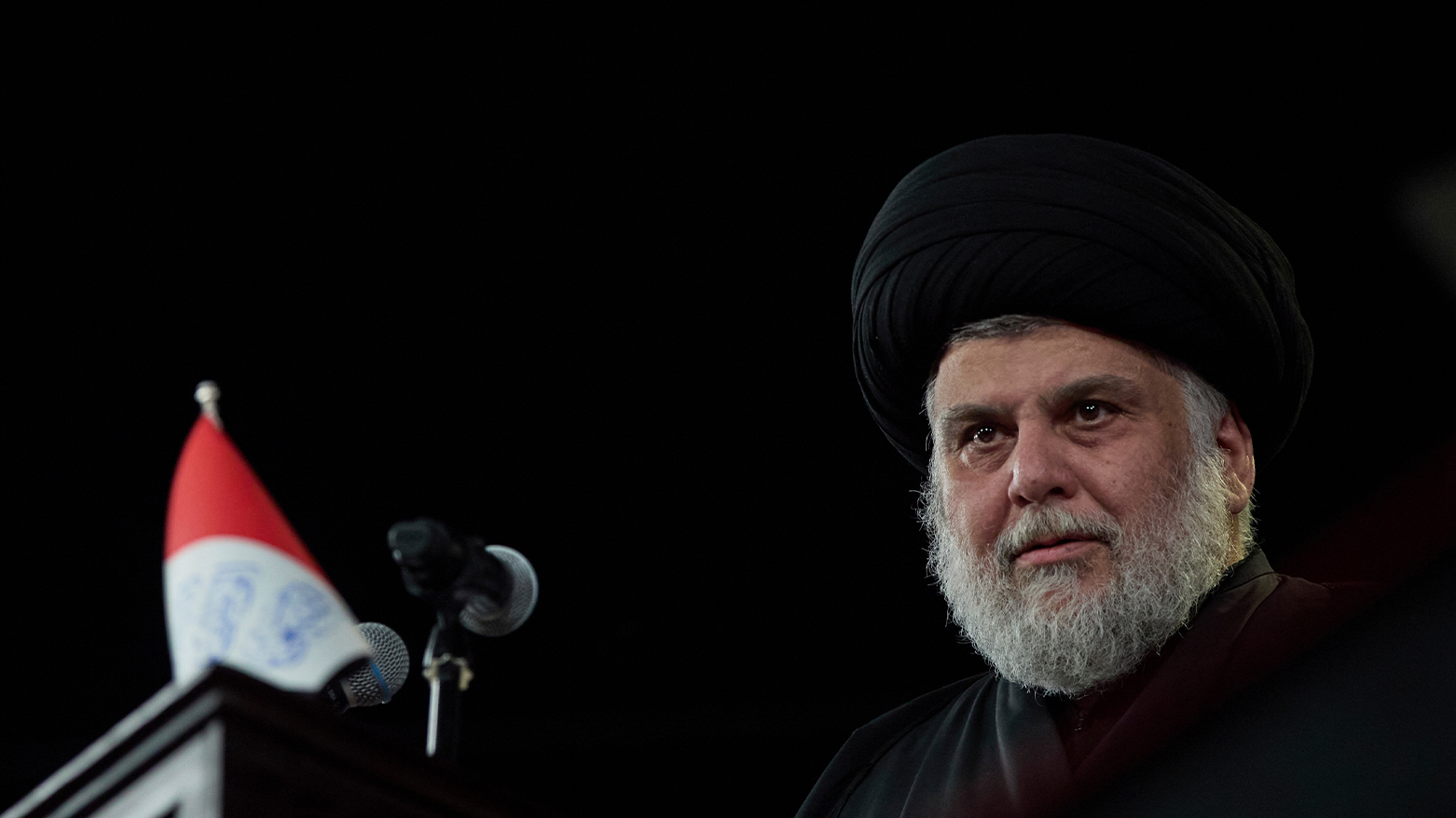
ERBIL (Kurdistan24) – In a thunderous reassertion of his influence that stands to unsettle the delicate political calibrations of Baghdad, Muqtada al-Sadr, the powerful Shiite cleric and leader of the National Shiite Movement, issued a handwritten directive on Sunday calling for a massive, "million-strong" unified prayer in the province of Babil.
The call to action, couched in the fiery rhetoric of resistance and religious devotion, comes at a moment of supreme political sensitivity, landing precisely as his rivals in the ruling Coordination Framework prepare to finalize their choice for Iraq’s next Prime Minister.
By mobilizing his vast grassroots following to "strike fear into the enemies," Sadr has effectively signaled that while he may have withdrawn from Iraq's political arena, his capacity to dominate the Iraqi street—and potentially paralyze the state—remains undiminished.
The directive, published on Sunday bearing Sadr’s signature and the date 15 Jumada al-Thani 1447, frames the gathering not merely as a religious obligation but as a political demonstration of loyalty and strength.
In the letter, Sadr explicitly invoked the legacy of his father, the "Martyr Sadr," whose defiance of the Ba’athist regime through Friday prayers became a foundational myth of modern Iraqi Shiite activism.
To ensure the scale of the event matches his rhetoric, Sadr issued strict logistical instructions: "Friday prayers in all other provinces are to be suspended or held with only the Imam and a few individuals," funneling the entire weight of his movement into Babil.
This strategic concentration of manpower is designed to create a visual spectacle of obedience to what he termed the "Speaking Hawza," a direct challenge to competing centers of power.
"Let this be a million-strong gathering that strikes fear into the enemies, as we have always known you to be—out of love for the homeland," Sadr wrote, intertwining nationalist sentiment with religious fervor.
He expressed "full confidence" that his followers would not fail to attend, framing their participation as a test of their "pledge" to the Sadr family’s bloodline.
The timing and the combative tone of the letter suggest that the "enemies" referenced are not foreign adversaries, but the political forces currently consolidating control over the Iraqi state—forces that have thrived in the vacuum left by Sadr’s earlier withdrawal from the political process.
The urgency of Sadr’s mobilization becomes clear when viewed against the backdrop of the accelerated government formation efforts led by the Shiite Coordination Framework (SCF), the constellation of Iran-aligned parties that opposes Sadr.
The SCF is on the verge of settling the country’s leadership crisis. Salam Al-Zubaidi, spokesperson for the Victory (Nasr) Alliance—a key faction within the Framework—revealed on Sunday that the coalition is poised to finalize the candidate for Prime Minister within the current week.
The selection process has narrowed to a specific profile: a figure possessing an "assertive personality" combined with political and economic acumen, capable of balancing Iraq’s complex domestic and regional entanglements.
According to statements followed by the Al-Sa'aa Network, Al-Zubaidi noted that "all indicators suggest the possibility of settling the file of the three presidencies by the beginning of next year."
This timeline suggests the Framework is moving aggressively to cement its hold on the executive branch. The search for an "assertive" leader reflects an acknowledgment within the ruling coalition that the next premier must navigate a state apparatus rife with dysfunction and fragmentation.
The Framework’s leadership, having met recently at the office of Hadi al-Amiri, emphasized that the nominee must meet clear national criteria of competence and integrity to face the challenges of the coming stage.
However, the political elite’s path to power has been stripped of religious cover, increasing their vulnerability to the kind of populist pressure Sadr is now applying.
In a significant development reported by Kurdistan24, the Coordination Framework recently attempted to solicit the opinion of Grand Ayatollah Ali al-Sistani on a shortlist of nine potential Prime Ministerial candidates. The Supreme Marja’, whose endorsement is often sought to legitimize political decisions, categorically rebuffed the overture.
Through intermediaries, Sistani conveyed that the selection of the head of government is "not my job" and rests entirely with the political parties.
Sistani’s refusal to intervene has forced the Coordination Framework to own the consequences of their choice without the shield of the Najaf religious establishment. Into this gap steps Muqtada al-Sadr, who, unlike the quietist Sistani, actively positions himself as a "Speaking" authority deeply involved in the direction of the state and the "reform" of its institutions.
By calling for a million-man prayer just as the Framework attempts to install a government, Sadr is reminding the political class that their legislative majority does not equate to popular legitimacy or stability.
The fragility of the state that the new Prime Minister will inherit was laid bare last week in an embarrassing administrative debacle involving national security.
The Iraqi Presidency was forced to issue a public denial regarding its knowledge of a government decision to designate Hezbollah and the Houthis as terrorist organizations—a decision that was published in the official gazette and then abruptly reversed due to an "error."
The Presidency admitted it learned of the asset freeze via social media, highlighting a dangerous disjointedness in Baghdad’s decision-making machinery.
This incident underscored the urgent need for the "assertive personality" the Framework is seeking, but it also provided ammunition for critics like Sadr who argue the current system is broken.
Sadr’s letter concludes with a prayer for his followers, asking God to preserve them "for reform." This specific choice of words aligns with his long-standing branding as a reformist outsider fighting a corrupt establishment.
As the Coordination Framework moves behind closed doors to divide the spoils of government and select a premier to manage the status quo, Sadr is moving to the open fields of Babil to demonstrate that he holds the veto power of the street.
The juxtaposition of a technocratic search for an economic manager in Baghdad against a million-strong religious mobilization in the south sets the stage for a high-stakes confrontation over the future of Iraq’s governance.
You can see the photo of the handwritten letter below with its translation:
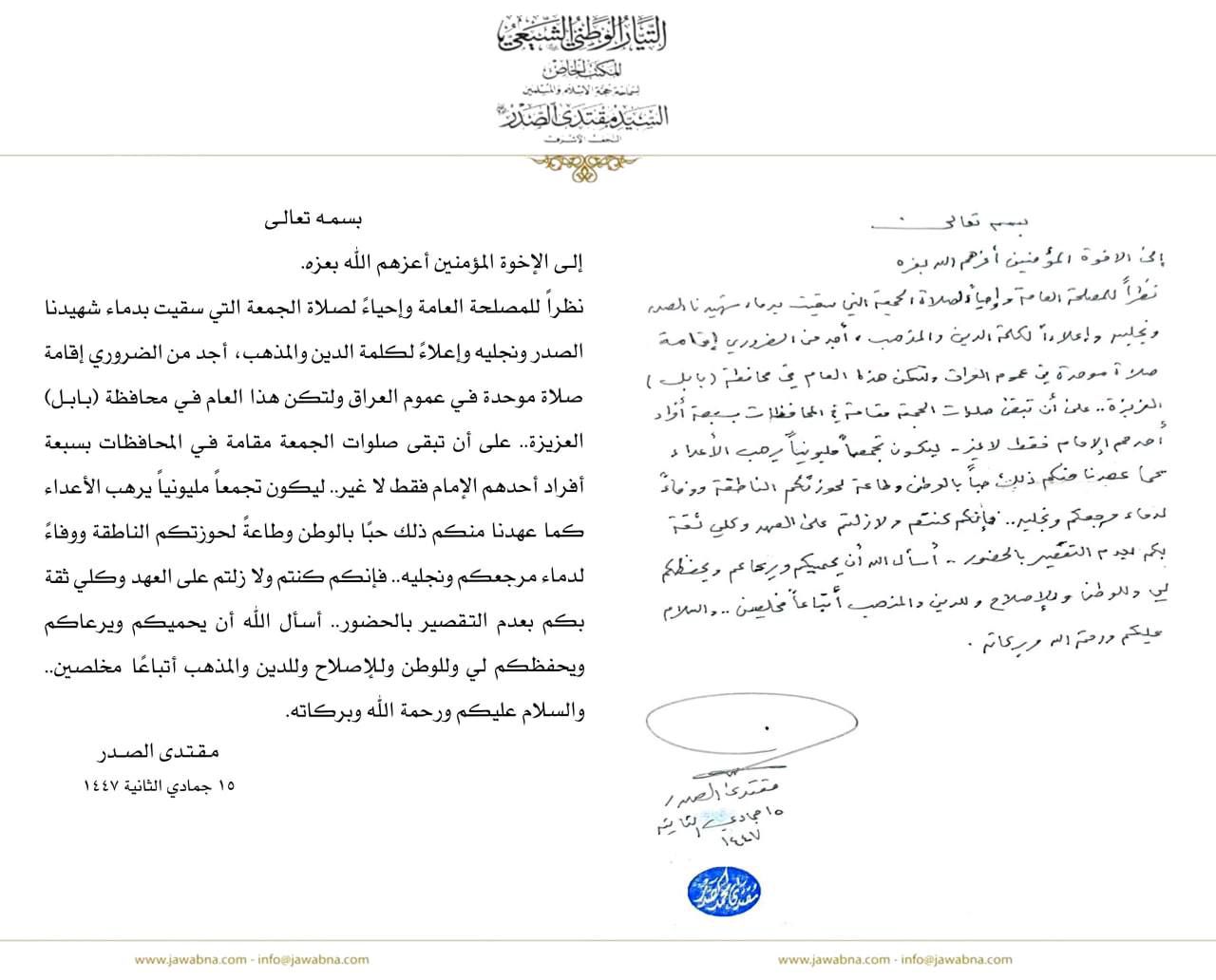
The translation of the letter:
In His Name, the Exalted
To the believing brothers, may God honor them with His glory.
In view of the public interest, to revive the Friday prayer that was watered by the blood of our Martyr Sadr and his two sons, and to exalt the word of the religion and the School [Madhhab], I find it necessary to hold a unified prayer throughout Iraq. Let it be this year in the dear province of Babil; provided that Friday prayers continue to be held in the [other] provinces with only a few individuals, one of whom is the Imam, and no others.
Let this be a million-strong gathering that strikes fear into the enemies, as we have always known you to be—out of love for the homeland, obedience to your Speaking Hawza, and loyalty to the blood of your Religious Authority [Marja’] and his two sons. For you have been and remain true to the pledge, and I have full confidence that you will not fail to attend.
I ask God to protect you, care for you, and preserve you for me, for the homeland, for reform, and for the religion and the School as sincere followers.
May the peace, mercy, and blessings of God be upon you.
(Signature)
Muqtada al-Sadr
15 Jumada al-Thani
1447