SDF’s Abdi Warns Syria Faces Renewed Terror Without U.S. Backing, Decentralized Governance
SDF Commander Mazloum Abdi warns Syria's future depends on US support, conditional backing for the interim government, and integrating SDF forces.
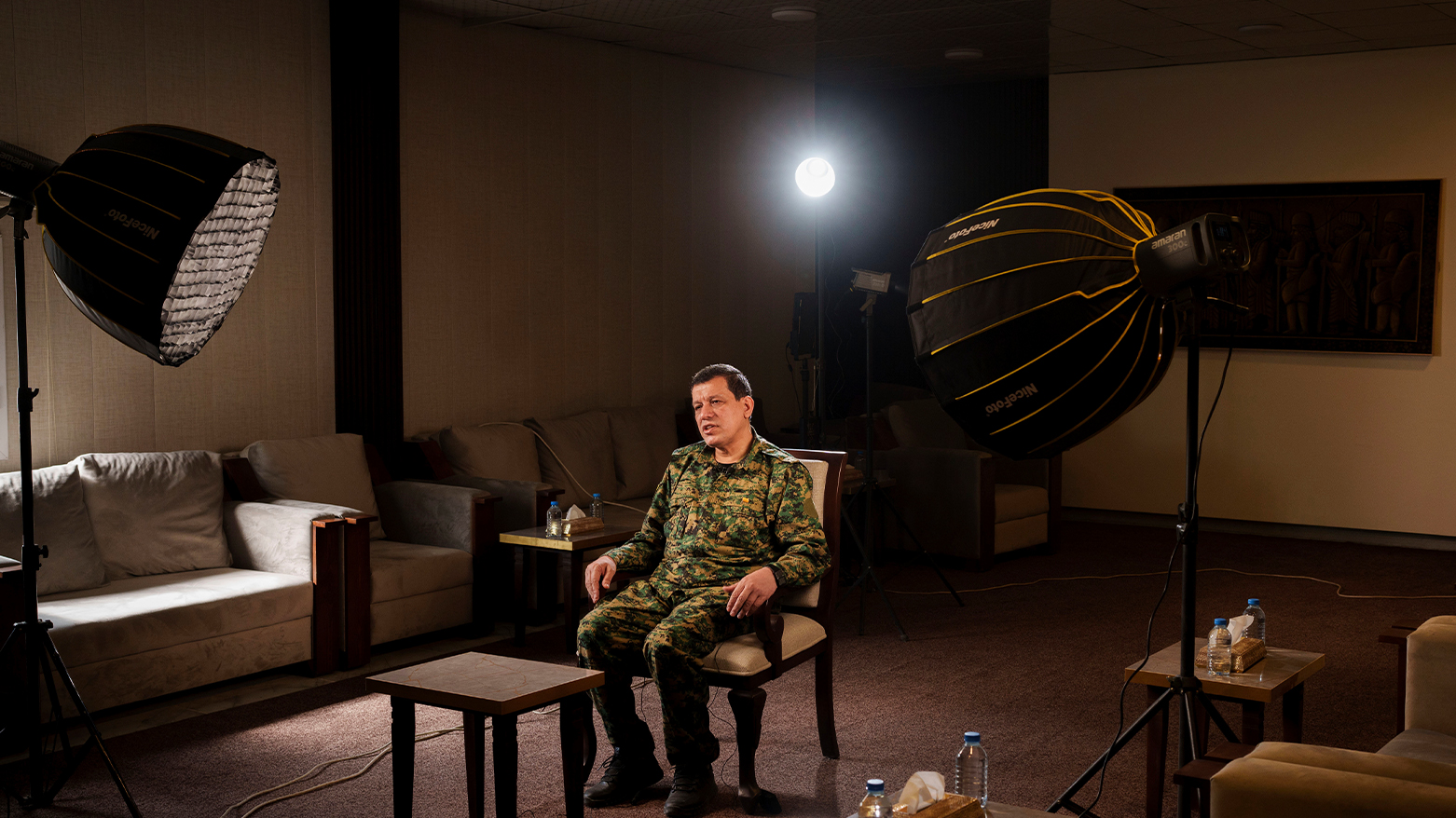
ERBIL (Kurdistan24) – General Mazloum Abdi, the commander of the Syrian Democratic Forces (SDF), has issued a stark and urgent warning regarding the fragile future of Syria, asserting that the country’s ability to avoid a resurgence of terror and sectarian bloodshed is entirely contingent upon renewed American political backing and the preservation of the SDF’s autonomy within a new national framework.
In a detailed account of a meeting held at a military base in al-Hasaka, conducted by the British Physician Qanta Ahmed and published by The Jerusalem Post on Sunday, the Kurdish commander outlined the existential threats facing the region—from a resource-starved fight against ISIS to the looming specter of sectarian retribution—and laid out a roadmap for integrating his 100,000-strong force into a decentralized Syrian state.
The interview paints a portrait of a region operating on the razor’s edge.
The drive from the Iraqi border into Northeast Syria, described in the report as a punishing traverse through pitch-black darkness illuminated only by the occasional flare of gas fires and moonlight, serves as a grim metaphor for the political uncertainty clouding the territory.
Having survived conflicts involving the Assad regime, Hezbollah, Russia, ISIS, Türkiye, and Hay’at Tahrir al Sham (HTS), the terrain controlled by the SDF remains a fortress under siege, not just by militants, but by dwindling resources and shifting geopolitical tides.
General Abdi’s most immediate concern centers on the degradation of humanitarian and security capabilities following policy shifts in Washington.
He revealed that since President Donald Trump reduced or eliminated USAID funding, the burden of managing the massive security risk posed by the Al-Hol Camp has fallen squarely on the shoulders of the SDF’s already stretched budget.
The camp, which houses approximately 25,000 wives and children of Islamic State fighters—referred to as "ISIS cubs"—requires immense manpower to secure.
"There is less aid, and there are fewer security personnel," Abdi told The Jerusalem Post, explaining that the SDF is now forced to divert funds from its own defense budget to prevent the camp from becoming an incubator for the next generation of terrorists.
With fewer non-governmental organizations operating on the ground, the strain on the Kurdish-led administration is becoming unsustainable.
The threat of a resurgent ISIS is not hypothetical.
General Abdi detailed a sprawling network of detention facilities that remains a ticking time bomb in the heart of the region. The SDF currently manages over 26 detention centers and three major prisons holding a collective population of up to 10,000 male ISIS combatants.
The commander specified that the main facilities in Al Hasaka hold between 3,000 and 4,000 inmates each, with additional thousands held in Raqqa and Qamishlo.
These are "extremely dangerous fighters," Abdi noted, emphasizing that the battle against the terror group is far from over.
The SDF continues to lose soldiers in active skirmishes and attacks by sleeper cells operating in Deir Ezzor and Raqqa, a reality that necessitates not just the support of US Central Command (CENTCOM), which Abdi praised, but explicit political backing from the United States Congress.
The General’s vision for the future involves a complex political maneuvering to integrate the SDF into the emerging Syrian state without dissolving its unique identity or capabilities.
Abdi disclosed details of a preliminary understanding known locally as the "March 10 agreement," which outlines the integration of military and civilian structures.
In discussions with Tom Barrack, the US special envoy to Syria, the SDF leadership has proposed a model where its forces would become part of the Syrian Ministry of Defense, the Syrian National Army, and the Ministry of Interior. However, this integration comes with non-negotiable conditions designed to protect the diverse demographic makeup of the SDF.
"Here in Northeast Syria, we have 100,000 soldiers including 70,000 fighters and 30,000 police and security," Abdi explained.
The proposal involves maintaining three specific divisions of the SDF and two special battalions—one focused on border security and the other a dedicated female battalion—under the umbrella of the national defense ministry.
The preservation of the female battalion is a particularly poignant point of contention and pride.
Abdi highlighted the logistical and ideological difficulty of merging these women fighters into a national army that lacks any female equivalent, asking rhetorically how such an integration could occur without separating the women fighters, a move the SDF refuses to consider.
He expressed confidence that the United States is beginning to understand the necessity of this arrangement to maintain the force's integrity while cooperating with the national military.
The political backdrop to these military negotiations is the rise of Syria’s interim President, Ahmed al-Sharaa, a figure viewed with deep suspicion by the SDF leadership due to his history as the leader of HTS.
General Abdi was candid about his reservations, reminding his interviewer that the very compound they were meeting in was under HTS control a decade ago.
While acknowledging that al-Sharaa is currently working to convince Western powers to give Syria a "new chance," Abdi pointed to recent atrocities as evidence of the dangers lurking beneath the surface.
He cited the killing of 2,000 Alawites in Latakia and 1,000 Druze in Suwayda, noting that videos circulating during these massacres carried a chilling message: "the Kurds will be next."
This sectarian violence stands in stark contrast to the composition of the SDF, which Abdi described as a coalition of Kurds, secular Arabs, Christians, and various other ethnicities.
He argued that this diversity has inoculated his forces against the internal conflicts and sectarianism that plague other armed groups in the country.
To ensure that the new Syrian government does not slide into extremism or ethnic retribution, Abdi urged the United States to attach strict conditions to its support for al-Sharaa.
"US support must not be unconditional," he asserted, calling for a wider discussion on the application of sanctions and the need for genuine, verifiable change from the interim leadership rather than mere promises.
The General also addressed the shifting roles of regional powers, noting a recalibration of influence.
While US forces are repositioning in Erbil, the Iranian footprint in Syria has notably diminished following the war with Israel and the collapse of the Assad regime and Hezbollah. However, Abdi warned that Tehran has not abandoned its ambitions and is actively attempting to rebuild proxy groups using former regime officers who have fled abroad.
He recalled the period between 2013 and 2014 when Hezbollah was a significant and harmful combatant in Northeast Syria, stressing that while Iran is weaker, the threat of its interference persists. Conversely, he noted that Türkiye had established a peace accord with the Kurds in 2019, suggesting a complex but manageable dynamic on the northern border.
Throughout the four-hour discussion, Abdi returned repeatedly to the theme of decentralization as the only viable governance model for a fractured Syria.
Echoing sentiments he said were shared by Kurdistan Region President Nechirvan Barzani—for whose support he expressed deep gratitude—Abdi argued that stability in Damascus is inextricably linked to the continued US presence in Northeast Syria.
He framed the upcoming year of 2026 as a "defining year" that will determine whether the interim president acts rationally to meet the needs of the Syrian people or succumbs to the extremist elements that have historically defined his faction.
The SDF commander’s message to Washington was unequivocal: President Trump’s desire to stabilize the region and "make Syria great again" cannot be achieved without the SDF.
By positioning his forces as the only reliable partner capable of protecting the Alawite, Druze, and secular Arab communities alongside the Kurds, Abdi made the case that there are no alternatives to the SDF.
As the region stands at a critical junction, the General’s words serve as a reminder that the war against ISIS may have evolved, but the battle for the soul and structure of Syria is entering its most precarious phase yet.