Hegseth Presses for Modernized Nuclear Arsenal, Linking Trump to Reagan Doctrine
Secretary of War Hegseth vows to modernize the nuclear triad and resume testing, framing Trump's "Peace Through Strength" as Reagan's true legacy.
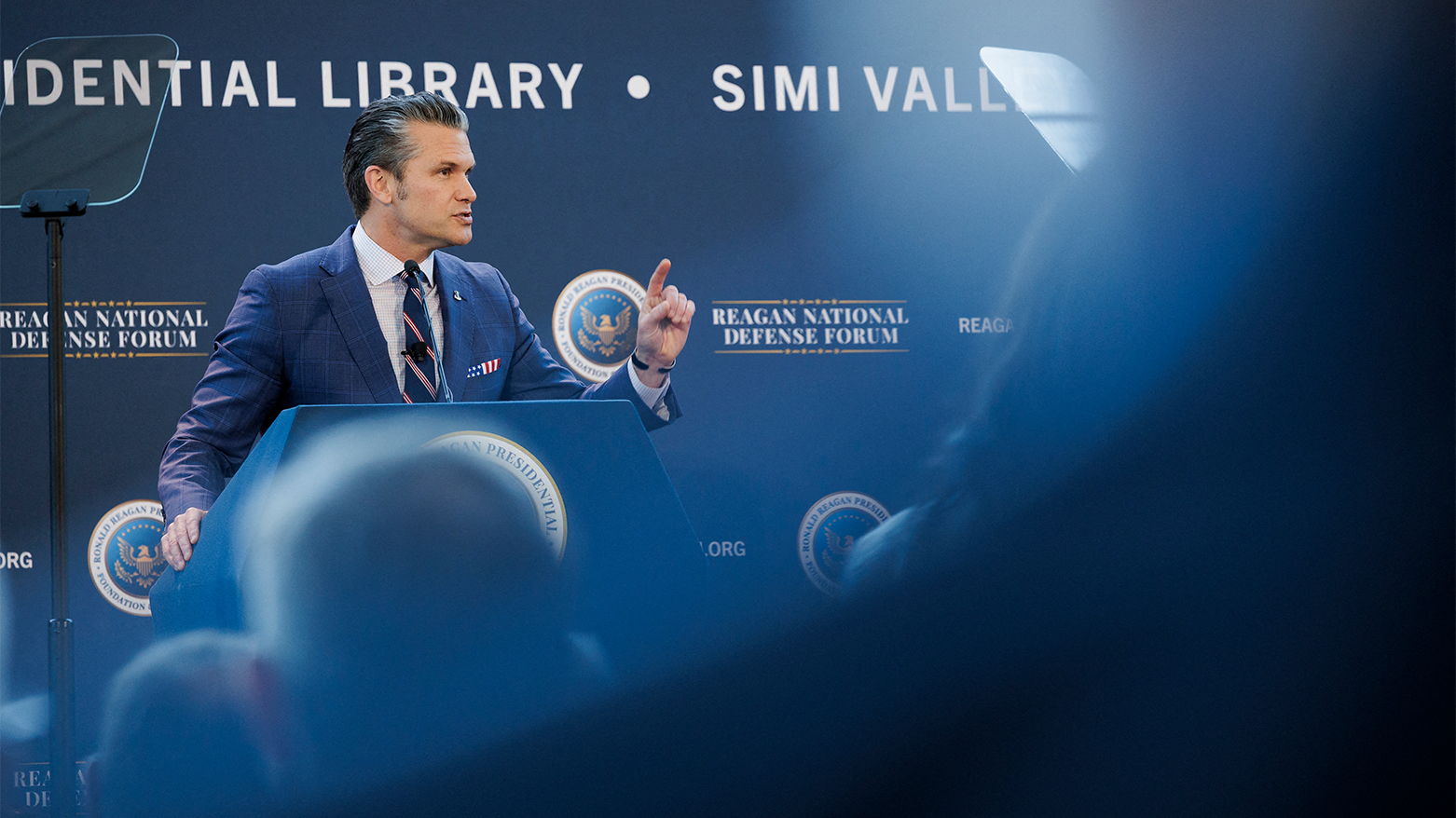
ERBIL (Kurdistan24) – In a forceful declaration of renewed American military doctrine that signals a sharp departure from decades of strategic restraint, U.S. Secretary of War Pete Hegseth announced on Sunday that the Trump administration will aggressively modernize the nation’s nuclear triad and resume the testing of nuclear weapons on an "equal basis" with global rivals.
Speaking at the prestigious Reagan National Defense Forum, Hegseth positioned these moves not as aggressive escalation, but as the restoration of deterrence necessary to secure the homeland, explicitly rejecting the "wokeness and weakness" he claimed characterized previous administrations while crowning President Donald Trump as the "true and rightful heir" of Ronald Reagan’s "Peace Through Strength" legacy.
Addressing a gathered assembly of defense officials, lawmakers, and industry titans at the Reagan Presidential Library, Hegseth delivered a speech that dismantled the bipartisan foreign policy consensus of the post-Cold War era. He framed the administration's nuclear policy as a non-negotiable pillar of national survival in a world increasingly defined by great power competition.
"Nothing else matters if we don’t get this right, and so we will," Hegseth asserted, his voice cutting through the hushed auditorium.
"As President Trump has said, we will modernize our nation’s nuclear triad. We will develop additional options to support deterrence and escalation management. And we will never allow this nation to be left vulnerable to nuclear blackmail, even in a world where we face two other major nuclear-armed powers."
The Secretary’s commitment to testing represents a significant pivot in global arms control norms, echoing recent directives from the White House that have already drawn sharp warnings from Moscow.
"We will test nuclear weapons and nuclear delivery systems on an equal basis as others," Hegseth stated unequivocally. This announcement aligns with President Trump’s instruction last month to the Pentagon to restart testing "immediately," a move that the Kremlin has already signaled would trigger a reciprocal response.
Russian officials, including President Vladimir Putin, have ordered preparations for possible nuclear tests if the United States proceeds, raising the specter of a new arms race that the Secretary of War dismissed as necessary preparation rather than provocation.
Hegseth’s speech was not merely a technical briefing but a sweeping ideological manifesto designed to reclaim the mantle of Republican foreign policy from what he termed "self-styled Republican hawks" and "Neo-Reaganites."
He argued that for the better part of 30 years, these factions had championed policies antithetical to Reagan’s vision, leading the country into "rudderless wars" and "utopian idealism."
In contrast, Hegseth presented President Trump’s "America First" agenda as the authentic continuation of Reagan’s focused and realistic approach. "If you look at actual policies, Donald Trump is the true and rightful heir of Ronald Reagan," he declared. "It’s President Trump who has inherited and restored President Reagan’s powerful but focused and realistic approach to national defense."
To substantiate this claim, Hegseth drew parallels between Reagan’s rebuilding of the military after Vietnam and Trump’s historic investments in defense today.
He highlighted Reagan’s willingness to engage with adversaries like Mikhail Gorbachev from a position of strength, comparing it to Trump’s diplomacy with leaders such as Vladimir Putin and Xi Jinping. "This is born of strength, not weakness. It is born of clarity of purpose," he argued, rebuking critics in Washington who mistake negotiation for appeasement.
The Secretary outlined four key lines of effort for the newly renamed Department of War: defending the U.S. homeland and hemisphere, deterring China through strength, increasing burden-sharing among allies, and supercharging the defense industrial base.
On the first point, Hegseth was particularly emphatic about the "Trump Corollary" to the Monroe Doctrine, a policy codified in the recently released 2025 National Security Strategy.
"After years of neglect, the United States will restore US military dominance in the Western Hemisphere," he vowed, promising to deny adversaries the ability to position forces in the region and to secure key terrain such as the Panama Canal and the Arctic.
This hemispheric defense strategy includes a "no safe haven" policy for narco-terrorists, whom Hegseth compared to Al-Qaeda.
"We are tracking them, we are killing them, and we will keep killing them so long as they are poisoning our people," he warned.
He also touted the "Golden Dome for America," a revolutionary missile defense initiative ordered by President Trump that aims to provide tangible protection for the homeland, likening it to Reagan’s Strategic Defense Initiative but with the technology finally available to make it a reality.
Regarding China, Hegseth articulated a strategy of "flexible realism" aimed at a balance of power rather than confrontation. He praised recent trade breakthroughs and reciprocal state visits planned for 2026, while simultaneously insisting on a military posture strong enough to deter aggression in the Indo-Pacific.
"We’re not trying to strangle China’s growth... Nor are we trying to change the status quo over Taiwan," he clarified. However, he emphasized that deterrence means ensuring Beijing sees "unquestionable US military strength" capable of backing up national interests if necessary.
On the critical issue of burden-sharing, Hegseth delivered a stern message to American allies, rejecting the "Neo-Reaganite" assumption that only the U.S. can provide global security.
He cited the "Hague Commitment," where NATO allies pledged to spend 5% of their GDP on defense, as a victory for Trump’s leadership.
"We will no longer tolerate free-riding," he stated, warning that allies who fail to contribute to collective defense will face consequences, while model allies like Israel, South Korea, and Poland will receive "special favor."
Hegseth’s remarks also touched upon the administration’s decisive actions in the Middle East, specifically referencing "Operation Midnight Hammer."
He described the operation as a textbook example of the Weinberger Doctrine—decisive, focused, and limited—asserting that it "obliterated the Iranian nuclear program" after decades of indecision by previous leaders.
"President Trump said they can’t have a nuclear bomb. And he meant it," Hegseth said. He contrasted this with the "weakness" of the Biden administration, which he blamed for the debacle in Afghanistan and the wars in Ukraine and Gaza.
In closing, the Secretary of War appealed to a higher power and the nation’s history, invoking George Washington and Ronald Reagan’s reliance on divine providence.
"We do the same today, with Jesus Christ as our guide," he concluded. "We owe safety, freedom, and prosperity to the American people. And we will deliver."
As the echoes of his speech fade, the geopolitical ramifications are only beginning to surface. By committing to nuclear testing and a muscular, unilateralist foreign policy, the Trump administration is signaling that the "unipolar moment" may be over, but American dominance is not.
The challenge now lies in managing the reactions of rivals like Russia and China, who are already adjusting their own strategic calculus in response to a Washington that speaks softly but is sharpening a very big stick.
The remarks by Secretary of War Pete Hegseth come against the backdrop of the recent National Security Strategy, which sets out an unambiguous shift from open-ended foreign interventions to a doctrine grounded in selective, purpose-driven force and the primacy of economic statecraft.