U.S. Congress Links Iraq Security Cooperation Funds to Restrictions on Iran-Aligned Militias
U.S. National Defense Authorization Act for Fiscal Year 2026 (NDAA 2026) limits Iraq security funds pending action on militia control, prime ministerial authority, and accountability.
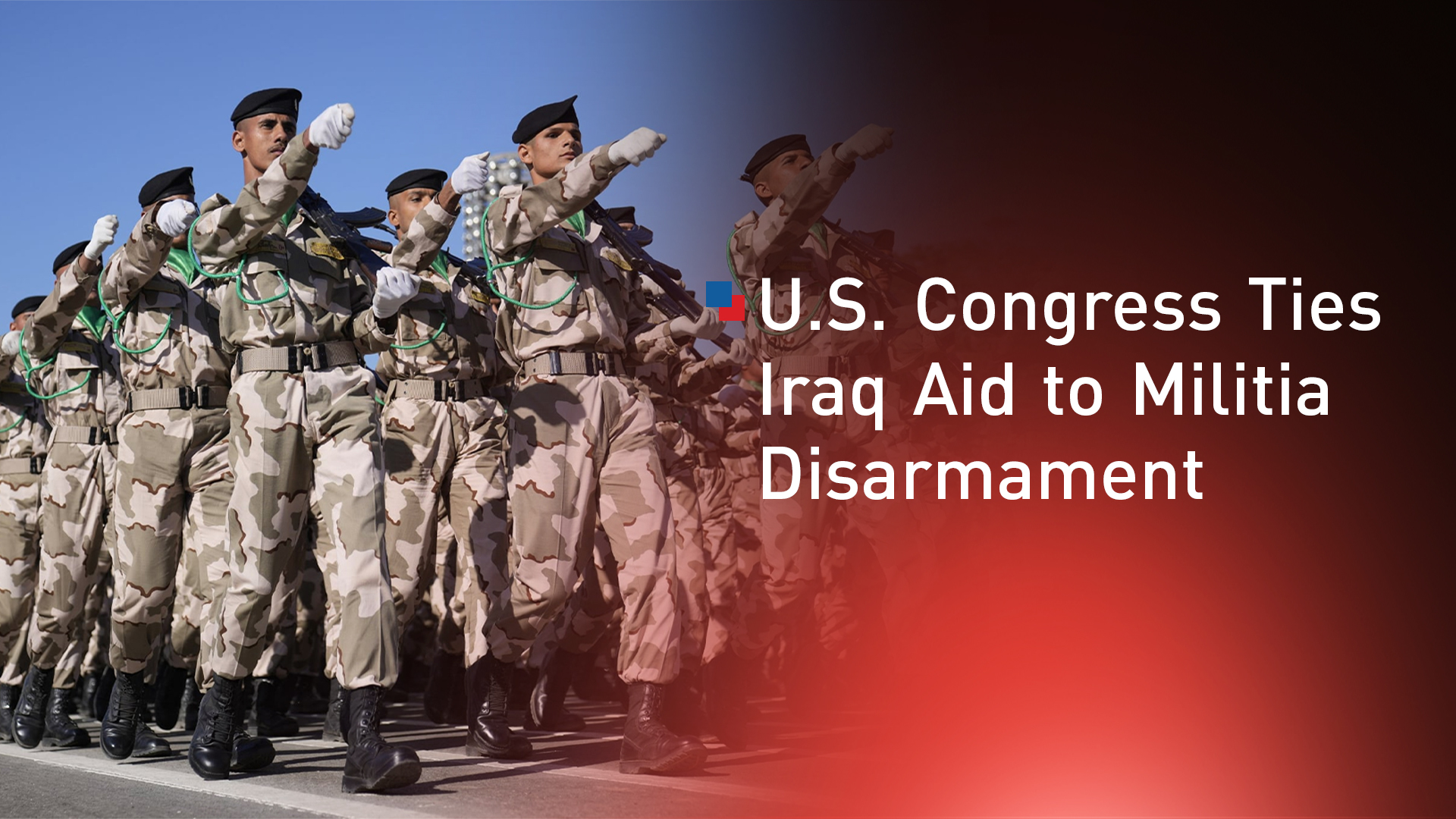
ERBIL (Kurdistan24) — In a significant legislative maneuver poised to reshape the United States’ security relationship with Baghdad, the U.S. Congress has introduced rigorous new conditions on military assistance to Iraq, directly linking funding to the suppression of Iran-aligned militias. The National Defense Authorization Act (NDAA) for Fiscal Year 2026, designated S. 2296, contains provisions that would freeze half of the funds allocated for the Office of Security Cooperation in Iraq (OSC-I) until the Iraqi government demonstrates "credible steps" toward disarming rogue factions and asserting the exclusive authority of the state.
The legislation, currently before the 119th Congress, reflects a marked shift in Washington’s approach to the region, moving away from unconditional support toward a strategy of strict accountability.
Under Section 1218 of the act, titled "Limitation on Availability of Funds for the Office of Security Cooperation in Iraq," lawmakers have engineered a financial mechanism designed to force the integration or disarmament of paramilitary groups that have long operated outside the formal chain of command.
The text mandates that not more than 50 percent of the authorized funds for fiscal year 2026 may be obligated or expended until the Secretary of Defense submits a certification to the congressional defense committees verifying specific progress by the Government of Iraq.
This certification requirement effectively places the burden of proof on Baghdad to demonstrate control over its internal security landscape. The legislation outlines three specific criteria that must be met to unlock the remaining funds.
First, the Iraqi government must prove it is reducing the operational capacity of Iran-aligned militia groups that are not integrated into the Iraqi Security Forces.
The bill specifies that this must be achieved through a "publicly verifiable disarmament, demobilization, and reintegration process," signaling that nominal integration or paper transitions will not satisfy Congressional intent.
The second condition demands the strengthening of the authority and operational control of the Prime Minister of Iraq in his capacity as Commander-in-Chief over the Iraqi Security Forces.
This provision addresses long-standing U.S. concerns regarding the fragmentation of command structures within Iraq, where militia leaders have often acted independently of, or in direct opposition to, the head of government. By tying financial assistance to the Prime Minister’s consolidated control, the legislation seeks to bolster the sovereignty of the central government against parallel military institutions.
The third and perhaps most contentious requirement mandates that the Government of Iraq investigate and hold accountable members of militias or security forces operating outside the formal chain of command who engage in attacks on United States or Iraqi personnel.
The text further broadens this mandate to include accountability for those who "otherwise act in an illegal or destabilizing manner." This provision directly targets the impunity often enjoyed by factions responsible for rocket and drone attacks against coalition facilities and diplomatic missions, conditioning future security cooperation on the judicial prosecution of these actors.
While the legislation imposes strict limitations, it includes a waiver provision allowing the Secretary of Defense to bypass the funding freeze for a period of not more than 180 days. However, to exercise this waiver, the Secretary must determine that it is in the national security interest of the United States and submit a written justification to the congressional defense committees no later than 15 days after issuance.
Crucially, this waiver submission must include a description of the steps being taken to achieve the specific objectives of disarmament and accountability outlined in the limitation, ensuring that even if funds are released, the pressure for reform remains operative.
The NDAA’s focus on the influence of Tehran is reinforced elsewhere in the document. Title V, Section 535, establishes a "Duty to Warn United States Persons Threatened by Iranian Lethal Plotting."
Within this section, the legislation explicitly defines the term "Iranian proxy" to include "Shia militia groups in Iraq and Syria," placing them in the same legal category as Hezbollah, Ansar Allah, and Hamas.
This definition underscores the legislative view that these entities are extensions of the Government of the Islamic Republic of Iran or the Iranian Revolutionary Guard Corps, rather than independent national actors.
The section mandates that the intelligence community notify the Federal Bureau of Investigation upon collecting credible information indicating an impending threat of intentional killing, serious bodily injury, or kidnapping directed at a U.S. person by these entities.
Beyond the immediate funding restrictions for Iraq, the bill addresses the broader legal framework of the U.S. military presence in the country.
Section 1219 calls for the repeal of the Authorization for Use of Military Force Against Iraq Resolution of 1991 and the Authorization for Use of Military Force Against Iraq Resolution of 2002.
The repeal of these war authorizations, combined with the extension of the authority to support operations of the Office of Security Cooperation in Iraq through fiscal year 2026 under Section 1212, suggests a transition toward a normalized, albeit conditional, bilateral security partnership rather than a posture defined by legacy wartime statutes.
The legislation also directs significant attention to the security dynamics in neighboring Syria, which remain inextricably linked to stability in Iraq. Section 1217 imposes a limitation on the use of funds for the reduction or consolidation of United States Armed Forces bases in Syria.
The Act stipulates that no amounts authorized may be obligated to reduce the number of U.S. bases until the Secretary of Defense, in consultation with the Commander of the United States Central Command, certifies that such a reduction would not compromise mission objectives.
This certification must include a detailed description of the current and planned posture of U.S. forces, projected levels of engagement with Syrian groups, and an assessment of any gaps in assistance or training that would result from consolidation. This provision reflects Congressional intent to maintain a robust footprint in Syria to prevent a security vacuum that could be exploited by ISIS or Iranian affiliates.
Further emphasizing the threat of a resurgent Islamic State, Section 1216 mandates the Secretary of Defense to take "appropriate measures" to support the defenses of the Al-Hol and Roj camps in northeast Syria.
These camps, which house thousands of detainees and families associated with the Islamic State of Iraq and Syria, are identified as critical flashpoints. The legislation requires support for vetted foreign partner security forces to prevent escape and radicalization efforts.
A comprehensive annual report is required from 2026 through 2028, assessing the status of U.S. operations, the conditions and security of detainees, and efforts to repatriate detainees to their home countries or third countries. The report must also include recommendations for further actions to prevent the resurgence of ISIS, acknowledging the camps as potential incubators for future conflict.
In a major policy shift regarding the post-Assad Syria, Section 6211 repeals the Caesar Syria Civilian Protection Act of 2019. However, this repeal is structured as a conditional mechanism rather than a complete lifting of pressure.
The section requires the President to submit a certification to Congress regarding the behavior of the Government of Syria. The certification must verify that the Syrian government has committed to eliminating the ISIS threat, is making progress in providing security for religious and ethnic minorities, is not taking unilateral military action against neighbors including Israel, and is not financing or harboring foreign terrorist organizations.
Additionally, the government must remove foreign fighters from senior roles and prosecute those responsible for human rights abuses.
If the President cannot make an affirmative certification for two consecutive reporting periods, it is the "sense of Congress" that the sanctions under the Caesar Act should be reimposed. This structure attempts to incentivize behavioral change in Damascus while retaining the threat of economic isolation.
Additionally, Section 6212 authorizes the Secretary of State to establish a program to counter Captagon production and distribution.
This program would provide funding to rehabilitate border crossings in Syria and support counter-narcotics and counter-terrorism efforts, specifically targeting trafficking networks linked to the government of Syria.
This provision highlights the growing concern over the narcotics trade as a destabilizing force and a source of illicit revenue for regimes and militias in the region.
The bill also extends various other authorities relevant to the region. Section 1213 extends the authority to provide assistance to vetted Syrian groups and individuals through December 31, 2026.
Similarly, Section 1214 extends the authority to provide assistance to counter the Islamic State of Iraq and Syria through the same date.
Section 1211 extends the authority for reimbursement of coalition nations for support provided to U.S. military operations, ensuring continued logistical and financial cooperation with international partners operating in the theater.
The NDAA for Fiscal Year 2026 represents a comprehensive legislative effort to codify a "conditions-based" approach to U.S. engagement in the Middle East. By legislating specific benchmarks for the release of funds to Iraq, defining Shia militias as Iranian proxies, and restricting the drawdown of forces in Syria, Congress is asserting a granular level of oversight over the executive branch’s conduct of foreign policy.
The requirement for a "publicly verifiable" disarmament process for militias in Iraq sets a high bar for compliance, suggesting that future U.S. assistance will be contingent upon tangible changes in the security architecture of Baghdad.
As the bill moves through the legislative process, its provisions signal that the era of unconditional aid is ending, replaced by a framework that demands accountability, operational integrity, and the definitive curtailing of Iranian influence within the Iraqi state apparatus.