Beneath the Conical Domes: A Journey of Coexistence and Knowledge in the Heart of Kurdistan
The Al-Mada Reading Club in cooperation with Goethe-Institute organized a cultural trip for Kurdish and Arab youth to Lalish's Yazidi temples and the Zakho Book Fair, fostering interfaith understanding and literary dialogue to combat regional division.
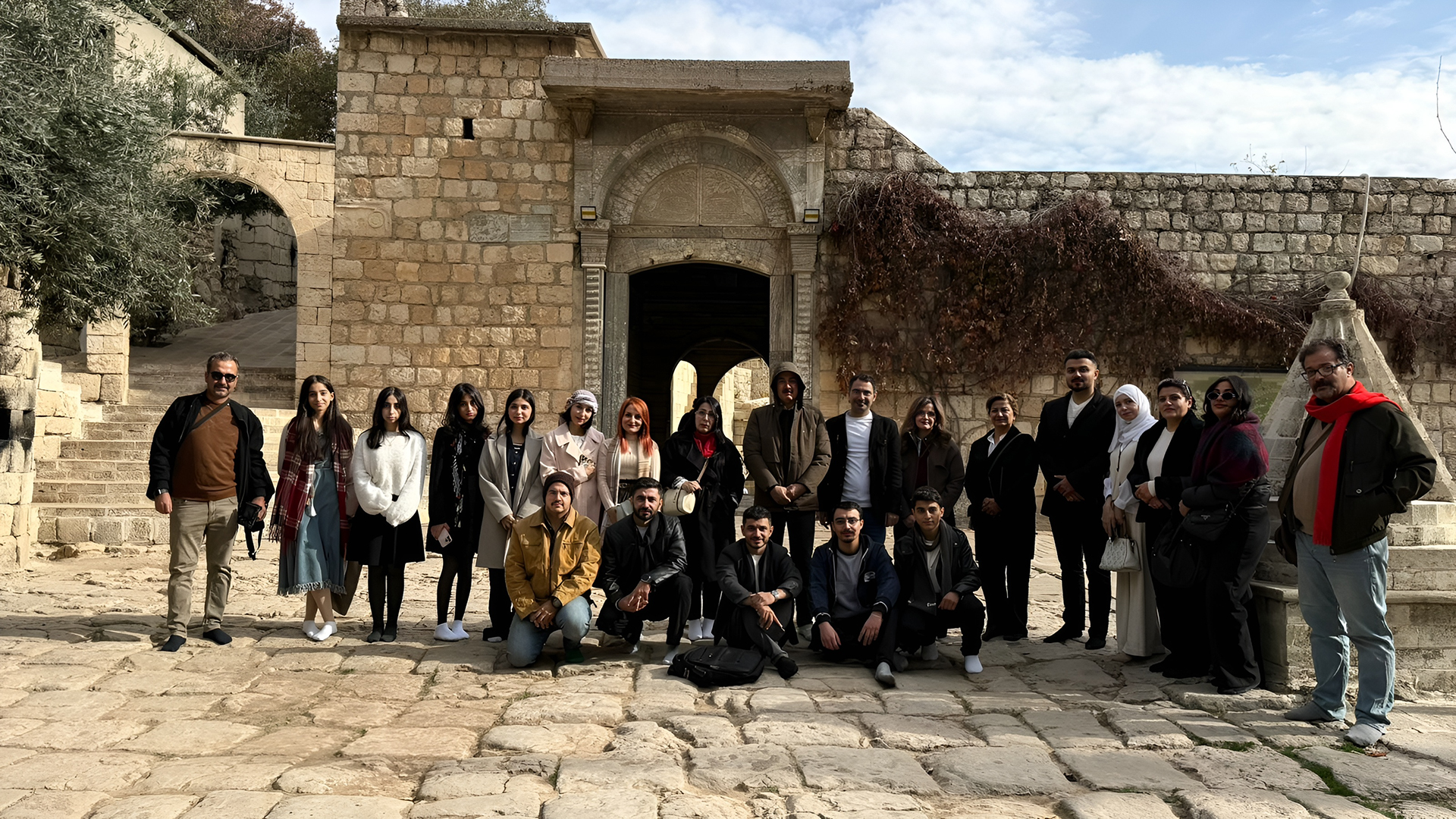
ERBIL (Kurdistan24) - There is a silence in the valley of Lalish that feels older than time itself. It is not the empty silence of a void, but the heavy, pregnant silence of a library or a cathedral—a quietude that speaks. Here, nestled within the embrace of the Nineveh plains and the Zagros mountains, the air carries the faint, sweet scent of burning olive oil, a fragrance that has permeated these stones for centuries.
To enter Lalish is to shed the armor of the modern world. Quite literally, one must remove their shoes. As the soles of the feet touch the cool, polished limestone, a current seems to pass from the earth into the body, grounding the visitor in a reality that defies the chaos of the outside world.
Above, the sun catches the fluted, conical domes of the temples, turning them into serrated peaks of light that point unyieldingly toward the heavens. They stand like stone sentinels, guarding the secrets of the Peacock Angel, watching over a history written in resilience and survival.
Shadows lengthen across the courtyards, dancing over the ancient engravings of the black snake, a symbol of protection that greets those who pass the threshold.
Here, the wind rustling through the ancient trees sounds like a whisper of the thousands of prayers tied into the silk rags of the wishing trees—knots of hope, sorrow, and longing left by pilgrims who have walked this path for generations.
It was into this ethereal landscape that a busload of young minds arrived, breaking the stillness not with the noise of tourism, but with the eager hum of inquiry.
A Festival of Diversity
Can a single journey serve as a history lesson, a festival of diversity, and a cultural workshop all at once?
The answer was found in a unique initiative organized by the Al-Mada Reading Club in cooperation with the Goethe-Institute. Kurdistan24 joined this first-of-its-kind cultural trip, which brought together a diverse mosaic of participants—Arabs and Kurds from the Kurdistan Region and Western Kurdistan.
They were united by one goal: to explore the deep and ancient history of Kurdistan.
In a region often fragmented by political lines and historical grievances, this gathering was a radical act of unity.
The bus ride itself was a microcosm of a hopeful future. Dialects and languages mingled—Sorani, Badini, Arabic—weaving a tapestry of conversation that predated the arrival at the holy site.
These were young students, artists, and readers who had chosen to step out of their comfort zones to witness the reality of their neighbors.
Lalish: The Educational Dimension
The first destination was the sacred temple of Lalish. However, as the group descended from the transport and removed their footwear to walk the holy path, the focus shifted immediately from casual tourism to profound education.
For many of the participants, particularly those from outside the immediate vicinity of the Nineveh Plains, Lalish was a place of myth.
Misconceptions about the Yazidi faith have circulated in the Middle East for centuries, often fueling the tragic persecutions the community has faced. This trip was designed to dismantle those myths brick by brick.
Participants didn't just come to take photos or marvel at the architecture; they were welcomed by local experts and spiritual guardians of the valley who opened the doors to understanding the Yazidi faith.
Guided by the Khadims (servants of the temple), the group moved through the inner sanctums where the tomb of Sheikh Adi bin Musafir rests.
The guides explained the intricate theology of Yazidism—a monotheistic faith rooted in the worship of one God and the veneration of the Seven Angels, led by Tawusi Melek (the Peacock Angel).
They spoke of the sanctity of the elements: earth, fire, air, and water. They explained the rituals of the baptism in the White Spring (Kaniya Spî) and the significance of the oil lamps that are lit at sunset, representing the light of God dispelling the darkness.
The objective was clear: for these young participants to learn about the culture and religion of their Yazidi brethren directly from the source, far from rumors or misinformation.
By walking the stone paths and listening to the chants, they were being empowered to become true ambassadors for coexistence in their own communities.
Voices from the Valley
"I grew up hearing stories, but I never understood the soul of this place until today," remarked Spenta, a university student in Erbil. Standing near the entrance of the sanctuary, watching an elder tie a knot in a piece of colorful silk, the student reflected on the weight of the experience.
"We are taught history in books, but here, history is breathing. To see the peacefulness of the Yazidi people, despite everything they have suffered, teaches us a lesson in grace that no classroom could offer," Spenta reflected.
Another participant, Hasanin an Arab youth from the disputed territories, noted the importance of the dialogue. "There is a wall of ignorance that separates our communities. Today, we didn't just walk into a temple; we walked through that wall. When I go back home, I can tell my friends and family what Lalish really is—not what the rumors say, but the peace I felt here."
The visit allowed for a raw and honest exchange.
The participants asked questions about the Yazidi calendar, their feasts, and the trauma of the 2014 genocide.
The answers provided by the local experts were not laden with bitterness but with a steadfast determination to preserve their identity. It was a transfer of knowledge that humanized the "other," turning abstract demographics into flesh-and-blood neighbors.
From Silence to Discourse: The Road to Zakho
Leaving the spiritual serenity of the temple was difficult.
The valley has a magnetic pull, a gravity that makes the modern world seem loud and abrasive. Yet, the journey had to continue. The group boarded the bus once more, winding through the dramatic landscapes of Duhok province towards the Turkish border.
From the spiritual serenity of the temple, we accompanied the group to the city of Zakho, specifically the Zakho International Book Fair. The transition was striking. If Lalish was the soul of the journey, Zakho was its intellect.
Zakho, a city historically defined by trade and transit, presided over by the ancient Delal Bridge, was the perfect setting for the second half of this cultural odyssey.
The Book Fair was buzzing with energy, a testament to the region’s hunger for knowledge.
The Workshop of Ideas
Here, the journey transformed into an open cultural dialogue. The atmosphere shifted from the reverent whispers of the temple to the spirited debates of the literary salon.
The group navigated the aisles of the fair, surrounded by thousands of volumes in Kurdish, Arabic, English, and Persian.
The focus wasn't just on browsing titles, but on a key question: How can we successfully manage book fairs in Kurdistan?
This was not merely a shopping trip; it was a seminar on cultural infrastructure.
The participants gathered for a discussion led by the Al-Mada and Goethe-Institute coordinators. They dove into the details of the publishing world, discussing the challenges of distribution, censorship, and the digital divide.
A central theme of the discussion was how to restore the prestige of the printed book in an era dominated by social media. The participants, being young digital natives, offered unique perspectives.
They argued that book fairs should not just be marketplaces, but cultural festivals—hubs of music, art, and debate that draw the youth in.
"The club's message to the world is that culture is not a secondary activity, but rather a bridge that connects people to each other," Simav, a member of the administration at Al-Mada Reading Club, who is from Western Kurdistan, argued during the roundtable. She emphasized that "today's visit to Lalish and Zakho is a reminder that Kurdistan Region is rich in its diversity, and we must celebrate and preserve this diversity.
They didn’t leave empty-handed.
In a gesture that underscored the commitment to literacy, the organizers spent time helping each participant choose a new book.
The selection process was collaborative; friends recommended titles to one another, crossing linguistic and cultural lines. An Arab participant might pick up a translation of a Kurdish novel; a Kurd might delve into contemporary Arabic poetry.
This act of purchasing books was actively encouraging the next generation to read, ensuring that the dialogue started on this trip would continue in the quiet of their own homes.
A Legacy of Enlightenment
As the sun began to set over the Khabur River in Zakho, the group gathered for a final reflection.
The physical journey covered miles of asphalt, but the internal journey was immeasurable. They had traversed the distance between ignorance and understanding, between silence and expression.
This spirit is nothing new for the Al-Mada Club. Since its founding in 2014—a year marked by darkness and conflict in the region—the club has been a beacon of light.
Over the past decade, they have discussed over 138 books and hosted dozens of intellectuals, writers, and thinkers. They have consistently bet on culture as the antidote to extremism.
The collaboration with the Goethe-Institute added an international dimension to Club’s mission, emphasizes that the Kurds have the ability to convey the voice and heritage of Kurdistan to the world.
As the participants boarded the bus for the final ride home, clutching their new books and scrolling through photos of the Lalish domes, the success of the initiative was palpable.
This cultural trip stands as the ultimate proof that culture remains the strongest bridge for building future generations.
In a region where bridges are often bombed or blockaded, Al-Mada and its partners are building the kind that cannot be destroyed—bridges made of shared memories, mutual respect, and the unshakeable belief that to know one's neighbor is to know oneself.
The journey was a pilgrimage of the mind and spirit, a testament to the enduring power of curiosity to conquer fear.
For the young Kurds and Arabs who traveled together, the valley of Lalish and the halls of Zakho were no longer just points on a map, but milestones in their shared destiny.