TIME’s 2025 Person of the Year: The Visionaries Behind Artificial Intelligence
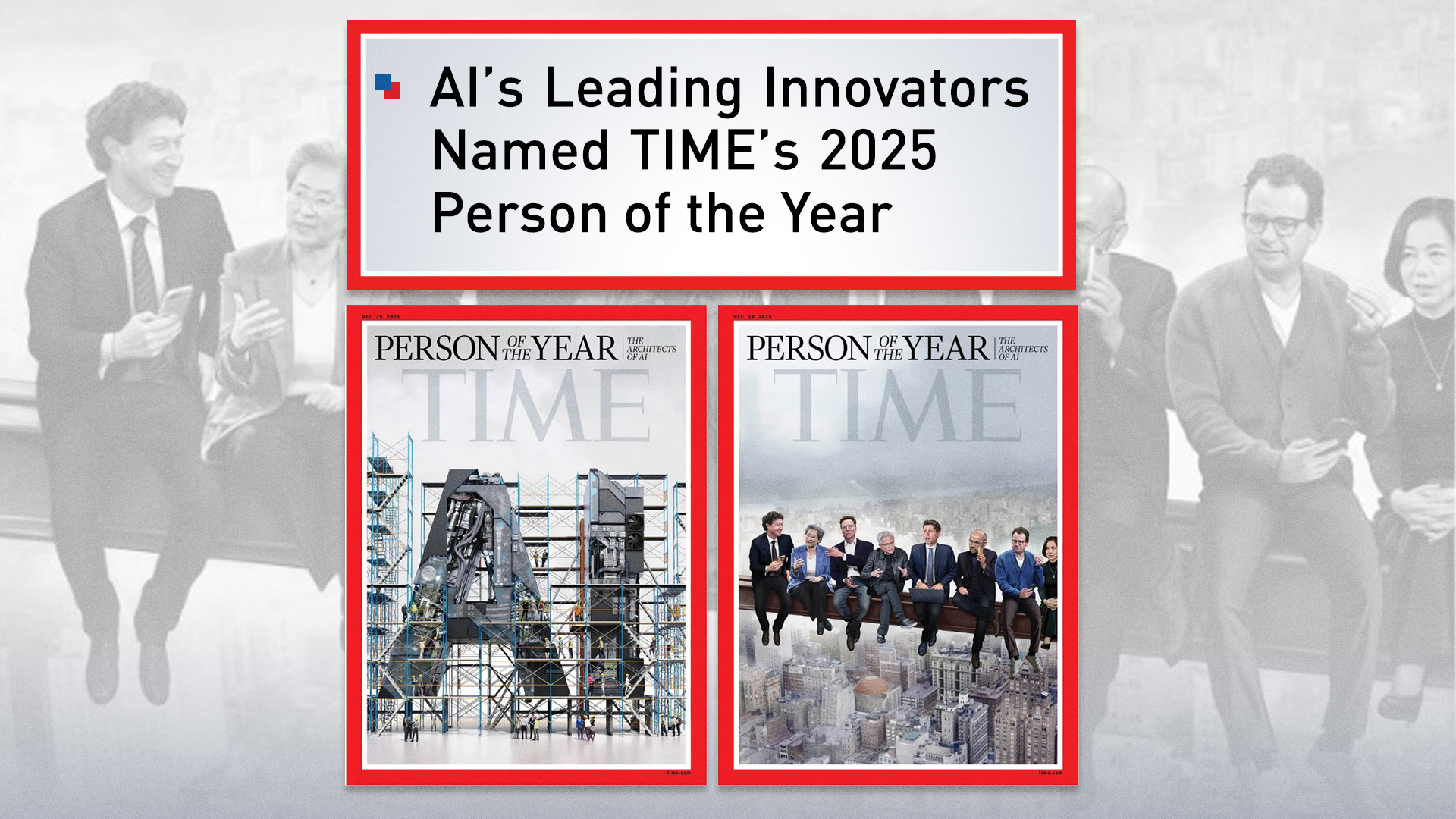
TIME names "The Architects of AI" 2025 Person of the Year, citing the technology's explosive growth, the "Stargate" project, and profound global impact.
ERBIL (Kurdistan24) – Since the dawn of the 19th century, the inauguration of a United States President has served as a ritualistic convergence of political authority, a day steeped in tradition where the nation’s most powerful figures gather in Washington, D.C., to witness the peaceful transfer of executive power. However, the return of Donald Trump to the White House in January 2025 was marked by a different kind of power dynamic, one that shifted the center of gravity from the political machinery of the capital to the technological titans of Silicon Valley.
While the chiefs of the United States’ leading technology companies stood prominent among the attendees, a seismic shift was occurring offstage, halfway across the globe, that would come to define the year and ultimately dictate the selection of TIME magazine’s 2025 Person of the Year.
On that very day of political pageantry, a relatively obscure Chinese firm known as DeepSeek released a new artificial intelligence model, a development that not only spooked global markets but served as a clarion call that rallied the American technology sector into a frenzy of defensive innovation.
This geopolitical and technological synchronization set the stage for a year defined by what TIME Editor-in-Chief Sam Jacobs describes as the "alchemizing forces of public and private interests."
The response to the Chinese development was immediate and staggering in its scale. The day following the inauguration, a triumvirate of tech titans—Sam Altman, Larry Ellison, and Masayoshi Son—appeared at the White House to unveil a countermeasure that would reshape the American physical and digital landscape.
They pledged an investment of up to $500 billion to construct AI data centers across the United States, a colossal infrastructure initiative dubbed "Project Stargate." These two consecutive days in January foretold the narrative arc of 2025: a year characterized by fierce global competition, astounding leaps in innovation, the mobilization of massive sums of capital, and the undeniable realization that the world had entered an era from which there would be no turning back.
In its announcement naming "The Architects of AI" as the 2025 Person of the Year, TIME articulates that this was the year artificial intelligence’s full potential finally "roared into view."
The technology ceased to be a niche interest or a speculative bubble and instead established itself as the singular answer to virtually every question posed by society. The visibility of AI became inescapable; it was difficult for citizens to read a newspaper or watch a broadcast without being confronted by news of the technology’s rapid advancement and the individuals driving it.
These developments unleashed millions of debates regarding the extent to which AI would disrupt daily life, permeating every sector of society. Business leaders found it impossible to discuss the future without invoking the impact of this technological revolution, while parents and teachers were forced to grapple with how teenagers and students were utilizing these powerful new tools.
The capabilities unveiled in 2025 often felt, in the words of the magazine, "like magic." In the weeks leading up to the announcement alone, humanity learned that AI could facilitate communication with whales, bridging a cross-species linguistic divide that had stood for eons.
The technology solved a mathematical problem that had remained unsolved for thirty years and demonstrated the ability to outperform traditional models in predicting hurricanes, a critical development in an era of extreme weather.
These systems are improving at a blistering pace, now capable of performing work in seconds that previously required hours of human labor.
According to studies cited by TIME, the capabilities of AI are now doubling nearly twice a year, a velocity of evolution that has no historical precedent. Jensen Huang, the leader of Nvidia—the world’s most valuable company and a central figure in this revolution—succinctly captured the magnitude of the moment, telling TIME, "This is the single most impactful technology of our time." The speed of adoption has been unmatched, with every industry needing it, every company using it, and every nation scrambling to build it.
However, TIME’s recognition of the Architects of AI is not an unmitigated celebration; it is a recognition of influence, acknowledging that this progress comes with profound and potentially perilous trade-offs. The report highlights that the immense amount of energy required to run these computational systems is draining resources at an alarming rate.
The economic ramifications are equally severe, with jobs vanishing—"going poof"—as automation encroaches on human labor. The information ecosystem has been polluted, as the proliferation of AI-generated posts and videos makes it increasingly difficult to discern reality from fabrication. Security concerns have also escalated, with the revelation that large-scale cyberattacks are now possible without any human intervention, introducing a new volatility to global stability.
Furthermore, the year has witnessed an extraordinary concentration of power among a handful of business leaders, a consolidation of influence not seen since the Gilded Age. TIME warns that if the past is prologue, this centralization will result in a dichotomy of significant advancements paired with greater inequality.
AI companies are now lashed to the global economy tighter than ever before, representing a gamble of epic proportions that has stoked fears of a catastrophic economic bubble. President Trump himself captured the undercurrent of societal unease in September, remarking, "If something happens, really bad, just blame AI."
The selection of the Architects of AI as Person of the Year places the current moment within a long historical continuum. Students of history recognize that this technological inflection point has been approaching for decades. Seventy-five years ago, a computer named Mark III graced the cover of TIME.
A $500,000 behemoth built for the Navy, it was described as roaring "louder than an admiral" and helped scientists of that era imagine a new future. The headline of that story was "The Thinking Machine." Today, as TIME notes, society is living in the world that the thinking machine—and its modern makers—have created.
The Person of the Year franchise, one of media’s longest-running traditions, has evolved significantly since Charles Lindbergh was named Man of the Year for 1927.
That initial selection was an effort to rectify an editorial oversight after editors failed to put the aviator on the cover following his pioneering transatlantic flight. Since then, the recognition has expanded to include not just individuals but groups, women, and on rare occasions, concepts such as "The Endangered Earth" in 1988 or "The Personal Computer" in 1982.
The drama surrounding the selection of the PC over Apple’s Steve Jobs in 1982 became the stuff of books and movies, highlighting the tension between human innovators and their creations. In 2025, that distinction has blurred, as the architects and their creations are now inextricably linked in driving the course of human events.
The narrative of 2025 is defined by the alchemizing forces of public and private interests, where the boundaries between state power and corporate innovation have dissolved in the face of a technological imperative.
From the "Stargate" project’s massive infrastructure push to the daily integration of AI in schools and businesses, the architects of this technology have fundamentally changed the world the next generation will inherit.
Whether this transformation leads to a golden age of productivity or a dystopian era of inequality and misinformation remains the central question of the age. What is clear, according to TIME, is that there is no opting out; the revolution is here, and its architects are the indisputable shapers of the future.