UN Secretary-General Arrives in Baghdad to Mark End of UNAMI Mission
UN Secretary-General António Guterres arrived in Baghdad to participate in the official ceremony marking the conclusion of the UNAMI mission after over two decades, following Iraq's request to end the mandate.
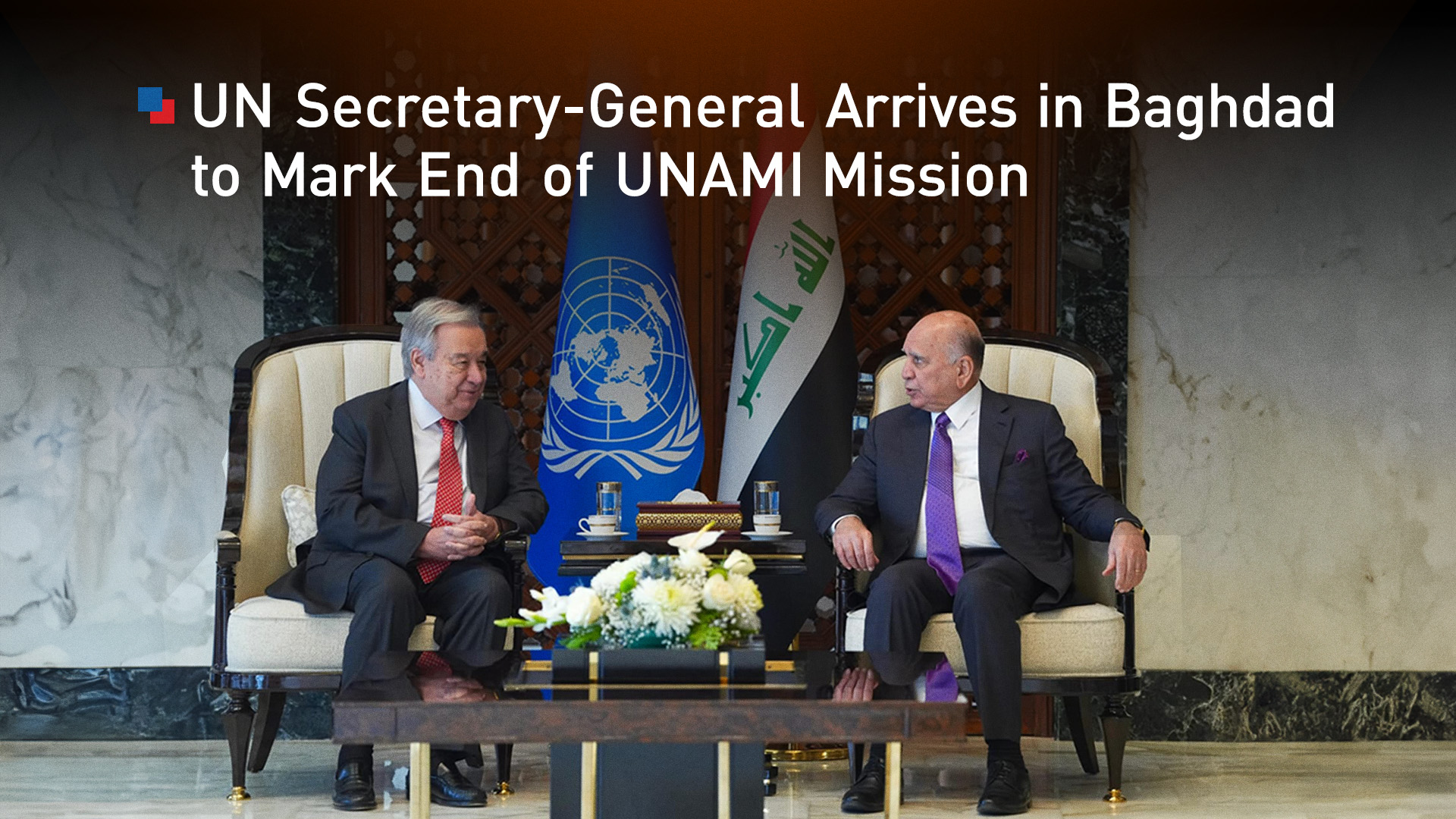
ERBIL (Kurdistan24) - United Nations Secretary-General António Guterres arrived in the Iraqi capital, Baghdad, on Saturday to take part in the official ceremony marking the conclusion of the United Nations Assistance Mission for Iraq (UNAMI), bringing to a close more than two decades of UN political engagement in the country.
Guterres was received at Baghdad International Airport by a delegation of senior Iraqi officials, including Deputy Prime Minister and Foreign Minister Fuad Hussein. The visit marks a significant milestone in UN–Iraq relations, as the mission established in 2003 to support Iraq’s political transition and post-war development formally reaches the end of its mandate.
The Iraqi government requested the termination of UNAMI, citing improved security conditions and political stability, and signaling readiness to assume full responsibility for national affairs. During his visit, the Secretary-General is expected to hold meetings with senior Iraqi leaders to discuss the future framework of cooperation between Iraq and the United Nations.
End of a Political Mission, Not UN Engagement
Earlier, the UN Secretary-General’s Special Representative for Iraq, Mohamed Al-Hassan, confirmed that UNAMI will officially conclude its mandate on December 31, with all mission members departing the country after that date.
In an interview with UN News, Al-Hassan said the mission was established at the request of the Iraqi people and is ending at their request as well. He stressed, however, that the UN’s presence in Iraq will continue and may even expand in scope, as its role shifts from political mediation to technical cooperation.
“The United Nations will remain present, and it may be present more extensively than before, because the work has now transformed into technical cooperation on climate issues, health, education, and technology,” Al-Hassan said.
Reflecting on more than twenty years of UNAMI operations, Al-Hassan described the mission as demanding but largely successful, noting that Iraqis themselves had defined its objectives and that those goals had been largely achieved. He added that it was now time for Iraq to manage its own affairs, like other sovereign states.
“I agree with this approach,” he said, affirming that the mission had fulfilled its purpose.
Despite the conclusion of UNAMI, Al-Hassan pointed to three unresolved files that remain priorities for international cooperation: the issue of missing persons from Kuwait and third-country nationals dating back to the Gulf War era, the question of Kuwaiti property, and the return of Kuwait’s national archives.
On the economic front, Al-Hassan highlighted that 38 of Iraq’s approximately 72 banks remain under international sanctions, warning that sustainable economic and developmental progress would be impossible without lifting these restrictions. He noted that Iraqis are seeking a clear path toward long-term economic growth.
Milestones and the Road Ahead
Al-Hassan also underscored key achievements in Iraq’s recent history, including the ability of Iraqis to participate freely in elections and choose their representatives without pressure, describing this as a fundamental exercise of freedom now firmly in the hands of the Iraqi people.
He further noted that the international community, particularly the Global Coalition, in coordination with Iraqi forces and with sacrifices largely borne by Iraqis themselves, succeeded in defeating ISIS.
Looking ahead, Al-Hassan said Iraq is moving toward what he described as an “Iraqi–Iraqi Marshall Plan,” aimed at redefining the country’s position on both the Arab and global stages without reliance on external credit.
In his closing remarks, he called on Iraqis to move beyond sectarianism and work toward a shared future, stressing that the time has come for all Iraqis to feel a sense of belonging based on equal citizenship rather than partisan or sectarian identity.
The Secretary-General’s visit, marking the end of UNAMI, thus signals not a withdrawal of international support, but a transition to a new chapter in which Iraq and the United Nations redefine their partnership on a more technical and developmental footing.